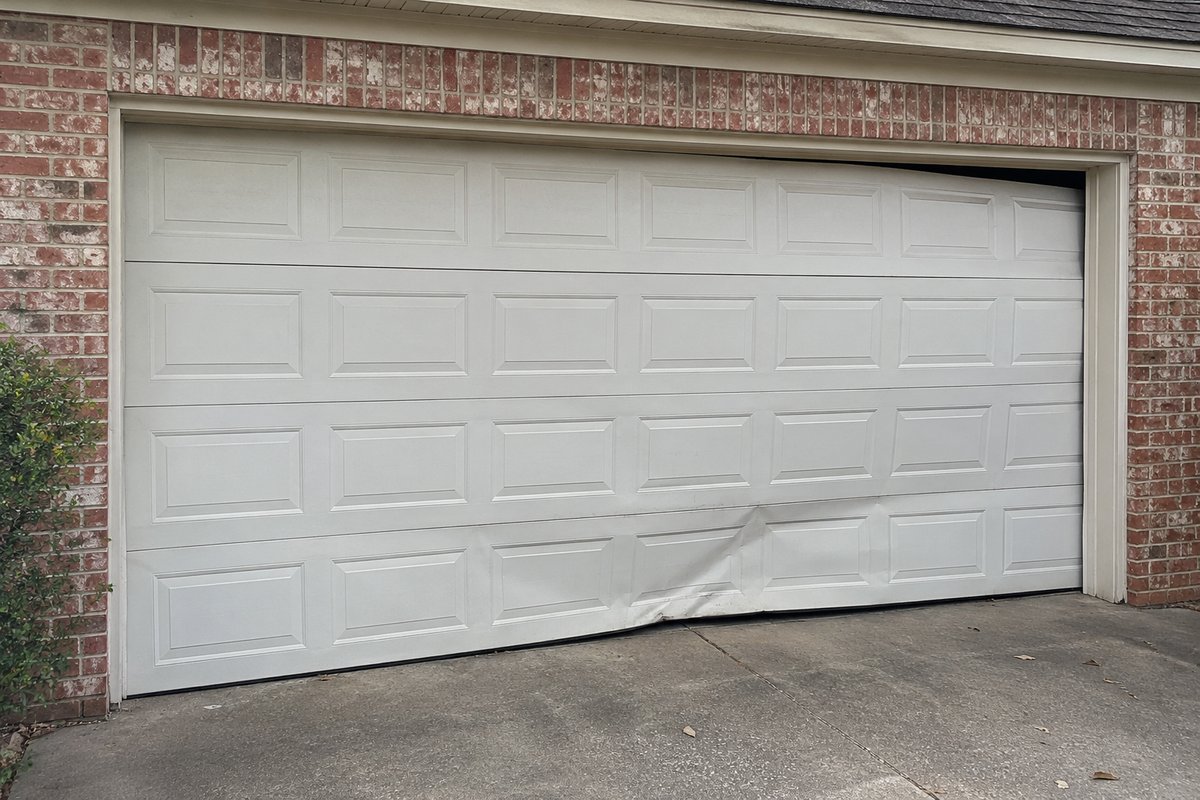
In a garage door emergency, stop using the door, keep everyone out from under it and unplug the opener. Don't touch springs, cables or bottom brackets. Then call for emergency garage door repair and tell us what the door did.
All Four Seasons provides 24/7 emergency service across Metro Atlanta. Call (678) 271-8918 day or night. This guide covers what counts as an emergency, how to make the door and the people around it safe, what to leave alone, what to tell us when you call and what the technician does when they get there.
First: make the door and the people safe
Do these in order, whatever went wrong.
- Stop pressing the button. Running the opener against a broken spring, a loose cable or a jammed door can bend the track, strip the opener's gear or pull the door further out of line.
- Get everyone out from under the door. Children and pets first. A door that has lost spring support can come down without warning.
- Unplug the opener so nobody runs it from a remote, a keypad or a phone app. If you can't reach the plug safely, switch off the breaker.
- Leave the door where it is. Don't push it up, pull it down or try to straighten it.
- Look, don't touch. From a safe spot, check above the door for a gap in the spring and at both bottom corners for a loose or hanging cable. Take photos.
- Secure the house. If the garage is open, lock the door from the garage into the house and bring anything valuable inside.
- Call us at (678) 271-8918. We answer emergency calls 24/7.
The reason for all this caution is weight and tension. Clopay's installation manual notes that a large garage door can weigh as much as 500 pounds without spring tension, and a single-car door as much as 200. DASMA, the door manufacturers' association, calls the springs "arguably the most important and most dangerous part" of the door. For the everyday side, see our garage door safety rules.
What counts as a garage door emergency?
A garage door problem is an emergency when the door is unsafe to use, the house can't be secured, or you can't get a car out. Match what you see to the row below.
| What happened | Why it can't wait | What to do now |
|---|---|---|
| Door stuck open at night | The house is open to anyone walking by, and to the weather | Try the safe checks below. If it still won't close, secure the house door and call |
| Car trapped inside | You can't get to work, school or an appointment | Don't force the door. Call; it's usually a spring |
| Loud bang, then the door won't lift | A torsion spring has almost certainly broken | Leave the door down, unplug the opener, call |
| Cable snapped or hanging loose | One side of the door has no support | Stop using the door. Keep clear of the corners |
| Door off track, crooked or hanging | It can fall out of the opening | Don't touch it. Keep everyone well back |
| Door hit by a car | Panels, tracks and the spring system can all be damaged at once | Don't run the opener. Photograph it, call |
| Door won't close in a storm or freeze | Rain, wind and cold get in; a door can be blown in | Don't force it. Secure the house, call |
If none of these fits and the door still works safely, it's probably not an emergency. A noisy door, a slow remote or a worn seal can be booked as a normal visit. Our guide to a garage door that won't open or close walks through the simple causes.
Garage door stuck open at night
Before anything else, look at the door. If it's crooked, hanging, or has a loose cable or a broken spring, don't try to close it. Skip to calling us.
If the door looks straight and whole, try these safe checks:
- Look at the opener lights. On Chamberlain and LiftMaster openers, Chamberlain says the lights flashing 10 times point to a problem with the safety reversing sensors, and flashing twice means the LOCK button on the wall control is on. Press LOCK to turn it off and try again.
- Check the safety sensors. These are the two small "photo-eyes" near the floor on each side of the door. Clear anything in the beam, wipe the lenses and make sure they point at each other. Low evening sun can also blind a sensor. More in our garage door sensor problems guide.
- Press and hold the wall button. On many older Chamberlain and LiftMaster openers, holding the door control until the door is fully down closes it even with a sensor fault. Chamberlain notes that openers and replacement logic boards made after February 3, 2022 no longer have this feature. Watch the door the whole way and keep everyone clear.
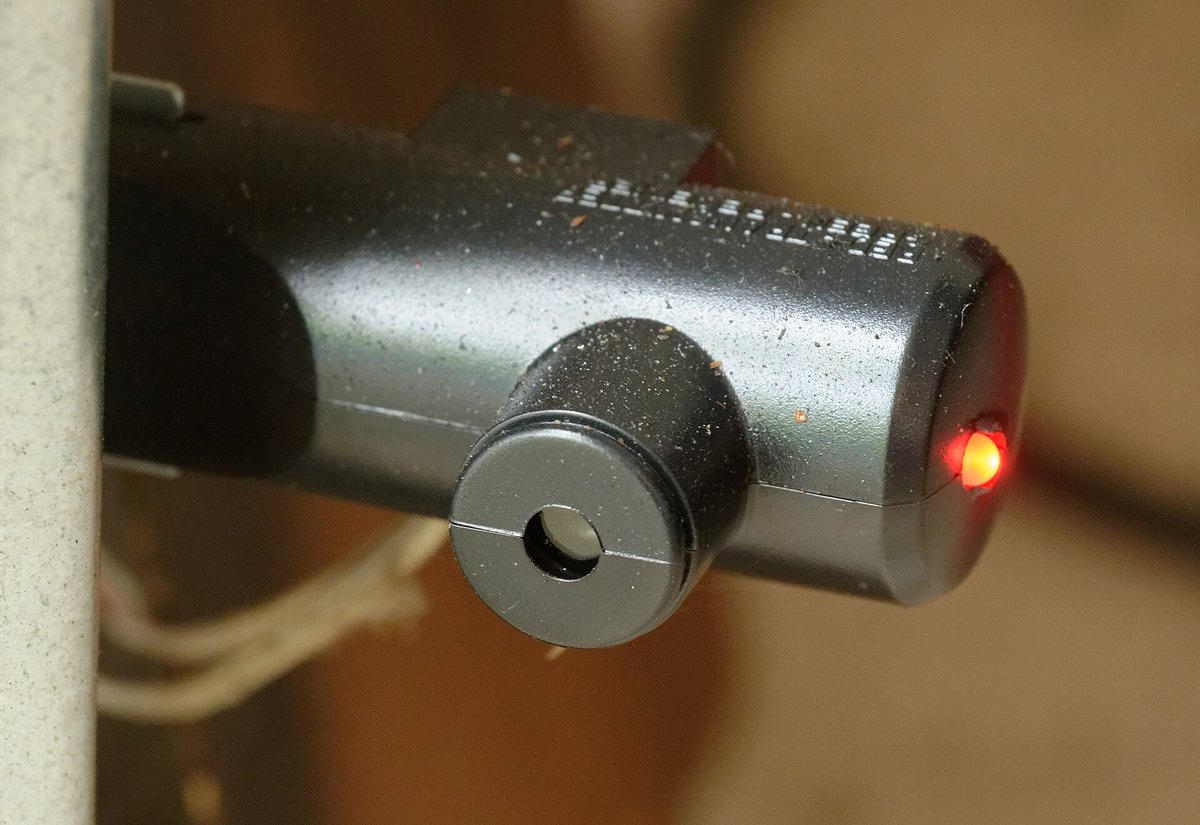
Photo: Jud McCranie, CC BY-SA 4.0, via Wikimedia Commons.
Don't tape over, unplug or remove the sensors to get the door down. They're required safety equipment. The U.S. Consumer Product Safety Commission (CPSC) says openers made for sale in the U.S. after January 1, 1991 must reverse, and an external entrapment protection system, such as an electric eye, was added to the requirement in 1993. If you used the hold-to-close trick, get the sensors fixed before the door goes back to daily use.
If the door still won't close, lock the door from the garage into the house, move cars and valuables if you can, and call our 24/7 line.
Car trapped in the garage
A trapped car usually means a broken torsion spring. The opener can't lift the door's full weight, so it strains, stops or reverses.
Don't try to lift the door by hand to get the car out. With a broken spring you'd be lifting most of the door's weight, and Chamberlain warns that if the springs are weak or broken, the door can fall rapidly and without warning.
What to do while you wait:
- Plan a ride for anything that can't wait. That's usually faster and safer than any workaround at the door.
- Don't idle the car in the garage to warm it up or charge a phone. The CDC says never to run a car in an attached garage, even with the garage door open.
- Tell us a car is trapped when you call, so the technician brings what the job needs.
If the spring isn't broken and the door simply won't move because the power is out or the opener has failed, you can often open it by hand. See how to open a garage door manually, and read the release section below first.
Broken spring: the loud bang
Most homeowners hear a broken torsion spring before they see it: a sharp bang from the garage, often with nobody near the door. Torsion springs are the tightly wound coils on the steel bar above the door. They carry its weight, so when one breaks the door turns very heavy, the opener can't lift it, or it lifts a few inches and stops.
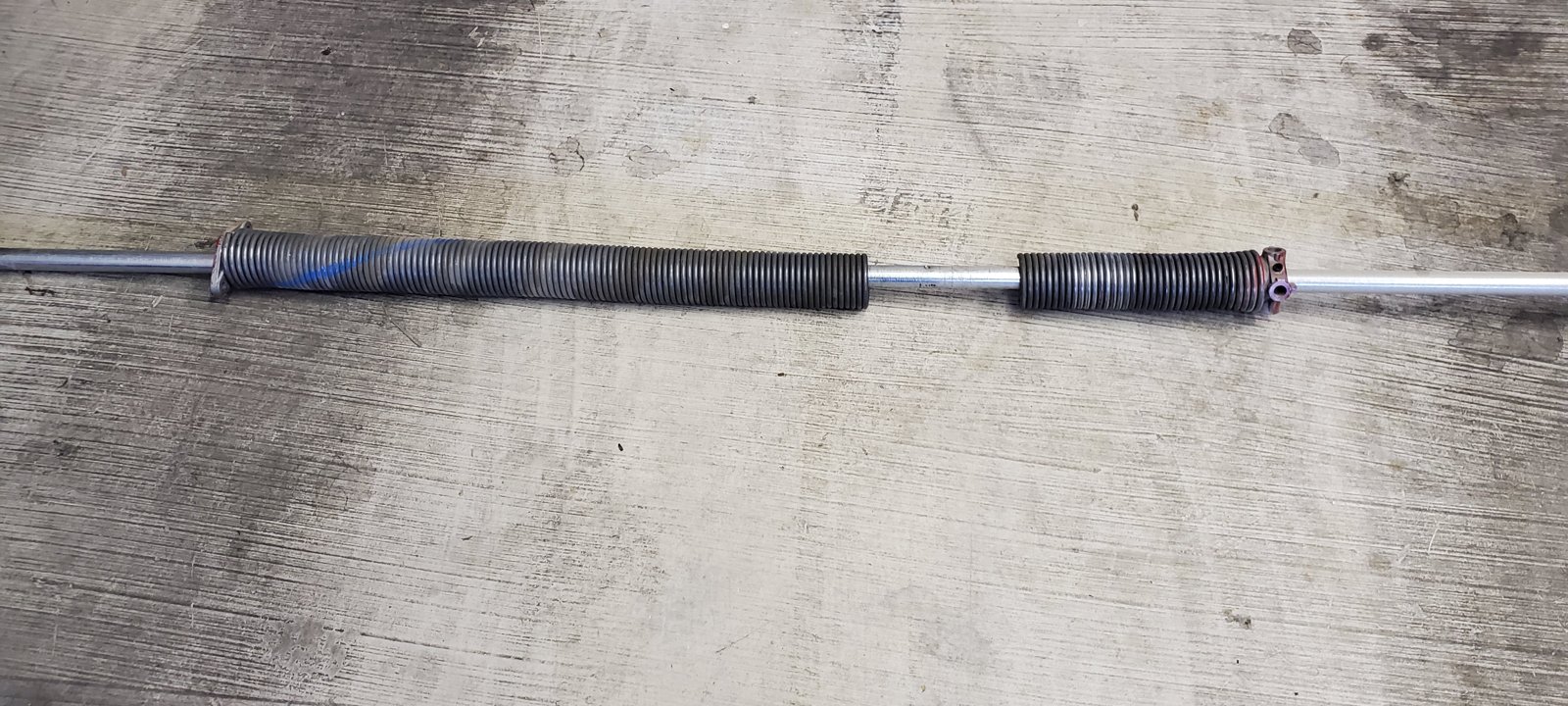
Photo: Garagedoorrepairlasvegas, CC BY-SA 4.0, via Wikimedia Commons.
How to tell from the floor: look up at the spring above the door. A gap of a few inches between two sections of coil means it has broken. On older doors with extension springs, the long springs along the ceiling tracks, look for a spring that is stretched out, hanging or missing.
What not to do: don't touch the spring, the winding cones at its ends, or the cables. Don't pull the emergency release while the door is open; with no spring holding it, the door can drop. Replacing springs means unwinding and rewinding stored tension with winding bars, and that's a job for a technician.
On a two-spring door we replace both springs together, because the second spring has the same age and wear as the one that broke. Spring repairs carry our written warranty: 3 years on torsion springs and 5 years on extension springs. See our garage door spring repair page for the service itself.
Snapped or loose cable
The lift cables are the thin steel wire ropes at each bottom corner of the door. They connect the springs to the door, so they're under tension all the time. When one snaps or comes off its drum, one side of the door has no support and the door often hangs crooked.
DASMA says that because of the high spring tension, these cables should be replaced only by a trained technician, and that the bottom brackets they hook onto are under extreme tension too. So:
- Don't pull on a loose cable or try to wind it back on its drum.
- Don't loosen anything at the bottom corners.
- Don't run the opener.
Our guides cover the details: broken or frayed garage door cable for a cable that has worn through or snapped, and garage door cables that came off track for one that has unwound from the drum. The repair itself is on our garage door cable repair page.
Door off track, crooked or hanging
A door is off track when one or more of its rollers, the small wheels on each side, has come out of the metal track. The door then sits at an angle, jams partway, or hangs out of the opening. Common causes are a broken cable or spring on one side, a bent track, or a car bumping the door.
This is one of the most dangerous situations on the list. Clopay's manual says not to operate a door that is hard to move, opens too fast, or has rollers coming out of the track, and the CPSC warns that a severely unbalanced door could crash to the floor.
- Don't try to push the rollers back in or force the door level.
- Don't park or stand under or beside it.
- If it's partly open and you have to get a car out, don't. Call us first.
Our garage door off track guide explains the causes in more depth, and the door off track repair page covers the service.
Door hit by a car
A car backing into a closed door, or someone pulling in before it's fully open, can damage panels, tracks, rollers, cables and the opener in one go. A door can look only dented and still have a bent track or a slipped cable behind it.
- Check that nobody is hurt. If the car is still pressed against the door, move it only if the door isn't resting on it.
- Don't run the opener, even to "see if it still works". A bent door can pull itself further out of the track.
- Take photos of the door from inside and out, before anything is moved, for your records and any insurance claim.
- Look for broken springs and loose cables from a safe distance.
- Call us. We make the door safe first, then explain whether the damaged sections can be replaced or the door needs replacing.
A single damaged section can often be swapped out; see garage door panel replacement. For badly damaged doors, our crashed garage door service page explains what we do.
Door won't close in a storm or a freeze
Metro Atlanta doesn't get many hard freezes, but when it does, garage doors suffer. On January 10, 2025, Atlanta set a record 24-hour snowfall of 2.10 inches, and one-tenth to one-third of an inch of freezing rain built up across most of north Georgia, according to the National Weather Service in Peachtree City.
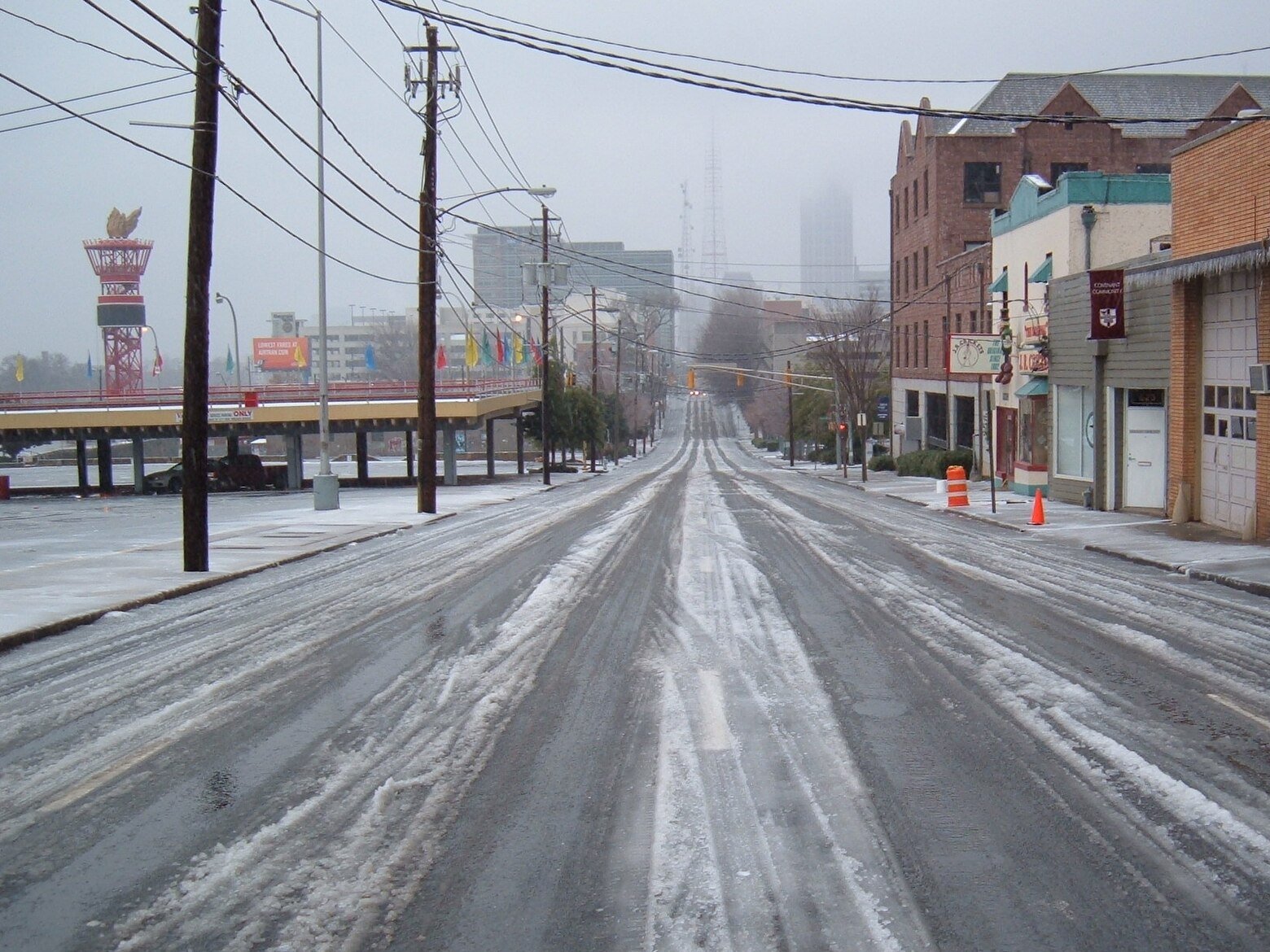
Ice storm on Spring Street, Atlanta, January 29, 2005. Public domain, via Wikimedia Commons.
- Frozen to the ground: don't keep pressing the button. The opener will strain against the ice, and the door can lift on one side. Our winter garage door guide explains how to free it safely.
- Power out: the opener won't run. If the door is closed and the springs and cables are intact, you can open it by hand. Here's how.
- Stuck open in rain or wind: follow the stuck-open steps above. If the door won't close, secure the house door and call. Don't stand in the opening in high wind. If rain is already getting in, read how to stop garage flooding.
Strong wind can push a closed door in off its tracks, as in the photo below. A door in that state is resting on nothing you can trust. Leave it, keep people away, and call.
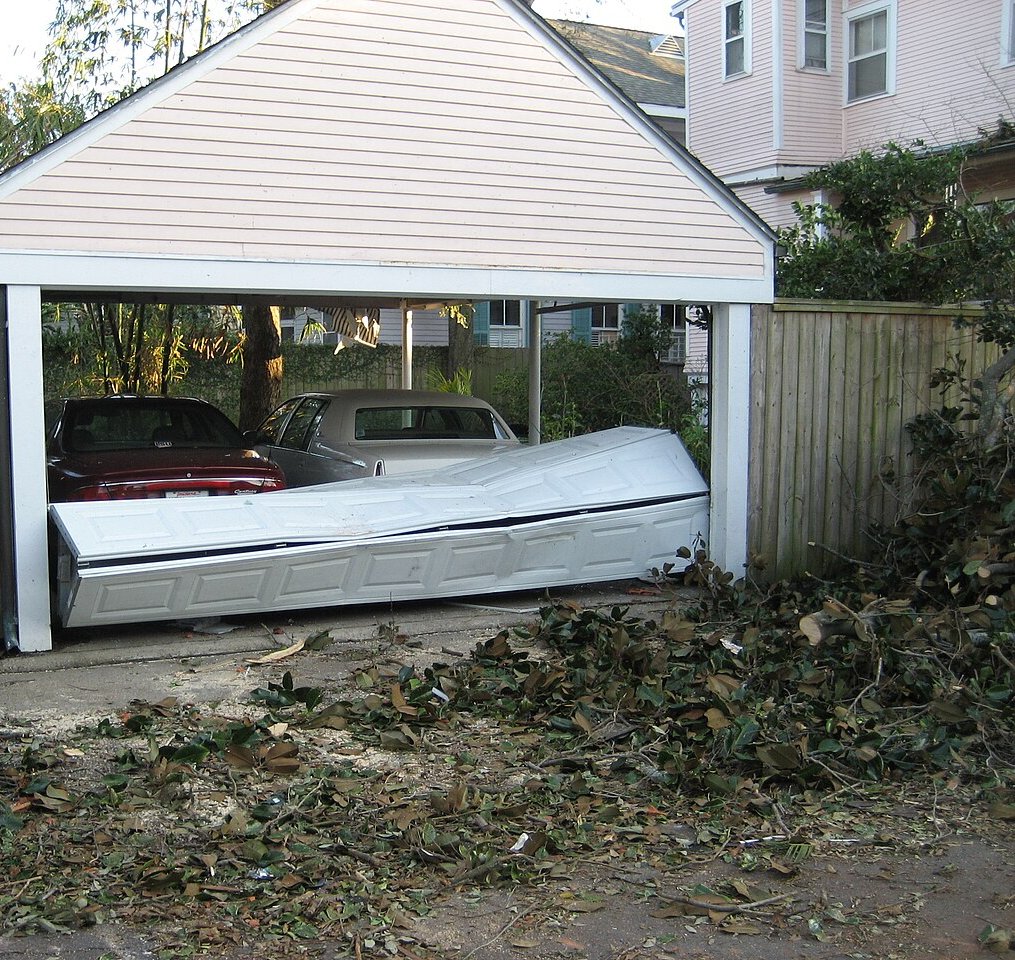
Photo: Infrogmation, CC BY 2.5, via Wikimedia Commons (New Orleans, 2007). Cropped.
What not to touch
These parts hold stored spring energy or carry the door's weight. Clopay, Wayne Dalton and DASMA all say to leave them to a trained technician.
| Part | Where it is | Why to leave it |
|---|---|---|
| Torsion springs and winding cones | On the bar above the door | Wound tight. Releasing them without the right tools injures people |
| Extension springs | Along the ceiling tracks on older doors | Stretched under load; a broken one can whip if it has no safety cable |
| Lift cables | Up each side of the door | Under tension. DASMA says only a trained technician should replace them |
| Bottom brackets | Bolted to the bottom corners | DASMA says these are under extreme tension because they're tied to the springs |
| Cable drums and the shaft | Ends of the bar above the door | Hold the spring tension on the cables |
| A door that's crooked or out of its tracks | The whole door | Can fall without warning |
Wayne Dalton's installation manual makes the same list: don't adjust springs, bottom corner brackets, fasteners or lift cables yourself. It's the oldest advice in our trade, and the one we repeat most: a spring is never worth doing yourself to save a service call.
What you can do safely: unplug the opener, clear the sensors, check the LOCK button, check the breaker, and take photos.
The emergency release: when to pull it, and when not to
The emergency release is the red cord or handle hanging from the opener's trolley, the carriage that runs along the rail. Pulling it disconnects the door from the opener so the door can move by hand.
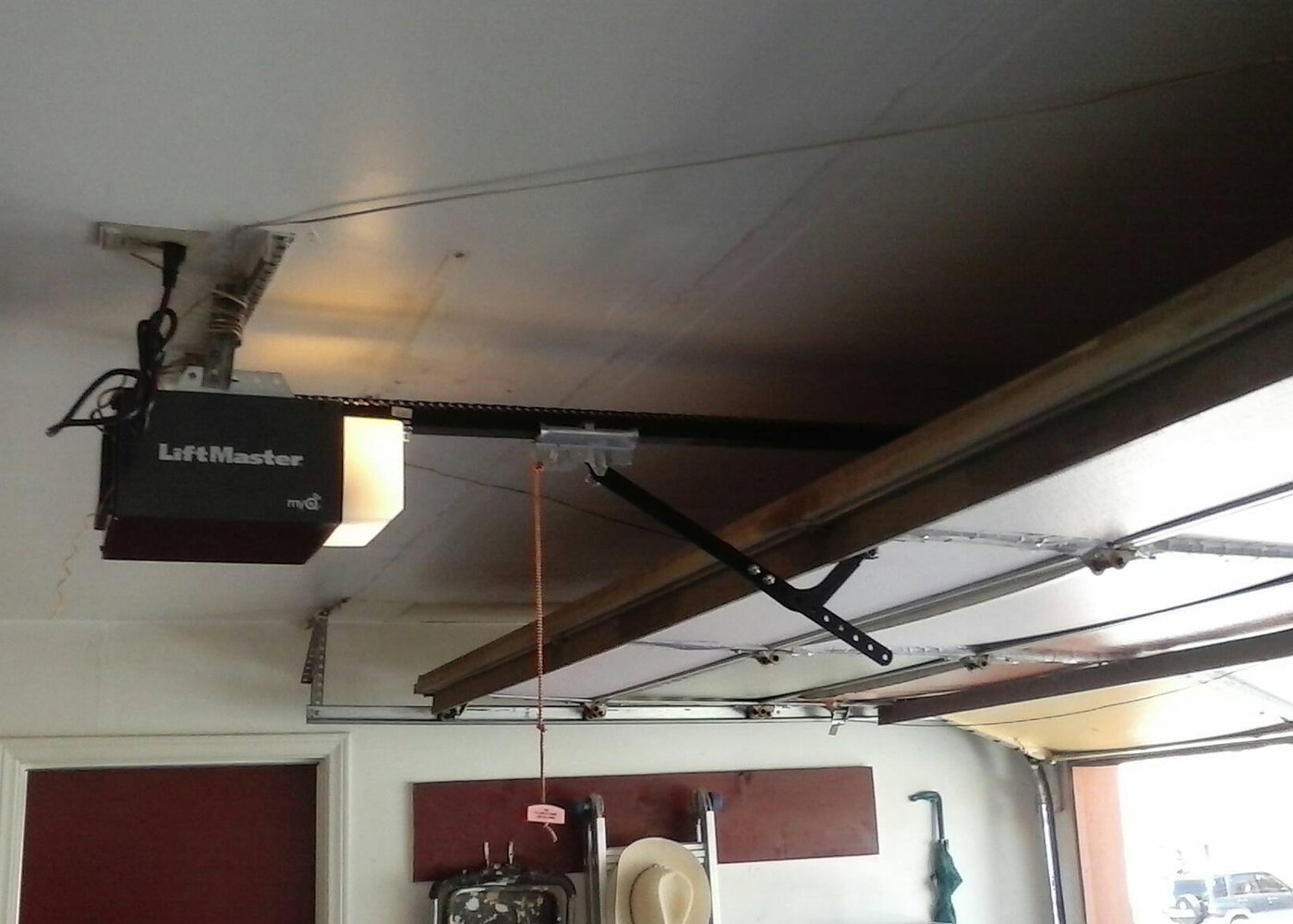
Chamberlain's guidance is clear:
- Use it only with the door fully closed, if possible. Pull it on an open door with a broken spring and nothing is holding the door up.
- Don't go ahead if the springs, cables or rollers look damaged.
- Never use the release handle to raise or lower the door. Lift with the door's handle or the bottom section.
- Stop if the door feels heavy, won't stay up, or slams down. That's a spring or cable problem, and it's time to call.
A properly balanced door, the CPSC explains, stays in place when stopped partway open. If yours drifts down or shoots up, don't keep using it. For step-by-step instructions on each opener type, and how to reconnect the trolley, see how to open a garage door manually.
What to tell us when you call
Have these ready when you call (678) 271-8918. They help us send the right technician with the right parts the first time.
- Your address and the best number to reach you.
- What happened, in your own words: "loud bang", "door came down crooked", "car backed into it".
- Where the door is now: closed, open, partly open, crooked, out of the opening.
- Is a car trapped? Is the house open to the street?
- What you can see from a safe distance: a gap in the spring above the door, a hanging cable, rollers out of the track, dented sections.
- Door size and opener brand if you know them, such as a 16-foot double door with a LiftMaster opener.
- Photos. Keep them on your phone to show the technician.
Calls during office hours (7 AM to 8 PM, every day) reach our office directly. After hours, our answering service takes your details and passes them on.
What the technician does on an emergency visit
When one of our technicians arrives for emergency garage door repair:
- Makes the door safe. If the door is hanging or off track, the first job is to support it so it can't fall, before anything else is touched.
- Finds the cause. Springs, cables, drums, rollers, tracks, hinges, sections and the opener all get checked, because one failure often causes another. A broken spring, for example, can let a cable come off its drum.
- Explains it and writes down the price. You'll get a written price before any work starts. Nothing is done until you approve it. Our guide to how to spot garage door repair scams covers what else to check.
- Repairs the door, or secures it if a part has to be ordered, such as a matching section for a car-damaged door.
- Balances and tests it. After a spring or cable repair, the technician checks the door's balance and runs the safety reverse test, so the door stops and reverses when it should.
If the opener was damaged too, we're an authorized LiftMaster dealer and repair or replace openers on the same visit once you approve the price. For the service itself, see our 24/7 emergency garage door repair page, and our same-day garage door repair page for problems that can wait for daylight.
Emergency now, or can it wait until morning?
Not every problem needs a technician in the middle of the night.
| Call now, any hour | Book a normal visit |
|---|---|
| Door stuck open and won't close | Door works but is noisy or jerky |
| Car trapped and needed soon | Remote works only up close |
| Spring broken with the door partly open | Spring broken, door closed, no car needed until later |
| Cable snapped or door hanging crooked | Worn bottom seal or light under the door |
| Door hit by a car, or blown in | Opener slow but working |
| Door won't close and a storm is coming | Small dent, door runs fine |
If in doubt, call. We'll tell you honestly whether it can wait.
How to avoid the next emergency
Most garage door emergencies come from parts that wore out slowly. A few habits catch them early:
- Look the door over once a month. The CPSC recommends inspecting the door and opener every 30 days. Look for frayed cables, rust, gaps in the springs, loose hardware and damaged rollers.
- Test the auto-reverse. The CPSC's test: lay a 2x4 flat on the floor in the door's path and close the door. If it doesn't reverse when it hits the board, disconnect the opener until it's adjusted, repaired or replaced.
- Check the balance. With the door closed, pull the release, lift the door halfway by hand and let go. It should stay put. If it drifts or feels heavy, the springs need attention.
- Book a yearly tune-up. A technician checks the springs, cables, rollers and opener settings. See our garage door tune-up.
When to call us
All Four Seasons has repaired garage doors across Metro Atlanta since 1999. We're rated 4.9 on Google, with Over 4,000 Five-Star Reviews, and we provide 24/7 emergency service with a written price before any repair.
Call (678) 271-8918 any time, day or night, or book a visit online if it can wait.
Frequently asked questions
Is a broken garage door an emergency?
It is when the door can't be closed, a car is trapped, a spring or cable has broken, or the door is crooked or out of its tracks. A door that still works safely but is noisy or slow can wait for a normal appointment.
Can I open my garage door if the spring is broken?
We don't recommend it. With a broken spring you'd be lifting most of the door's weight, and Chamberlain warns that a door with weak or broken springs can fall rapidly and without warning. Leave it closed, unplug the opener and call.
What should I do if my garage door won't close at night?
Check the opener lights, clear and wipe the safety sensors, and make sure the LOCK button is off. On many older openers you can hold the wall button until the door is fully down. If it still won't close, lock the door into the house and call our 24/7 line.
Is it safe to pull the red emergency release cord?
Only when the door is fully closed and the springs, cables and rollers look undamaged. Never pull it on an open door with a broken spring, and never use the cord itself to raise or lower the door.
What should I do if my car hit the garage door?
Make sure nobody is hurt, don't run the opener, take photos from inside and out, and keep clear of the door. Then call. A door can look only dented and still have a bent track, a slipped cable or a damaged spring behind it.
Do you provide 24/7 emergency garage door repair?
Yes. All Four Seasons provides 24/7 emergency service across Metro Atlanta. Call (678) 271-8918. Outside office hours our answering service takes your call.
Will I know the price before the repair starts?
Yes. The technician explains what failed and gives you a written price before any work starts, at any hour. Nothing is done until you approve it.