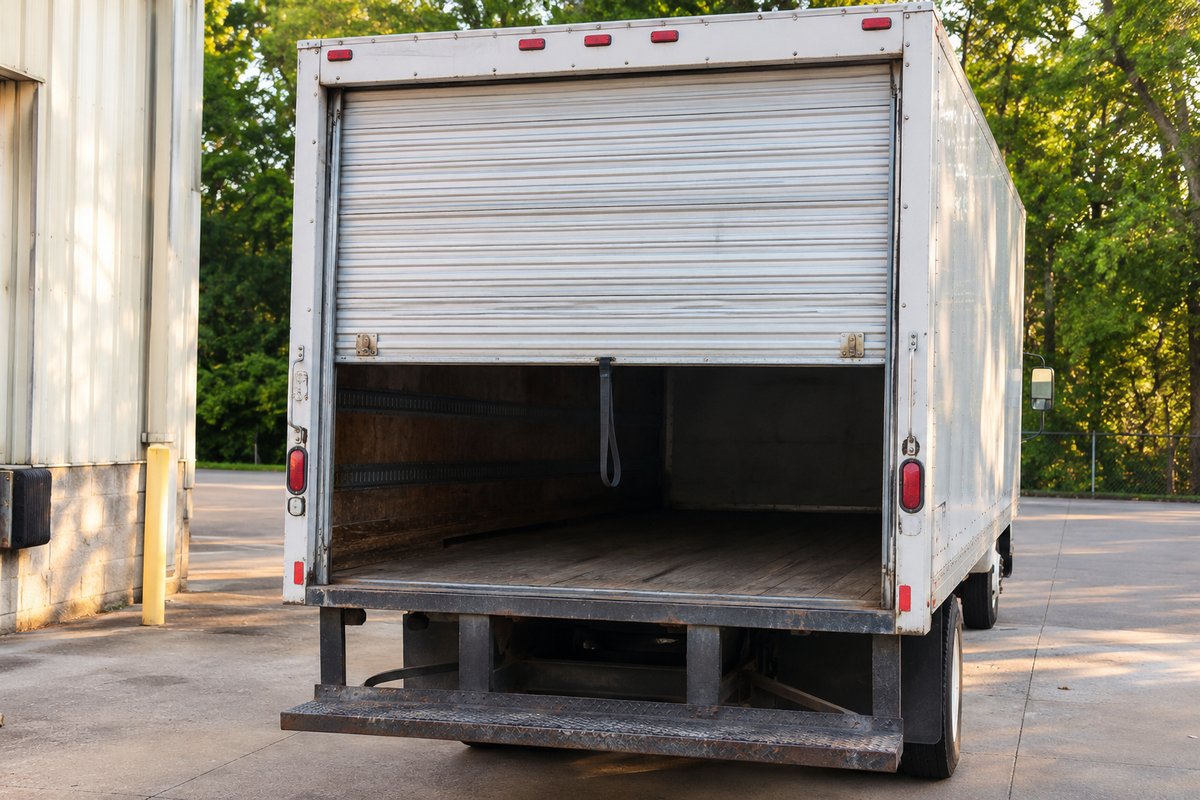
A box truck door is balanced by a torsion spring on a shaft above the opening. If the door won't stay up, slams down or feels heavy, the spring is weak or broken. If it rises by itself, the tension is too high.
This guide covers how the spring works on Whiting, Todco and similar truck doors, how to read the signs, what adjusting the tension and replacing the spring involve, and the care that keeps a spring working longer. It's written for drivers, owner-operators and fleet managers. For the parts of the door and how the door works overall, see our guide to box truck roll-up doors.
Before you touch anything
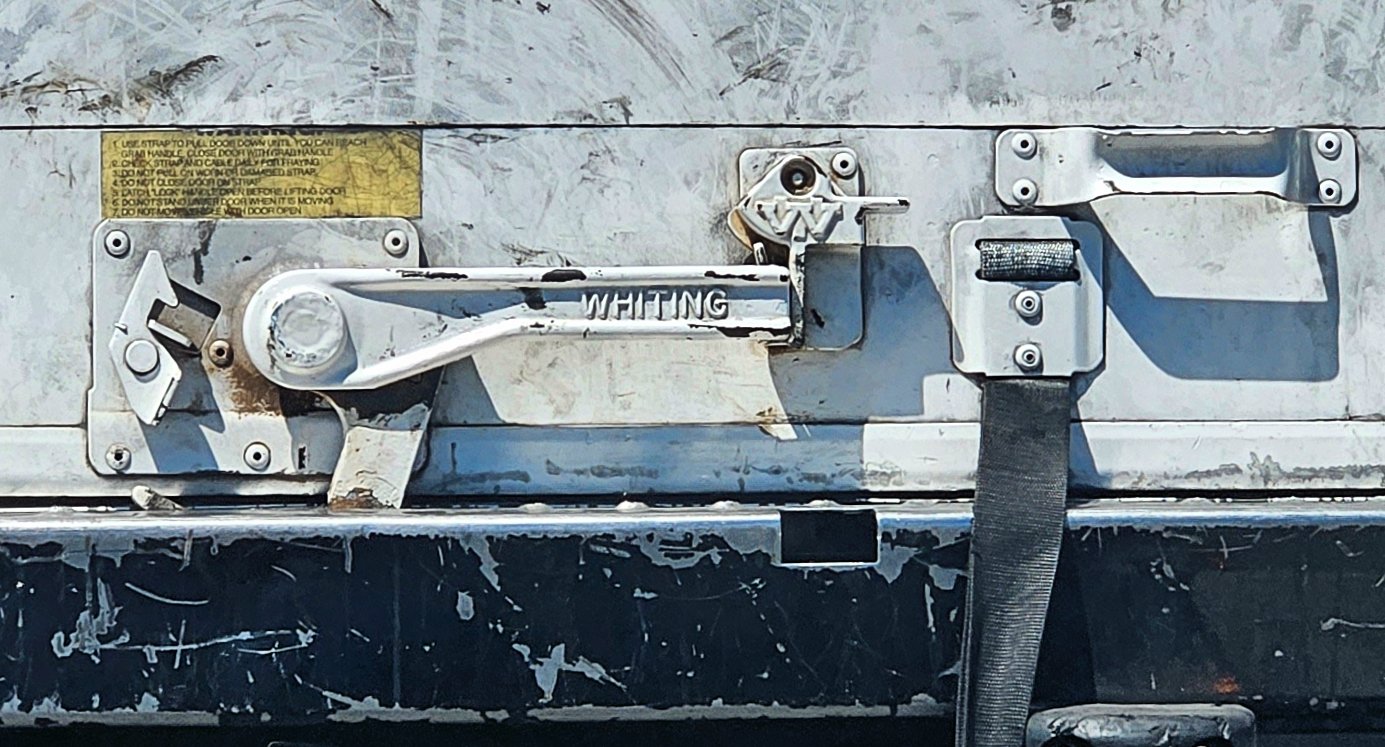
Todco puts a warning sticker on the inside of the door's top panel, and Utilimaster prints the same warning in its service guides: the counterbalance spring is wound under high tension and can cause severe injury or death. Three rules follow from it.
- If the spring is broken, don't open the door. Todco's safety instructions say it plainly: with a broken counterbalance spring, the door is no longer counterbalanced and will fall if opened. Leave it closed and latched until it's repaired.
- Don't put anything into the spring's winding plug. The round holes in the collar at the end of the spring are for winding bars of the size the door maker specifies. Utilimaster says never to use bent bars, screwdrivers or punches, and DASMA, the door industry's trade association, says not to use reinforcing bar or any other tool the maker hasn't called for.
- Keep people out from under a door that's misbehaving. A door that drops when you let go of the strap can come down on someone's head or hands.
How the spring on a box truck door works
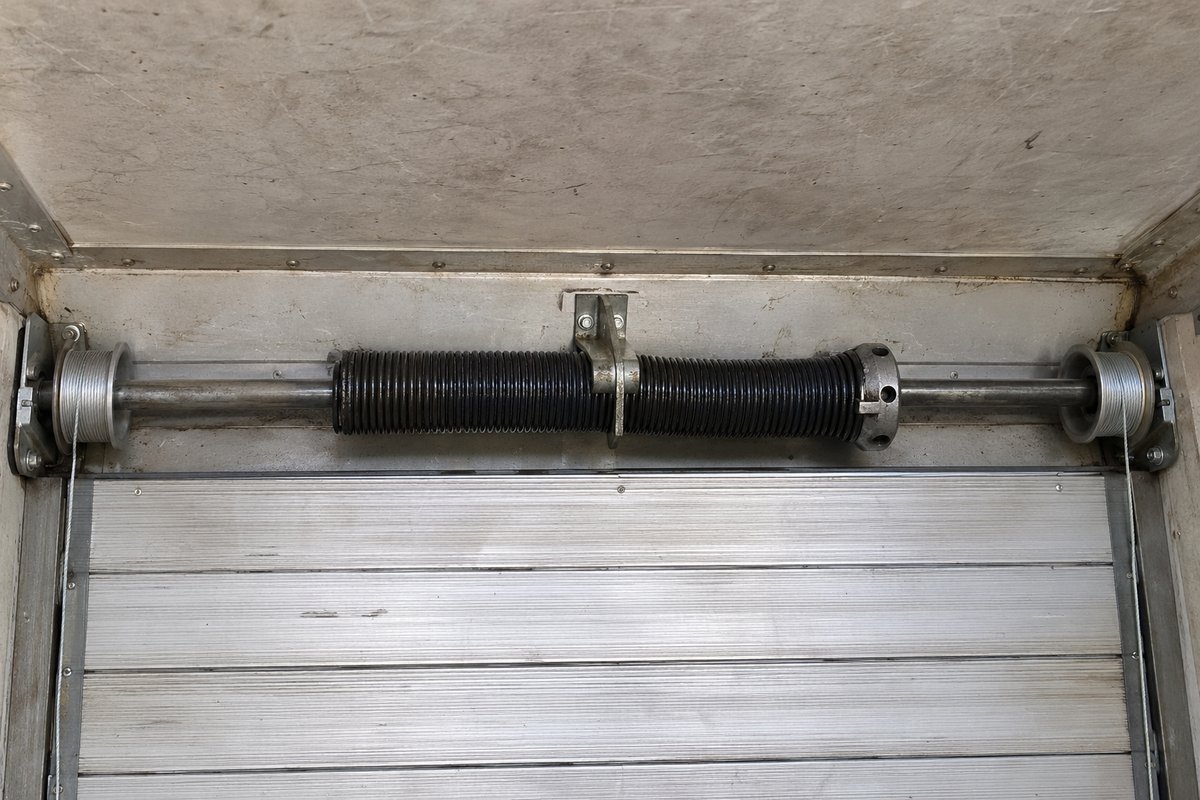
The rear roll-up doors Whiting and Todco make for box trucks are sectional doors: a stack of horizontal panels, joined by hinges, with rollers that run up vertical tracks and back along horizontal tracks under the roof. The spring that balances them sits in the header, the frame across the top of the rear opening, as part of what door makers call the counterbalance or balancer assembly.
| Part | What it does |
|---|---|
| Counterbalance shaft | A steel shaft across the width of the opening, just under the roof |
| Torsion spring | A coiled steel spring on the shaft. Twisting it stores the energy that lifts the door |
| Winding plug (or winding cone) | The cast collar at one end of the spring, with holes for winding bars and set screws that lock it to the shaft |
| Anchor bracket | Holds the other end of the spring still so it can be twisted |
| Cable drums | Small grooved drums at each end of the shaft |
| Cables | Steel cables from the drums down to the bottom panel of the door |
When you pull the door down, the cables unwind from the drums and turn the shaft, which twists the spring tighter. When you lift the door, the spring unwinds and turns the drums, which take up the cables and lift the door with you. That's why a well-set door feels light going up and stays where you stop it.
Not every truck door is wound the same way
If you've seen a torsion spring on a house garage door, the idea is the same (how springs balance a garage door explains the house version). What changes is how each truck door maker has you set the tension:
- Single-spring assemblies on standard Todco counterbalances and on the rear doors Utilimaster fits to its truck bodies are wound with the door closed, with the shaft clamped so the cables stay tight.
- Whiting's two-spring balancer is worked on with the door open, pushed back into the horizontal tracks and clamped in place. It uses a pair of springs wound in opposite directions, a left-hand spring on the roadside and a right-hand spring on the curbside, with a center clamp holding the tension.
- Pre-wound counterbalances come from the factory already under tension. Todco's installation instructions say special precautions are needed when handling one, and the set screws aren't loosened until a specific step of the install.
DASMA's technical sheet on rolling door winding bars adds one more point that matters here: springs set to balance a door are under extreme tension, especially with the door fully closed.
Signs the spring is weak or broken
Match what the door is doing to the likely cause. Most of these can be spotted without touching the spring.
| What the door does | What it usually means | What to do |
|---|---|---|
| Slams down when you let go of the strap, or drops hard near the bottom | A broken spring, or a broken or slipped cable | Stop using the door. Leave it closed and latched |
| Won't stay up, drifts down from halfway | Too little spring tension: a tired spring or one set too loose | Have the tension checked and adjusted |
| Hard to lift all the way up | Too little tension, or friction: dry rollers, a bent track, worn hinges | Lubricate as the maker's manual says. If it's still hard, have it checked |
| Rises off the floor by itself when unlatched, or shoots up | Too much tension | Have a few quarter turns taken off |
| Hangs crooked, or one cable is slack | A cable off its drum, a loose drum, or a broken cable | Don't run it. See cable repair and drum replacement |
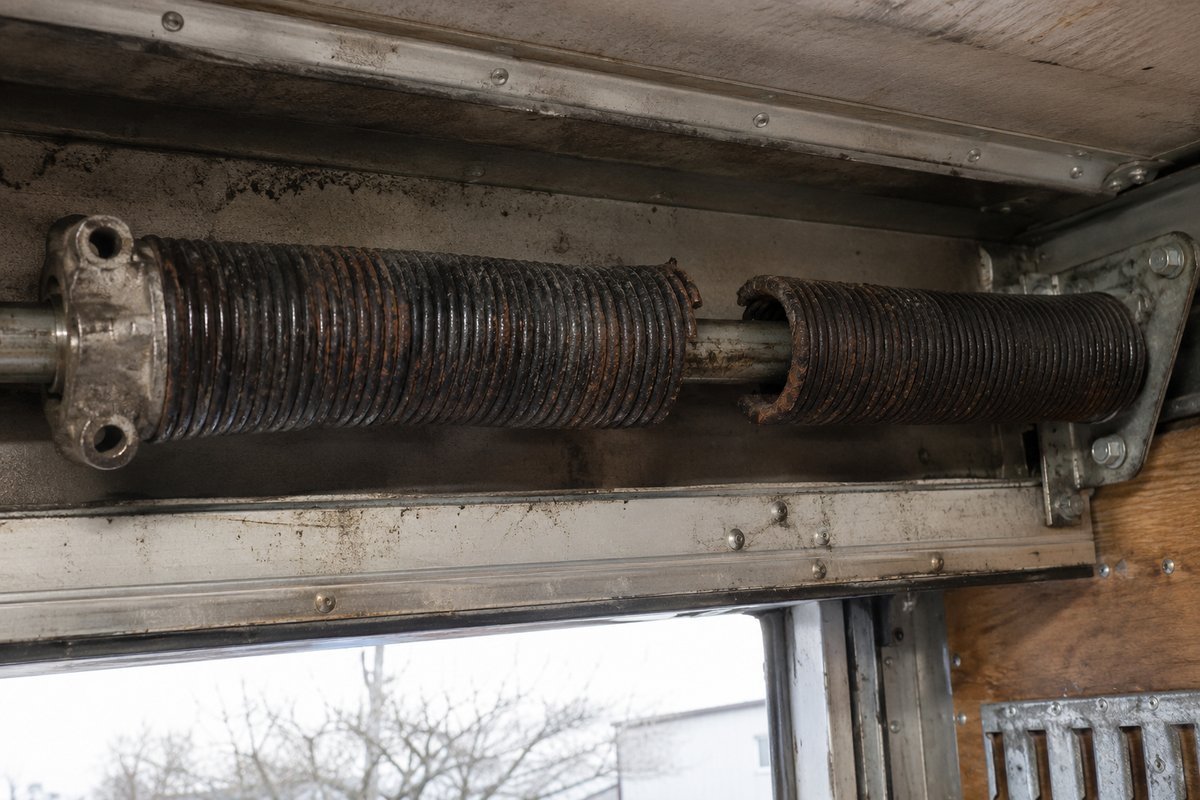
| A gap in the coils you can see from inside the box | A broken spring | Don't open the door again until it's replaced |
| Rust along the coils, squeaks from the header | A dry spring that hasn't been oiled | Lubricate per the maker; have it inspected if the rust is heavy |
If the door won't move at all, the cause is more often the latch or the track than the spring: see what to check when a box truck door is jammed. Two of the signs above are worth a closer look.
"Rises on its own" is a tension problem, not a broken part. Utilimaster's service guide is specific: if the door leaves the floor by itself, the spring is wound too tight and a few quarter turns should be released. If the door drops when you stop it, a few quarter turns should be added. Whiting's inspection form says a newly installed door can creep upward slowly, but never downward.
"Hard to lift" isn't always the spring. Todco's safety instructions tell drivers to lubricate the rollers, counterbalance spring, bearings and hinges first if the door is hard to move, and to have a trained service person check it if it's still hard. They also say not to try adjusting or repairing the spring yourself.
A safe check: is the door balanced?
Door makers give the same test for a correctly set door: when you stop it partway, it should stay where it is. Utilimaster puts it this way: a properly counterbalanced door should, when stopped, remain at any given location. Here's how to check without touching the spring or cables.
- Look first. With the rear open and the door up, or with a light inside the box and the door down, look at the spring and both cables. If you see a gap in the coils, a cable off its drum or a frayed cable, stop. Don't run the door.
- Unlatch the door and lift it with the strap to about waist height, standing to the side, not under it.
- Let go slowly. A balanced door stays put or creeps a little. A door that falls has too little tension or a broken part. A door that keeps rising has too much.
- Lower it with the strap and latch it. Don't let it drop.
This tells you whether the door needs a technician. The fix is an adjustment or a replacement, and both mean working on a loaded spring.
What adjusting the spring tension involves
Adjusting the tension means turning the spring tighter or looser, a quarter turn at a time, with winding bars. It sounds like a small job. The manuals show why it isn't one.
Based on the Utilimaster, Todco and Whiting procedures, a tension adjustment on a box truck door generally goes like this:
- Secure the door. Depending on the door, that's closing it and clamping the counterbalance shaft with locking pliers braced against the ceiling (Utilimaster and Todco single-spring doors), or opening it and clamping both tracks below the bottom roller (Whiting's two-spring balancer).
- Insert a winding bar of the size the maker specifies into the winding plug. Utilimaster lists a solid 1/2-inch bar, 18 inches long, for its T-series door, and says never to use bent bars, screwdrivers or punches.
- Take the load on the bar, then loosen the set screws that lock the plug to the shaft. From this point the technician is holding the spring's force by hand.
- Turn the spring a quarter turn at a time, passing the load between two bars, and count. Makers mark the spring with a chalk line so each full turn shows as a stripe.
- Tighten the set screws, remove the bars and clamps, and cycle the door. If it still drifts or rises, adjust again.
The number of turns isn't a guess and isn't the same from door to door. Todco and Utilimaster work out a new spring's turns from the height of the door opening. Whiting gives a set count for its two-spring balancer. DASMA says the starting tension for a counterbalance should come from the door manufacturer.
Why it's a job for a trained technician
- The force is real. Todco and Utilimaster both warn that the high-tension spring can cause severe injury or death. Utilimaster says only qualified technicians should adjust it, and Todco tells drivers not to try to adjust or repair the spring or counterbalance assembly. Whiting's maintenance guides open with a caution that anyone not trained in roll-up truck door repair should leave the work to those who are.
- The procedure depends on the door. Closed or open, one spring or two, wound up or down, standard or shallow header: Whiting notes that on a shallow header the bar moves the opposite way to a standard one. Using the wrong door's steps is how bars get thrown.
- Too many turns causes its own failure. Utilimaster warns that rotating the counterbalance too far can make the cables jump off the drums.
- The cables have to come out even. Both Utilimaster and Todco say the drums must be tight against their bearings and the two cables must have equal tension, or the door runs crooked and wears the cables.
DASMA's advice for rolling doors is the same: only a trained door systems technician should install, adjust or repair a counterbalance system, including using a winding bar on any part under tension. Always work from your door maker's manual.
What replacing a box truck door spring involves
When a spring has broken, or it's lost so much tension that adjusting it won't hold, it gets replaced. On some doors the technician replaces the spring alone; on others, the whole counterbalance assembly (shaft, spring, drums and brackets) is swapped as a unit.
1. Identify the door. Truck door springs aren't one size. The serial number plate tells the parts supplier what's on your door. Todco's plate is inside the door; Utilimaster puts its door tag on the inside upper corner on the driver's side. If the plate is gone, Todco's parts guide says to measure the spring instead: its inside diameter, its length with the tension off, the number of coils in 10 inches (which gives the wire size), the length of the shaft and the part numbers on both cable drums.
2. Release whatever tension is left using the maker's procedure, with the door secured.
3. Swap the spring or the assembly, check the anchor bracket is fixed firmly enough to take the spring's torque, and leave the room Todco calls for so the spring can grow in length as it's wound.
4. Inspect the cables while they're off the load. Utilimaster recommends replacing both cables even if only one is frayed. Cables have to follow the drum grooves; Whiting notes they can be put on backwards.
5. Wind the new spring to the maker's turn count, tighten the set screws, release the clamps and test the balance.
6. Oil the new spring along its length, as the manuals call for, and check that the warning decals on the door are in place and readable.
How the common doors differ
| Todco | Whiting | Utilimaster bodies (T-series door) | |
|---|---|---|---|
| Spring setup | Single torsion spring on most standard counterbalances | Two-spring balancer: left-hand roadside, right-hand curbside | Single torsion spring |
| Spring sizes listed | 1-3/4" and 2-1/2" inside diameter, right-wound | 2-3/16" inside diameter, sized by wire and length | Not listed in the service guide |
| Door position for winding | Closed, shaft clamped | Open, door clamped in the tracks | Closed, shaft clamped |
| Where to find the door's details | Serial plate inside the door | Door serial number | Tag inside upper driver's-side corner |
| Lubricant named | Todco FG Lube, no grease | Not stated on the guides we read | Light oil, no grease |
Other makes, and older doors from these makers, can differ. Your door's own manual or plate settles it.
Care that helps a spring last
Springs wear out with use, and a delivery truck's rear door can go up and down dozens of times a day. You can't stop that wear, but you can stop the habits that add to it.
- Keep the spring oiled. Todco says to spray the counterbalance with its FG Lube to prevent rusting and to lubricate the counterbalance bearings. Utilimaster says to oil the spring along its entire length with a light oil, for the same reason. That matters on trucks that spend humid Atlanta summers parked outside.
- Use the lubricant the maker names, not grease. Both Todco and Utilimaster say not to use grease on their doors. Utilimaster adds: don't get oil on the rubber seals, and wipe up drips.
- Don't hang on the pull strap. Utilimaster and Todco both warn drivers not to use the strap to climb in or out of the box: it can break or pull the door down on you. Use the grab handles. Todco also says not to tie anything to the strap.
- Stand clear while the door moves. Utilimaster's guides say to stay out of the opening while the door is moving, and Todco says not to stand or walk in the doorway.
- Close and latch the door before you drive. Todco and Utilimaster both say so.
- Check the door at every service. Todco's instructions note that how often a door needs maintenance depends on how it's used, the climate and how it's cleaned. The check is short: balance, spring, cables on their drums, strap, latch. Our commercial door maintenance checklist covers the same kind of routine for building doors, and we handle commercial door service at depots and warehouses too.
- Keep the warning decals. Todco and Utilimaster both say to replace faded decals and never paint over them.
What you can do, and what to leave to a technician
| Safe for a driver or fleet manager | Leave to a trained technician |
|---|---|
| Look at the spring and cables for gaps, fraying or rust | Any spring tension adjustment |
| The balance check above, with the spring and cables intact | Spring or counterbalance replacement |
| Oil the rollers, hinges, spring and bearings with the maker's lubricant | Cable replacement or putting a cable back on its drum |
| Inspect and replace a worn pull strap | Loosening any set screw on the shaft, winding plug or drum |
| Keep tracks and the opening clear | Straightening or replacing bent tracks |
| Note the door make and serial plate before you call | Releasing tension on a pre-wound counterbalance |
When to call us
Call if the spring is broken, the door slams or won't stay up, it rises on its own, or a cable is slack or off its drum. We repair the rear roll-up doors on Whiting, Todco and other box truck bodies: box truck roll-up door repair in Atlanta covers springs, cables, tracks, latches and panels, for one truck or a fleet. We also serve the same work out of Marietta and Kennesaw, among other cities around Atlanta.
When you call, have the door brand and serial plate, what the door is doing, and where the truck is parked. We've worked on garage, overhead and roll-up doors around Atlanta since 1999, we're rated 4.9 on Google with Over 4,000 Five-Star Reviews, and our office is open Mon–Sun, 7 AM to 8 PM.
Call (678) 271-8918 or book online. The technician looks at the door first and writes down the price before any work starts.
Frequently asked questions
How do I know if my box truck door spring is broken?
The door slams down or won't stay up, it's much heavier than it was, and from inside the box you can see a gap in the coils of the spring on the shaft above the door. Don't open the door again until it's repaired.
Why does my box truck roll-up door go up by itself?
The spring has too much tension. Utilimaster's service guide says that if the door leaves the floor on its own, the spring is wound too tight and a few quarter turns should be released. A technician does that with winding bars and the door secured.
Why won't my box truck door stay up?
Usually the spring tension is too low. Utilimaster's guide says a door that drops when stopped needs a few more quarter turns. A broken spring or a cable off its drum does the same thing, more suddenly. Check for a gap in the spring and slack cables before you run the door again.
How do you adjust the spring tension on a box truck roll-up door?
With the door secured as the maker specifies, a technician takes the load on a winding bar, loosens the set screws on the winding plug and turns the spring a quarter turn at a time, then locks it and tests the balance. The door makers say only trained technicians should do it.
How many turns does a box truck door spring need?
It depends on the door. Todco and Utilimaster work out a new spring's turns from the door opening height, and Whiting gives a set count for its two-spring balancer. The right number for your door comes from its maker's instructions.
Can I use the truck if the door spring is broken?
Don't open or run the door. Todco says a door with a broken spring isn't counterbalanced and will fall if opened. If the door is closed and the latch holds, leave it latched until the spring is replaced. If the latch won't hold, park the truck.
Do Whiting and Todco doors use the same spring?
No. Todco's counterbalance springs come in 1-3/4-inch and 2-1/2-inch inside diameters, right-wound. Whiting's two-spring balancer uses a pair of 2-3/16-inch springs, one left-hand and one right-hand wound. The door's serial plate tells a parts supplier exactly which one you need.