A garage door feels heavy when the springs are no longer carrying its weight. Most often a spring is worn out or broken. Less often a lift cable is frayed, the door is binding in its tracks, or the door has picked up extra weight. A two-minute balance test tells you which.
This guide explains what normally holds a garage door up, the six reasons it starts to feel heavy, how to run the balance test safely, and which fixes are yours and which belong to a technician.
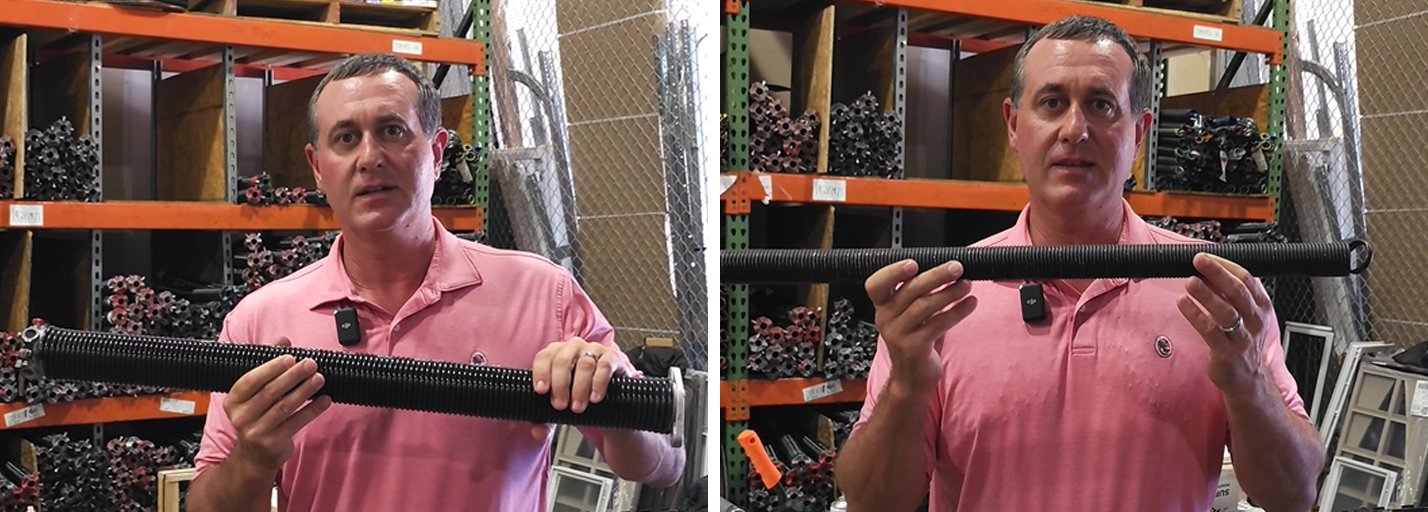
Before you lift it: three safety rules
- If you heard a loud bang, see a gap in a spring, or the door hangs crooked, don't lift it. A bang is usually a torsion spring breaking. A crooked door usually means a cable has come off its drum. Leave the door where it is, unplug the opener and read what to do when your garage door cables are off track.
- Pull the emergency release only with the door closed. Chamberlain's balance test starts with the door down for a reason: if the springs are weak or broken, an open door that's let go of the opener can drop.
- Don't touch the springs, cables, drums or bottom brackets. They are under extreme tension even when the door is closed. DASMA, the door manufacturers' association, says the bottom brackets should be adjusted or loosened only by a trained door systems technician, and its standard has the fasteners on these parts painted red with warning labels beside them.
What normally carries a garage door's weight
You never lift the whole weight of a working garage door. The springs do. DASMA's counterbalance standard (ANSI/DASMA 103) defines a counterbalance system as one that "counteracts the weight of a garage door" so a balanced force can open and close it, with spring tension set roughly equal to the door's weight. Clopay's installation instructions warn that, without its springs, a large door can weigh up to 500 pounds and a single-car door about 200.
There are two kinds of spring systems on residential sectional doors:
| Torsion springs | Extension springs | |
|---|---|---|
| Where they are | On a steel bar (the torsion shaft) across the top of the door opening | Above the horizontal tracks on each side, running toward the back of the garage |
| How they lift | The spring twists. As the door rises, it unwinds and turns the cable drums, which wind up the lift cables | The spring stretches. Lift cables run over pulleys and pull the door up as the springs contract |
| When they're under most tension | Door closed | Door closed (DASMA: "When your garage door is down, extension springs are under high tension") |
| Safety part to look for | Springs on a shaft, contained by it | A safety cable running through each spring, fixed at both ends, so a broken spring can't fly across the garage |
Either way, springs, cables, drums, pulleys and bottom brackets work as one system. When any part of it weakens, the weight moves to you or to the opener. For a fuller comparison, read our guide to torsion vs extension springs.
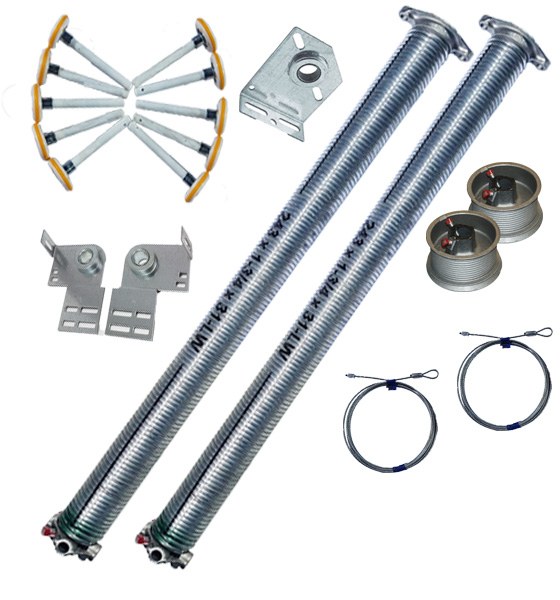
Photo: Blizzard6204, Wikimedia Commons, CC0.
Why your garage door feels heavy: the 6 causes
| What you notice | Most likely cause | Safe to check yourself? |
|---|---|---|
| Door has been getting harder to lift over months; drifts down when let go halfway | Springs worn and losing lift (cause 1) | Yes, run the balance test |
| Sudden: a bang, then the door is very heavy or won't move | A broken spring (cause 2) | Look only |
| Door heavy on one side, hangs unevenly, cable looks loose or hairy | A frayed or broken lift cable (cause 3) | Look only |
| Door is stiff, jerky or noisy along the whole travel, not just heavy | Binding rollers, hinges or tracks (cause 4) | Yes, look and lubricate |
| Door got heavier after you added insulation, a window kit, trim or paint | Added weight the springs weren't set for (cause 5) | Yes, think back on what changed |
| Wood door that feels heavier after a wet spell | Wood finish failing and the door taking on water (cause 6) | Yes, check the finish |
1. The springs are wearing out and losing lift
What you'll notice: the door has been getting harder to lift by hand for a while. In the balance test it drifts down instead of staying put. With an opener, it starts slower and sounds like it's working harder.
Why it happens: DASMA's safety tips say it plainly: springs wear out. A spring without enough torque leaves the door drifting down from the open position, as DASMA's data sheet on spring life describes. Rust speeds this up: it thins the spring wire, and its pits are where fatigue cracks start. In a humid Georgia garage, DASMA's advice to keep the door closed where possible keeps the springs out of the weather.
What to do: run the balance test below. If the door drifts down or is hard to lift, the springs need re-tensioning or replacing. That's a technician's job.
2. A spring has broken
What you'll notice: often a loud bang from the garage, sometimes while nobody was using the door. Then the door feels very heavy or won't lift at all, and the opener strains, hums, or lifts the door a few inches and stops. On a torsion system you can see a gap of a few inches in one spring's coil.
Why it happens: a spring that reaches the end of its cycle life breaks, usually at a point where rust or a nick started a crack.
What to do: don't lift the door, don't use the opener and don't pull the release with the door open. Our garage door springs page covers repair for both torsion and extension systems.
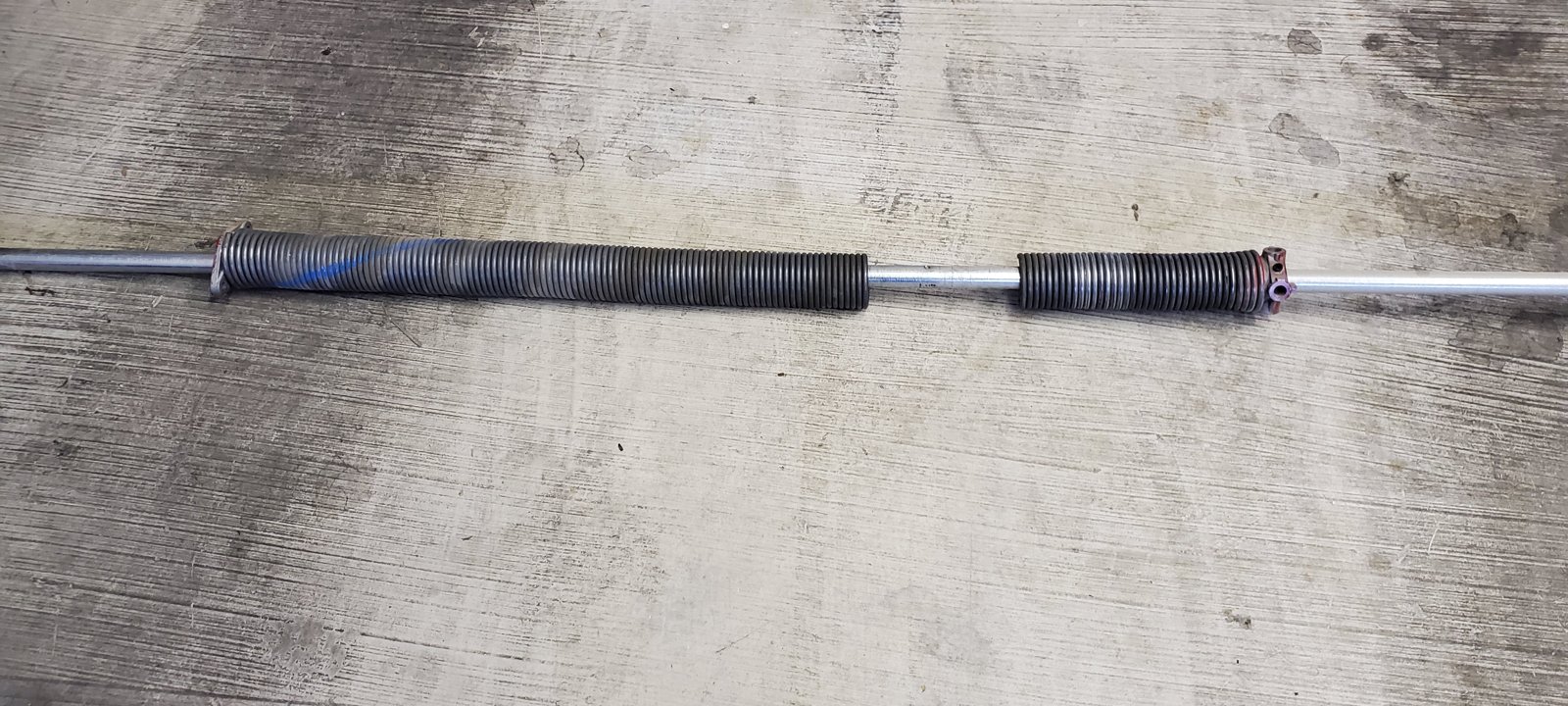
Photo: Garagedoorrepairlasvegas, Wikimedia Commons, CC BY-SA 4.0.
3. A lift cable is frayed or broken
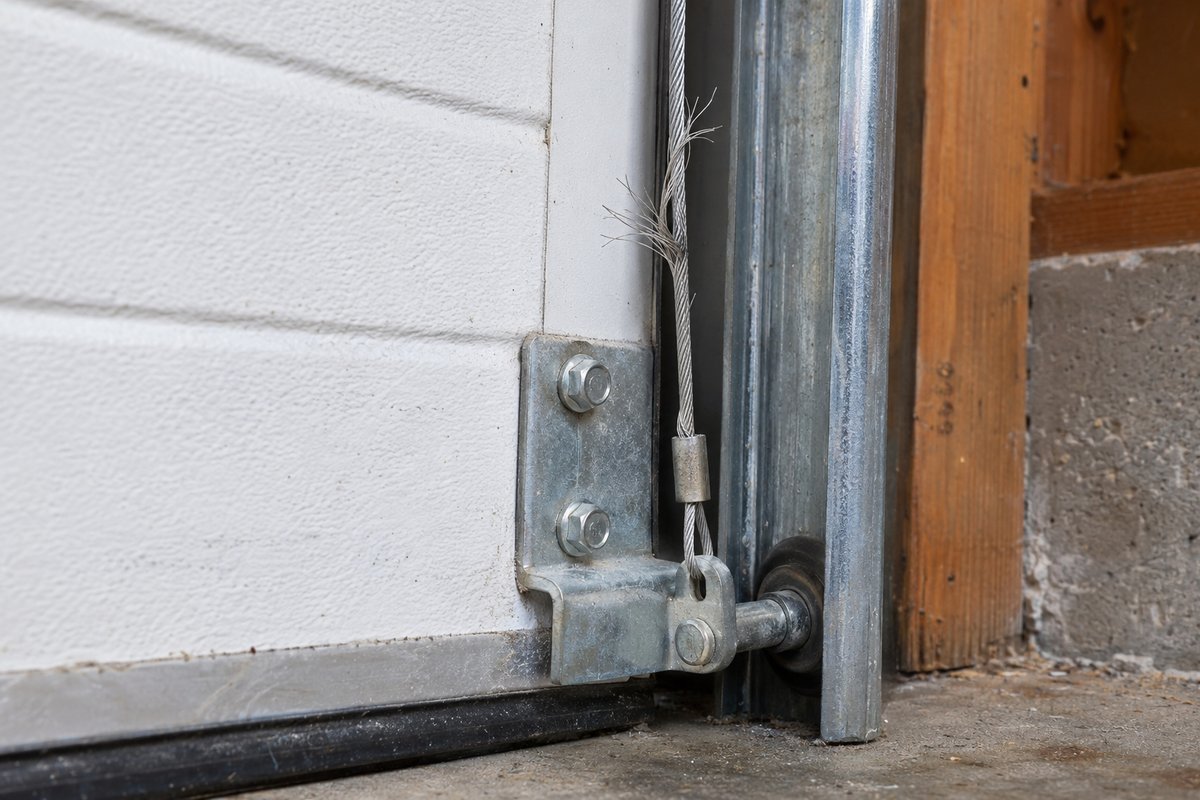
What you'll notice: the door is heavy on one side, it rises unevenly, or it hangs crooked. A cable near the bottom bracket looks loose, kinked or hairy with broken strands.
Why it happens: the lift cables carry the springs' force to the bottom of the door. A frayed cable is weaker, and a slack one lets one side of the door take more of the weight. Clopay warns that frayed cables are in danger of breaking and can cause serious injury or property damage.
What to do: stop using the door and call. Clopay, Wayne Dalton and DASMA all say cable replacement is for a trained technician. Our cables off track guide explains the cable and drum system in more detail.
4. Rollers, hinges or tracks are binding
What you'll notice: the door is stiff along the whole travel, not only heavy. It jerks, scrapes or squeals, or it sticks at one spot.
Why it happens: worn rollers, dry hinges, a dented or out-of-line track, or grit in the tracks add friction. The springs still balance the door, but you're fighting the friction on top.
What to do: this is the one cause that is partly DIY. Chamberlain's balance test says that if the door sticks or binds when you move it by hand, remove obstructions and lubricate the tracks, rollers and hinges, then call a professional if the problem stays. Use a garage door lubricant and follow your door maker's rules: Wayne Dalton's manuals, for example, say not to lubricate nylon rollers or the track itself. Our maintenance checklist covers what to lubricate and how. A bent track or a door that has slipped out of its track is a different job; see garage door off track: what to do.
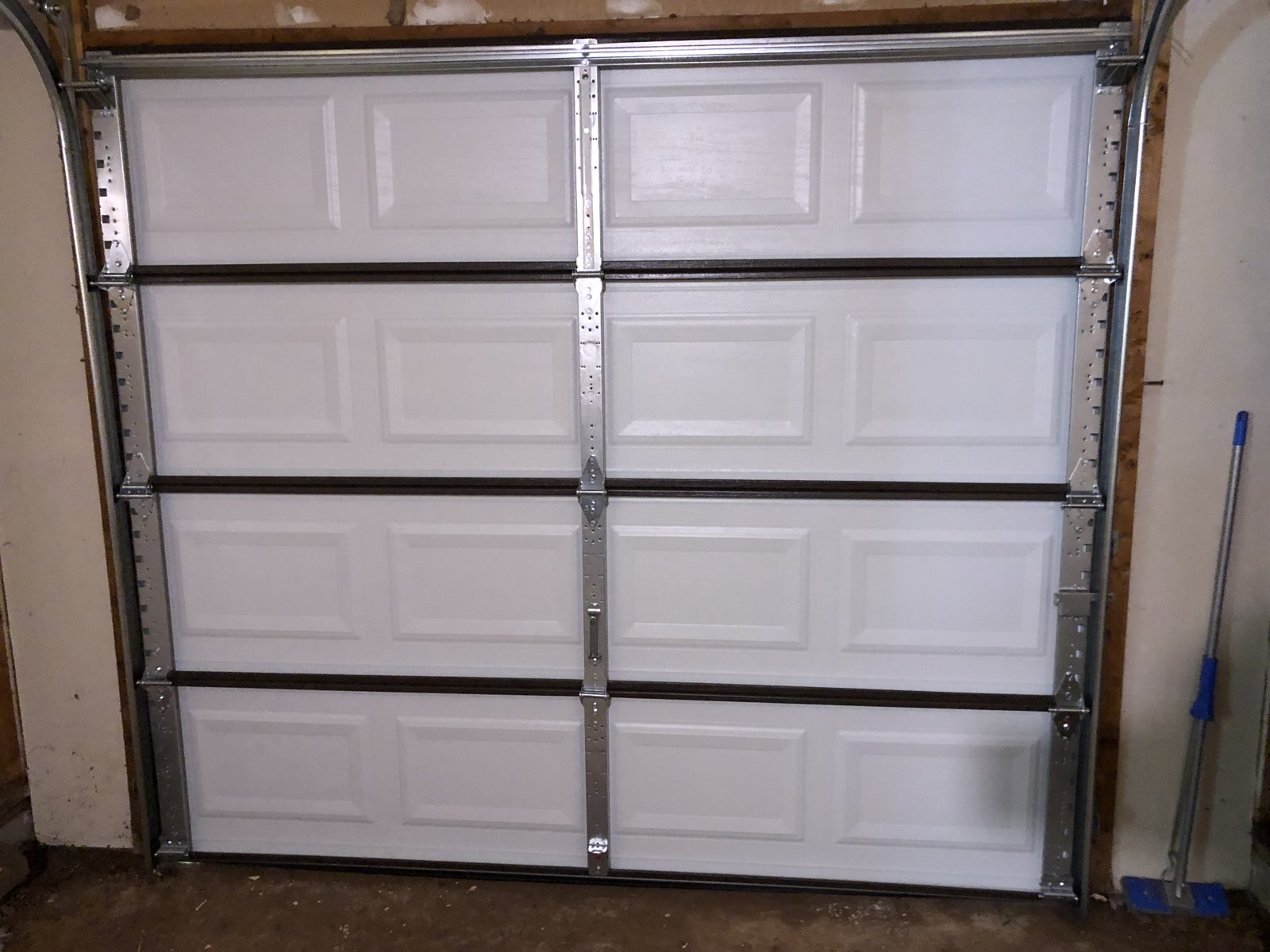
Photo: Famartin, Wikimedia Commons, CC BY-SA 4.0.
5. The door has gained weight
What you'll notice: the door got heavier soon after a change: an insulation kit glued to the panels, a window or glass section swapped in, decorative trim, or a thick coat of paint.
Why it happens: springs are sized and wound for the door's original weight. DASMA's data sheet on adding weight says weight added after installation can unbalance the door, damage or break the springs, and overwork the opener. Its spring life sheet names paint and added components as two common ways a door ends up heavier than its specification, and DASMA strongly advises against attaching anything to a door without the manufacturer's instructions.
What to do: the springs have to be re-set or replaced to match the new weight. Tell the technician what was added; a technician can weigh the door with the springs disabled. If you're considering an insulation kit, ask first.
6. A wood door is taking on water
What you'll notice: a wood door feels heavier, or drags, after a wet stretch. The finish is peeling or worn through on the bottom edge or the back.
Why it happens: wood exchanges moisture with the air, and finish only slows that down. Clopay's wood door care guide requires every surface, the face, back, sides, bottom and joints, to be finished, and says a door left partly unfinished voids its warranty. Where the finish has failed, the wood can take on water.
What to do: have the finish repaired on all sides, and have the balance checked once the door has dried out. If it's still heavy when dry, it's the springs.
The balance test, step by step
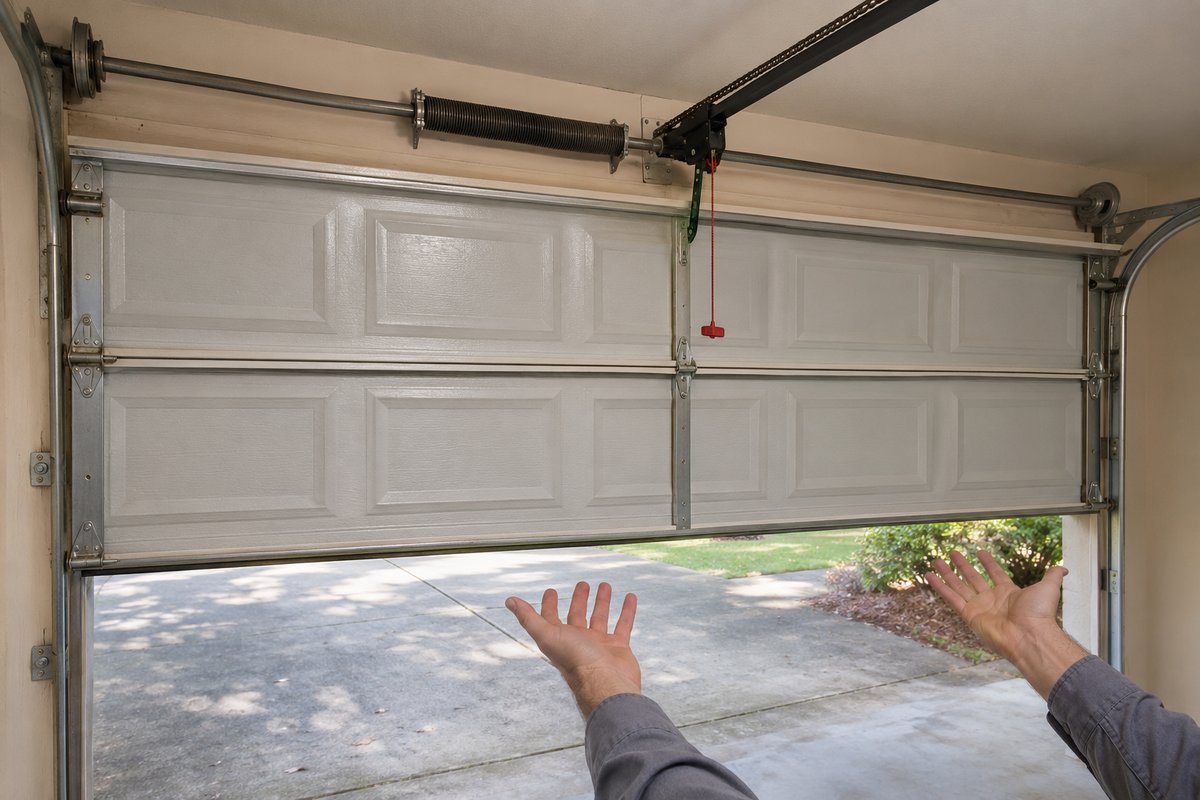
This is the same test Chamberlain, Clopay and Genie give homeowners. It tells you whether the springs are doing their job. Do it with two people if you can: one to lift, one to watch the springs and cables.
- Close the door all the way. Never start this with the door open.
- Look up at the springs and cables first. If a spring has a gap, a cable is loose or frayed, or the door hangs crooked, stop here. Don't lift it.
- Pull the emergency release. On most openers, pull the red cord straight down; on some, down and back toward the motor. The door is now disconnected from the opener.
- Lift the door by hand, from the middle of the bottom section. A balanced door rises smoothly with little effort. DASMA's consumer site says it should lift smoothly with little resistance; Chamberlain says it should move easily with one hand.
- Stop it about halfway, 3 to 4 feet off the ground, and slowly let go. Keep your hands near it and your feet out from under it.
- Watch what it does (next section).
- Lower it gently, close it and reconnect the opener. On most chain and belt openers, the trolley reconnects the next time you run the opener; your manual shows the method for your model.
What the balance test result means
| What the door does when you let go | What it means | What to do |
|---|---|---|
| Stays put, or creeps a little | The springs are carrying the door. Chamberlain counts a slow rise or gentle fall as a pass | Reconnect the opener. If the door was stiff to move, look at cause 4 |
| Drifts down steadily | The springs are weak and not carrying the full weight | Have the springs re-tensioned or replaced |
| Falls or slams shut | A spring is badly worn or broken, or a cable has failed | Stop using the door. Call a technician |
| Shoots up or keeps rising | The springs are wound too tight for the door | Have them adjusted. A door that flies open is as unsafe as one that falls |
| Hard to lift at all | A broken spring, a failed cable, or heavy binding | Lower it if you can do so safely, unplug the opener and call |
| Lifts unevenly, one side lower | A cable, drum or one spring of a pair has a problem | Stop using the door. Call a technician |
The CPSC says a properly operating door is balanced and that doors that aren't balanced, or that bind or stick, should be serviced by a professional. It also warns that a badly unbalanced door can crash down. Clopay suggests this check twice a year, and DASMA's consumer site suggests a balance check every month along with the reverse test.
How long garage door springs last: cycle ratings
Springs are rated in cycles. One cycle is the door opening once and closing once.
- The industry baseline is 10,000 cycles. The 2004 edition of DASMA's standard for sectional garage doors (ANSI/DASMA 102) set a design minimum of 10,000 cycles for residential and commercial door systems. The current edition points to a separate test method for cycle life instead of stating a number, but 10,000 cycles is still the figure standard residential springs are rated around.
- A residential door isn't expected to run much more than that each year. The same standard defines a residential door as one normally operated less than 1,500 cycles a year.
- High-cycle springs use more steel to carry the same door with less stress per cycle, which gives them a longer rated life. They're worth asking about if your garage is the main way in and out of the house.
In years, that depends on your household. At four cycles a day, 10,000 cycles is just under seven years; at eight a day, about three and a half. A family that comes and goes through the garage wears springs out much sooner than a couple who park once a day.
Cycle life also shortens with rust, a spring that's the wrong size for the door, the wrong number of turns, added door weight and no lubrication, all listed in DASMA's spring life data sheet.
Why a stronger opener isn't the fix
When a door feels heavy, it's tempting to let the opener do the lifting. The opener is not built for that.
- The opener is designed to move a balanced door. It guides the door; the springs lift it. DASMA's sheet on added weight says an unbalanced door can overwork an opener's motor or stop it working.
- It wears out the drive gear. On most chain and belt openers the motor turns a nylon gear, and every lift of a too-heavy door wears its teeth. That's the most common reason an opener runs and the door doesn't move; see garage door opener making noise but not opening.
- It can affect the safety reverse. Chamberlain warns that an unbalanced door can fail to reverse when it should.
- Turning up the force setting hides the problem. Chamberlain says never to use the force adjustments to make up for a binding or sticking door, because too much force interferes with the safety reverse.
A new opener on an unbalanced door inherits the same problem. If you're replacing the opener anyway, have the balance set first. Our guide to the types of garage door openers explains chain, belt, screw and wall-mount drives once the door itself is sorted out.
Why spring adjustment is a technician's job
A torsion spring is wound by hand, a quarter turn at a time, with steel winding bars, against the full force of the door. Extension springs are adjusted by moving the cable or spring hooks while the springs still carry tension. A slip at any point releases that stored energy through the bar, the cable or the spring.
Every source we checked agrees. Clopay calls manual winding of a torsion spring extremely difficult and potentially dangerous. Genie says spring adjustment is too dangerous without training. Wayne Dalton and Chamberlain tell owners not to adjust springs, cables, brackets or their fasteners, and to call a trained door systems technician. DASMA calls springs among the most dangerous parts of the door, and the CPSC says an unbalanced door should be serviced by a professional.
There's a second reason, from DASMA's spring sheet: a spring has to match the door's weight and be wound with the number of turns the door maker specifies. Too few turns and the door drifts down; too many and the cables and drums take extra force.
DIY or technician: who does what
| Job | You | Technician |
|---|---|---|
| Run the balance test with the door closed at the start | Yes | |
| Look at the springs, cables and rollers (look, don't touch) | Yes | |
| Clean the tracks and lubricate hinges and rollers as your manual says | Yes | |
| Keep the door closed when you're not using it | Yes | |
| Adjust spring tension | Yes | |
| Replace a broken or worn spring | Yes | |
| Replace a frayed cable or a damaged drum | Yes | |
| Loosen or adjust bottom brackets or anything with red fasteners | Yes | |
| Re-set springs after insulation, glass or trim has been added | Yes | |
| Straighten a bent track or rehang a door that's off track | Yes |
What a technician does to fix a heavy door
- Inspects the whole counterbalance system: springs, cables, drums, pulleys, bottom brackets, rollers and tracks.
- Measures the springs (wire size, inside diameter, length) against the door, and accounts for any weight that's been added.
- Re-tensions or replaces the springs. Worn springs are usually replaced rather than wound tighter. On doors with two springs, both are replaced together: Clopay advises replacing both at once, even if only one has broken.
- Replaces frayed cables and checks that each cable is seated on its drum with equal tension on both sides.
- Balances the door and checks it the way you did: let go halfway, and it stays put.
- Checks the opener: reconnects it, sets force and travel for the newly balanced door, and runs the safety reverse test.
New springs from us come with our written warranty: 3 years on torsion springs and 5 years on extension springs (see the warranty). You get a written price before any work starts.
How to keep the door from getting heavy
- Run the balance test twice a year. It's the earliest warning that the springs are wearing.
- Look at the springs and cables once a month for rust, a gap in a coil, a frayed cable, or an extension spring missing its safety cable.
- Lubricate as your door maker's instructions say. DASMA says regular lubrication helps a spring reach its full cycle life.
- Keep the door closed when you're not using it, and ask before you add weight such as insulation kits, glass inserts or trim.
- Book a yearly professional inspection. DASMA and Wayne Dalton both recommend one. Our garage door tune-up covers the springs, cables, rollers, lubrication, balance and the opener's safety settings in one visit. The maintenance checklist lays out what to do each month and season.
When to call us
Call if the door drifts down or falls in the balance test, if you heard a bang, if a cable looks frayed, or if the door has simply become too heavy to lift. If the door won't open at all, our garage door won't open guide covers the other causes, and our guide to opening a garage door manually explains when it's safe to do that and when it isn't.
We have repaired garage doors across Metro Atlanta since 1999. We're rated 4.9 on Google with Over 4,000 Five-Star Reviews, and our office is open seven days a week, 7 AM to 8 PM. Call (678) 271-8918 or book a visit online. If the door is stuck open and won't close, see emergency garage door repair.
Frequently asked questions
Why does my garage door feel heavy all of a sudden?
A door that becomes heavy overnight usually has a broken spring or a broken cable. Look for a gap in the torsion spring above the door, a hanging extension spring, or a loose cable. Don't lift the door or use the opener; call a technician.
Why is my garage door hard to lift manually?
The springs aren't carrying its weight. They're worn, broken or wound too loosely, or a cable has failed. Less often the door is binding in its tracks, or weight has been added to it. A balanced door lifts smoothly with one hand and stays put halfway up.
How do I test my garage door balance?
Close the door, pull the emergency release, and lift the door by hand to about 3 or 4 feet. Let go slowly. If it stays put or creeps a little, it's balanced. If it drifts down, falls or shoots up, the springs need adjusting by a technician.
How long do garage door springs last?
Standard residential springs are rated around 10,000 cycles, the minimum DASMA's sectional door standard set in its 2004 edition. One cycle is one open and one close, so at four cycles a day that's just under seven years. High-cycle springs last longer. Rust and added door weight shorten spring life.
Can I adjust my garage door springs myself?
We don't recommend it, and neither do Clopay, Genie, Wayne Dalton, Chamberlain or DASMA. The springs hold the full weight of the door as stored energy, and a slip with a winding bar or a cable releases it. Spring adjustment and replacement are a technician's job.
Will a stronger opener lift a heavy garage door?
It will lift it for a while, then wear out. Openers are designed to move a balanced door; the springs do the lifting. A heavy door strips the opener's drive gear, overworks the motor and can affect the safety reverse. Fix the balance first.
Should both garage door springs be replaced at the same time?
Yes, on doors with two springs. Clopay recommends replacing both at once, even if only one has broken, because the other has done the same number of cycles and the door stays evenly balanced.