Garage door maintenance comes down to a short routine: look the door over and test the auto-reverse and photo-eyes every month, lubricate and clean every season, and check the balance once a year. Springs, cables and bottom brackets stay with a technician.
This checklist follows what the door and opener makers and their trade group, DASMA, recommend, adjusted for a Georgia garage: long hot summers, a thick spring pollen season, a lot of rain and a few hard freezes each winter.
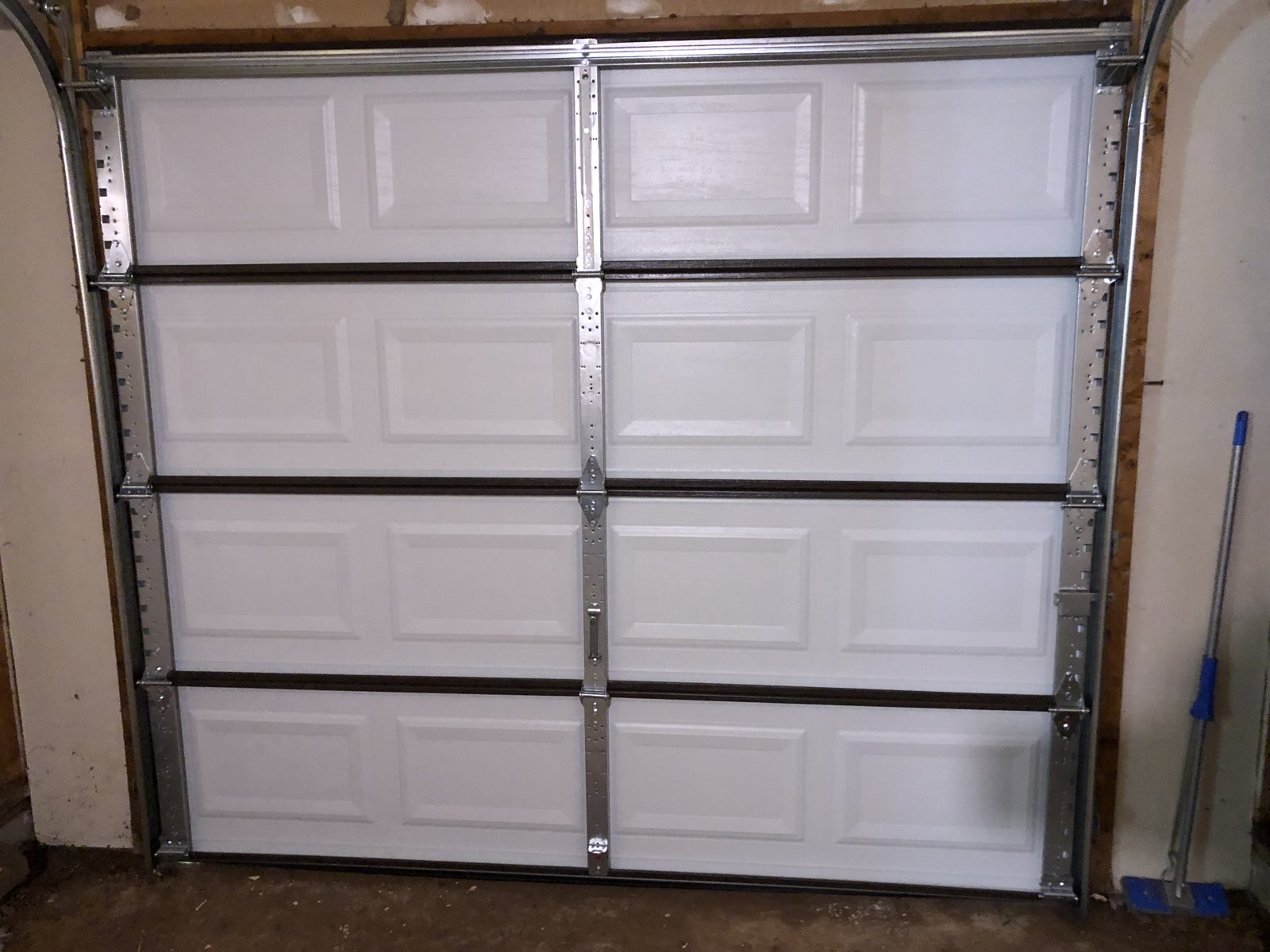
Photo: Famartin, Wikimedia Commons, CC BY-SA 4.0.
The checklist at a glance
Each line links to the steps below.
| When | Task | Who |
|---|---|---|
| Monthly | Look over the springs, cables, rollers, pulleys and hinges | You (look only) |
| Monthly | Run the door and listen | You |
| Monthly | Auto-reverse test with a 2x4 | You |
| Monthly | Photo-eye test | You |
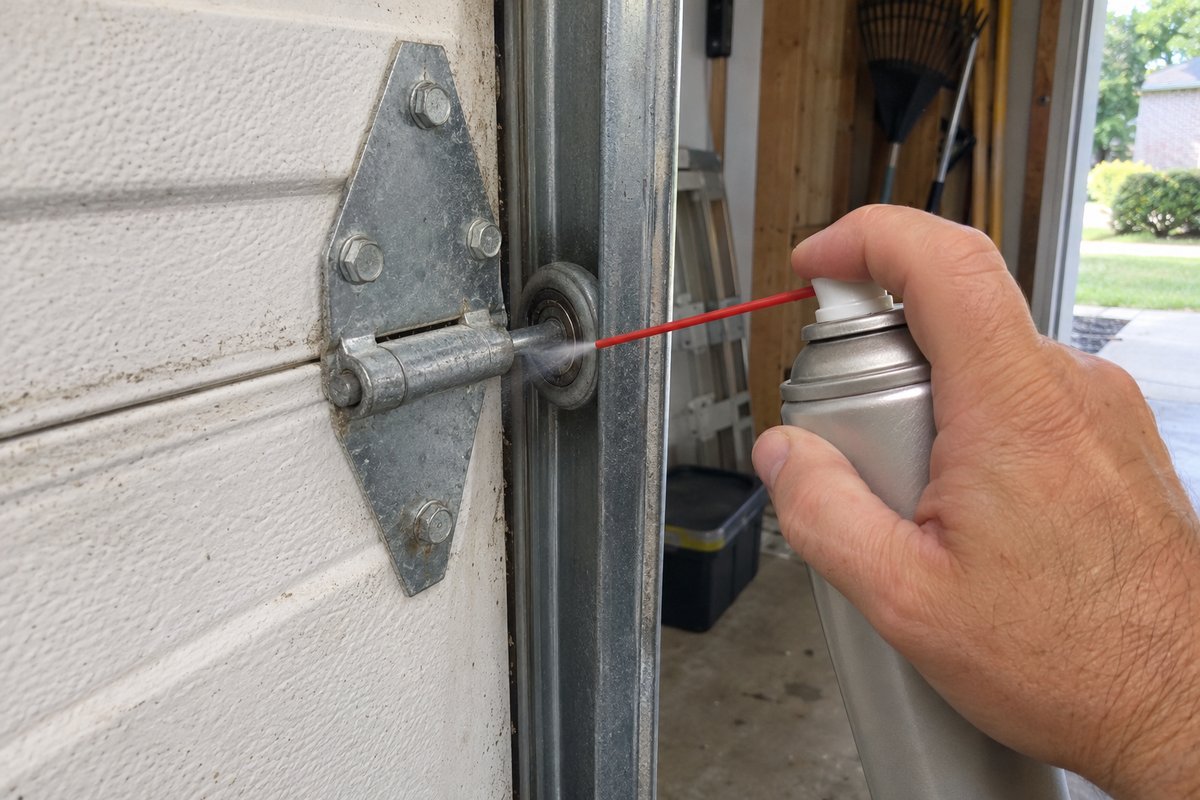
| Every season | Lubricate hinges, steel rollers and bearings | You |
| Every season | Clean the tracks (no grease) | You |
| Every season | Check the weatherstripping | You |
| Every season | Check the rollers | You; replacement by a tech |
| Every season | Remote, keypad and backup batteries | You |
| Yearly | Balance test | You; adjustment by a tech |
| Yearly | Tighten loose hardware, except the bottom brackets | You |
| Yearly | Professional inspection and tune-up | Technician |
| Never | Springs, cables, bottom brackets, red-painted fasteners | Technician only |
Before you start: three safety rules
- Keep the door closed when you pull the release. Chamberlain, the maker of LiftMaster openers, says never to disconnect the door from the opener while it's open. If a spring is weak or broken, an open door can drop.
- Unplug the opener before you work on the door. Genie says so in its maintenance guide, and it stops a remote or a family member from starting the door while your hand is in a hinge. Tell everyone in the house you're working on it.
- Inspect, don't adjust, anything that holds spring tension. Chamberlain's maintenance guide puts it plainly: never loosen, move or adjust garage door springs, cables, pulleys, brackets or related hardware.
Monthly: four checks
The U.S. Consumer Product Safety Commission (CPSC) asks homeowners to inspect the garage door and opener every 30 days. DASMA, the door and opener makers' trade group, gives the same monthly list on its consumer site. Wayne Dalton's manuals agree, and add a professional inspection once a year.
1. Look the door over
With the door closed, stand inside the garage and look at:
- Springs. On most Georgia homes it's a torsion spring, the tightly wound spring on the bar above the door that carries its weight. Look for a gap in the coils. Older doors use extension springs that stretch along each upper track.
- Lift cables. The steel cables at the bottom corners of the door. DASMA says to pay close attention to wear and fraying.
- Rollers, pulleys and hinges. Cracked or wobbling rollers, hinges that are cracked or pulling away from the door.
- Tracks. Chamberlain's monthly list says to check that the tracks are clear of debris and not bent.
- The door itself. Wayne Dalton's manual adds cracks in the sections and a door that has shifted sideways in the opening.
If anything looks frayed, broken, bent or loose, don't run the door. See what never to touch and call a technician.
2. Run the door and listen
Open and close the door with the opener and watch it the whole way. Chamberlain's guide says to look for sticking, jerking or uneven movement. A door that grinds, shudders, or stops partway is telling you something before it fails. If the opener runs but the door doesn't move, our guide to an opener making noise but not opening walks through the causes.
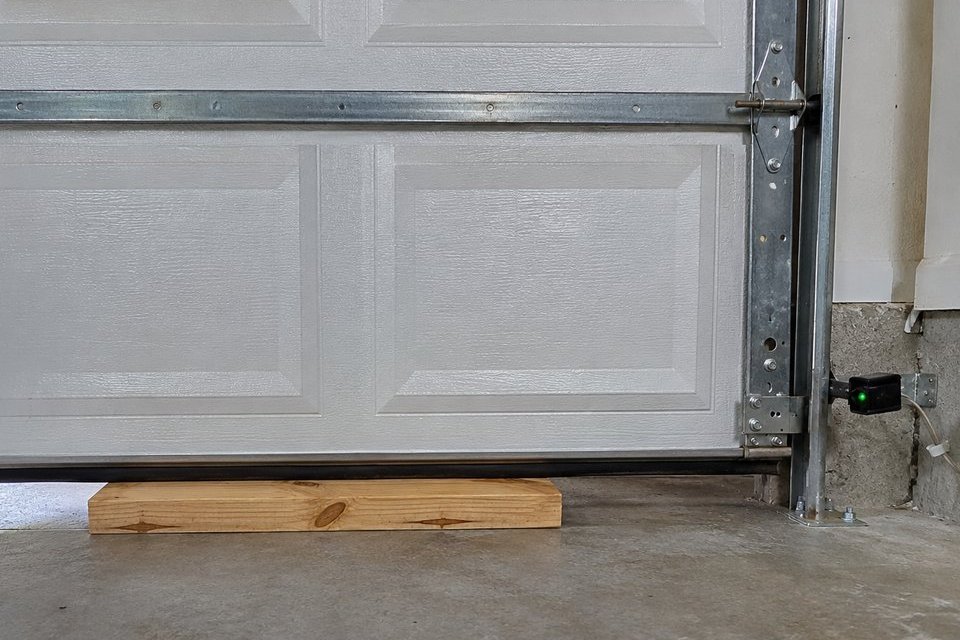
3. Test the auto-reverse with a 2x4
Federal rules have required automatic reversing on residential openers since the early 1990s, and the CPSC says to test it.
- Open the door all the way.
- Lay a 2x4 flat on the floor in the middle of the door's path. Chamberlain specifies a 1½-inch-high object, which is a 2x4 laid flat.
- Close the door with the remote or wall button.
- The door should reverse when it touches the board. Genie gives a 2-second limit for that reverse.
If it doesn't reverse, the CPSC says to disconnect the opener until it is adjusted according to the owner's manual, repaired or replaced. Use the door by hand in the meantime, or call us.
4. Test the photo-eyes
The photo-eyes (safety sensors) are the two small units near the floor on each side of the door. One sends an invisible beam and the other receives it. The CPSC has required this kind of extra protection, an electric eye or a door edge sensor, on openers since 1993, and says the eyes belong 4 to 6 inches above the floor.
- Start closing the door.
- Pass a long object, such as a broom handle, through the beam.
- The door should stop and reverse.
Genie suggests testing at three different points along the beam. If the door doesn't reverse, DASMA's steps are to clean the lenses, gently realign the eyes by hand, and test again. Genie says to watch the LED on the sensors to confirm they're aligned. If it still fails, it needs service. Our guide to garage door sensor problems covers blinking lights and misalignment in detail.
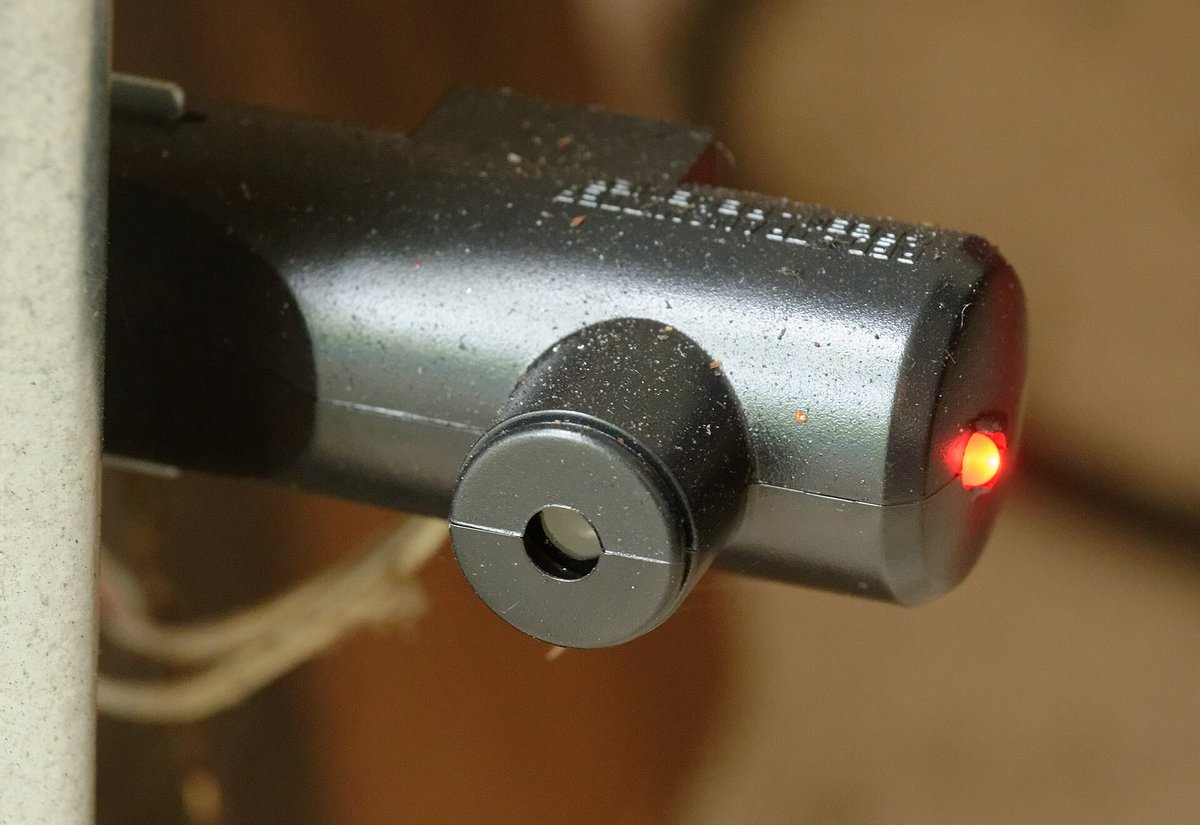
Photo: Jud McCranie, Wikimedia Commons, CC BY-SA 4.0.
Every season: lubrication, tracks, seals and rollers
DASMA suggests lubricating twice a year; Chamberlain and Clopay list it as a yearly job. In Georgia, where pollen and dust stick to anything oily, we suggest a look every season and lubrication in spring and fall.
Lubricate the right parts with the right product
| Part | Lubricate? | What the manufacturer says |
|---|---|---|
| Hinges | Yes | Chamberlain: rollers, bearings and hinges, a small amount, wipe off the excess |
| Steel rollers and their bearings | Yes | Same Chamberlain list. Wayne Dalton names hinges, steel rollers and bearings |
| Torsion spring coils | A light coat | Clopay lists springs with hinges and rollers. Genie: lightly, never so much it drips |
| Nylon rollers | No | Wayne Dalton and Clopay both say not to lubricate nylon rollers. Genie: only the roller stem |
| Plastic hinges | No | Genie: lubricant can break down the plastic |
| Tracks | No | Chamberlain and Wayne Dalton both say not to lubricate the tracks |
| Lock cylinder | Graphite only | Wayne Dalton: don't oil a cylinder lock; use graphite dust if it's stiff |
| Opener rail | Only if your manual says so | Chamberlain: every 2–3 years or as your manual recommends, a thin layer of white lithium grease where the trolley rides |
| Belt-drive opener | No | Genie: don't lubricate a belt drive |
| Screw-drive opener rod | Yes, about once a year | Genie: its own screw-drive lubricant, a pea-sized amount, then run the opener to spread it |
Which product? Use a lubricant made for garage doors, or the one your door's manual names. The makers don't agree on a single product: Genie suggests a lightweight silicone-based grease, Wayne Dalton's manuals call for a non-silicone lubricant, and Clopay sells its own. Your door's manual wins. Skip WD-40: it's a water-displacing penetrating oil, and Clopay says it softens plastic, nylon and rubber parts. Genie also warns it stops a screw-drive opener from working properly.
Wipe off the excess. A heavy coat holds grit, and in a Georgia spring it holds pollen.
Clean the tracks, don't grease them
Grease in the tracks makes the rollers slide instead of roll, and it collects dirt. Chamberlain and Wayne Dalton both say not to lubricate the tracks; Wayne Dalton says to clean them if the rollers don't turn freely. Genie's cleaning steps:
- Unplug the opener.
- Vacuum loose dirt and debris out of the tracks.
- Wipe the inside of the track with a rag and a cleaner such as brake cleaner, then wipe it dry.
- Look for bends, creases, rust and loose or missing bolts.
A bent or creased track is a technician job. If the rollers have come out of the track, stop using the door and read our guide to a garage door off track.
Check the weatherstripping
Close the door and look from inside for daylight along the floor and around the sides and top. Genie says to replace a seal that is cracked, dried out, brittle, worn, breaking off or no longer sealing under the door, and to buy a replacement that matches the one you have so it fits the retainer.
The bottom seal is the one that wears first. It takes the sun on the driveway in summer and, on freeze nights, can stick to the slab. Replacing it is a reasonable DIY job on most steel doors; our how-to for installing and removing garage door weatherstripping shows the steps, and we also replace weather seals if you'd rather not.
Check the rollers
Watch the rollers as the door moves. They should turn, not slide, and stay inside the track. Genie says to replace a roller that is cracked, chipped or worn, and notes rollers commonly need replacing every 5 to 7 years.
Most rollers come out by removing the hinge they sit in, one at a time. The bottom rollers are different. They sit in the bottom brackets, which hold the lift cables under spring tension, and Genie says to call a professional if the bottom roller brackets need to come off. We replace worn and broken rollers, including the bottom ones.
Yearly: balance, hardware and a professional look
Balance test
The springs, not the opener, lift the door. An unbalanced door wears out the springs and the opener's drive gear, and the CPSC warns that a severely unbalanced door can crash to the floor.
- Close the door and pull the red emergency release cord.
- Lift the door by hand to about halfway (Genie uses 3 to 4 feet).
- Let go. A balanced door stays put. DASMA says it should also lift smoothly with little resistance.
If it drifts down, shoots up, or is hard to lift, don't adjust anything. Genie says spring adjustment is too dangerous without training and to call your dealer. Lower the door, reconnect the opener and call a technician. Our guide to why a garage door feels heavy explains what's usually behind it.
Tighten loose hardware, but not the bottom brackets
A garage door moves thousands of times a year, and the vibration loosens screws. Wayne Dalton's manual and Clopay's maintenance guide both tell owners to tighten loose screws and bolts. Clopay adds a caution: don't overtighten, or you'll strip the threads.
What's safe to tighten: the hinge screws on each section, the track mounting brackets, and the opener's mounting brackets on the ceiling. Genie's checklist includes making sure the opener is securely mounted.
What isn't: the bottom brackets, the brackets at the two bottom corners of the door where the cables attach, and any fastener painted red. See the next section.
Professional tune-up
Wayne Dalton's manuals recommend a professional inspection once a year. A technician does the jobs on this list that you shouldn't: checking spring tension and cable wear up close, adjusting the balance, and setting the opener's force and travel.
Our garage door tune-up covers the springs and cables, hinge and track hardware, rollers, lubrication, the bottom seal, the balance, and the photo-eye and auto-reverse tests in one visit. If the door is used many times a day, our tune-up page suggests every six months.
What never to touch
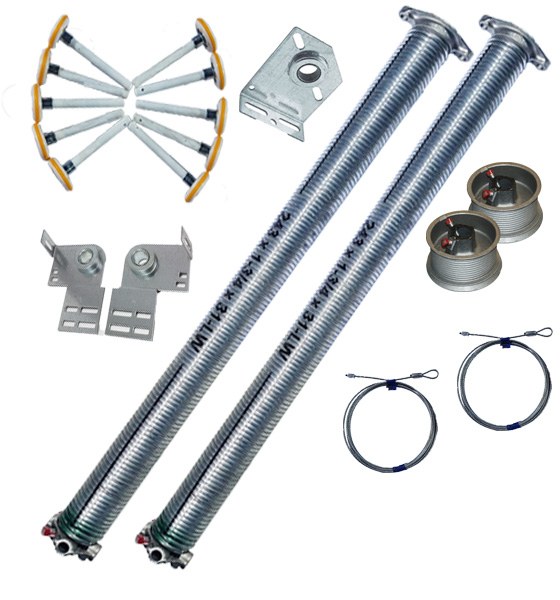
Photo: Blizzard6204, Wikimedia Commons, CC0.
Every door maker says the same thing in its manual: these parts hold enough stored energy to cause serious injury.
| Part | Why it's dangerous | What the manuals say |
|---|---|---|
| Torsion and extension springs | They're wound or stretched to carry the door's full weight | Genie: never try to adjust torsion springs. Chamberlain: never loosen, move or adjust springs |
| Lift cables and drums | They hold the spring tension and the door's weight | Chamberlain lists cables and pulleys with springs. Genie: inspect cables and drums, nothing more |
| Bottom brackets | The cables attach here, so the bracket is under full spring tension | Wayne Dalton: never remove, adjust or loosen the bolts or screws on the bottom brackets. Clopay: springs, cables and bottom brackets are under extreme spring tension; don't loosen any fasteners on them |
| Red-painted fasteners | Doors mark tension-holding fasteners in red | Clopay: don't loosen any red-colored fastener except as the manual directs |
| Spring adjustment to fix the balance | Winding a spring means working against full tension | Genie: too dangerous to do without training |
If a spring breaks, often with a loud bang, don't use the opener and don't lift the door. We replace torsion and extension springs, and new springs come with our written warranty: 3 years on torsion springs and 5 years on extension springs. If a cable is loose or the door hangs crooked, read what to do when your garage door cables are off track before anyone touches it.
Opener maintenance: batteries, force and travel
- Battery backup. Chamberlain says battery backup comes only on openers with DC motors, and the battery lasts about 1 to 2 years with normal use. Test it once a year: unplug the opener and run the door from the wall button or a remote. On LiftMaster and Chamberlain models an orange light means it's on battery, and a red light with a beep means the battery no longer holds a charge. Genie notes the door travels more slowly on battery power, so that part is normal.
- Remote and keypad batteries. Genie suggests replacing remote batteries as needed or at least every 2 to 3 years. Signs: shorter range, or a light on the remote that doesn't come on. An outdoor keypad wears through its battery faster.
- Force and travel settings. Don't turn the force up to push through a door that sticks. Sears PartsDirect's opener guide says force settings shouldn't make up for a sticking door; fix the door instead. LiftMaster's manuals note that weather can call for minor force and travel adjustments, and say to repeat the safety reverse test after any adjustment.
- Mounting and trolley. Genie's list: check that the opener is firmly mounted to its brackets and that the trolley on the rail isn't bent.
If the opener grinds or hums, see the opener noise guide. We're an authorized LiftMaster dealer; see opener repair and new openers.
Georgia climate notes
Summer heat. NOAA's climate normals for Atlanta show about 47 days a year at 90°F or hotter, and an average July high of 90°F. The bottom seal sits in full sun at the edge of the driveway all summer. After summer, look for the signs Genie lists for replacement: cracked, dried out or brittle rubber. The fall seal check catches it before the first freeze.
Sun in the photo-eyes. Sunlight shining straight into the receiving eye can block the beam. LiftMaster's support guide describes a door that opens but won't close, with the opener lights blinking. Its fixes: swap the sensors to opposite sides, so the receiver sits on the shadier side, or fit a sun-blocker kit. If your door only acts up at one time of day, this is the likely cause.
Pollen season. Atlanta Allergy & Asthma puts the peak of tree pollen season from about mid-March to mid-April, when pine pollen coats cars, streets and driveways. It also coats the photo-eye lenses and sticks to fresh lubricant. Do the spring lubrication after the pollen peak, and wipe the photo-eye lenses with a soft cloth when you wash the car.
Rain and humidity. Atlanta averages about 50 inches of rain a year (NOAA). Moisture is what rusts steel hardware, so keep the hinges and steel rollers lightly lubricated, and check that rain doesn't run under a worn bottom seal into the garage.
Freeze nights. NOAA's normals show about 36 nights a year at or below freezing in Atlanta. A wet bottom seal can freeze to the slab, and an opener pulling against it strains the springs and cables. Our Atlanta winter garage door guide covers freeing a frozen door safely and getting the opener ready for cold mornings.
A Georgia year at a glance
| Season | Focus |
|---|---|
| Spring (after the pollen peak, about mid-April) | Wipe pollen off the tracks and photo-eye lenses, lubricate, balance test, book the yearly tune-up |
| Summer | Check the bottom seal for heat damage, watch for sun in the photo-eyes, test the battery backup before storm season |
| Fall (October–November) | Replace worn weatherstripping, lubricate again, replace remote and keypad batteries before the cold |
| Winter | Keep the bottom seal clear of ice; if the door is frozen, release the opener first. Watch for a spring that breaks on a cold morning |
| Every month, all year | Visual check, run and listen, auto-reverse test, photo-eye test |
Signs it's time for service
Stop the DIY and call a technician if you see any of these:
- A loud bang from the garage, or a gap in the torsion spring.
- A frayed, loose or slack cable, or a door that hangs crooked.
- The door fails the balance test: it drifts down, shoots up or feels heavy.
- The door fails the auto-reverse or photo-eye test after you've cleaned and realigned the eyes.
- A roller has left the track, or a track is bent.
- Grinding, scraping or a door that jerks, even after lubrication.
- The opener strains, hums, or reverses for no reason.
If the door won't open or close at all, start with our garage door won't open guide, which covers power, Lock mode and the remotes.
DIY or call a technician?
| Safe to do yourself | Leave to a technician |
|---|---|
| Monthly visual check, auto-reverse and photo-eye tests | Broken, stretched or weak springs |
| Clean and realign the photo-eyes | Cables that are frayed, loose or off the drum |
| Lubricate hinges, steel rollers and bearings | Anything on the bottom brackets or red fasteners |
| Clean the tracks | Adjusting spring tension to fix the balance |
| Replace the bottom seal and stop molding | Bent tracks, or a door off its track |
| Replace upper rollers one at a time | Bottom rollers (they sit in the bottom brackets) |
| Tighten hinge and track screws | An opener that won't reverse, hums or grinds |
| Replace remote, keypad and backup batteries | Force and travel settings, if you're unsure |
When to call us
If the checklist turns up a problem, or you'd rather hand the yearly part to someone else, we can help. All Four Seasons has maintained and repaired garage doors across Metro Atlanta since 1999. We're rated 4.9 on Google with Over 4,000 Five-Star Reviews, and our office is open seven days a week, 7 AM to 8 PM.
Call (678) 271-8918 or book a visit online. You'll get a written price before any work starts. If the door is stuck open or a spring has broken, see emergency garage door repair.
Frequently asked questions
How often should a garage door be maintained?
Check it monthly: a look at the springs, cables and rollers, plus the auto-reverse and photo-eye tests, which the CPSC and DASMA recommend every month. Lubricate and clean the tracks every season or twice a year, and test the balance and have a professional inspection once a year.
What should I use to lubricate my garage door?
A lubricant made for garage doors, or the product your door's manual names. Genie suggests a lightweight silicone-based grease and Wayne Dalton calls for a non-silicone lubricant, so follow your manual. Put it on hinges, steel rollers, bearings and a light coat on torsion springs. Don't use WD-40.
Should I lubricate garage door tracks?
No. Chamberlain and Wayne Dalton both say not to lubricate the tracks. Grease makes the rollers slide instead of roll and collects dirt. Clean the tracks with a rag and a cleaner instead, and wipe them dry.
How do I test my garage door's auto-reverse?
Open the door, lay a 2x4 flat in the middle of the door's path, and close the door with the opener. It should reverse when it touches the board. Then pass a broom handle through the photo-eye beam while the door closes; it should reverse again. If either test fails, stop using the opener and have it serviced.
What garage door parts should I never touch?
The springs, the lift cables and drums, the bottom brackets where the cables attach, and any fastener painted red. Door makers say all of them are under high spring tension. You can look at them; adjusting or loosening them is a technician's job.
How do I know if my garage door is balanced?
Close the door, pull the release cord, and lift it by hand to about halfway. A balanced door lifts smoothly and stays put when you let go. If it drifts down, shoots up or is hard to lift, the springs need adjusting by a technician.
Is a professional garage door tune-up worth it?
Wayne Dalton recommends a professional inspection once a year, because the parts that wear out most, the springs and cables, are the ones homeowners shouldn't adjust. A tune-up checks them, sets the balance and the opener's force, and catches worn rollers and seals before they fail.