To open a garage door by hand, close it fully, check that the springs are whole, pull the red emergency release cord straight down, and lift the door from the bottom. If a spring is broken, the door is heavy or it hangs crooked, don't lift it. Call a technician.
This guide covers what to check before you pull the cord, how to open the door from inside and from outside, how to lift it without getting hurt, how to reconnect the opener on LiftMaster, Chamberlain and Genie models, and what to do in a power outage.
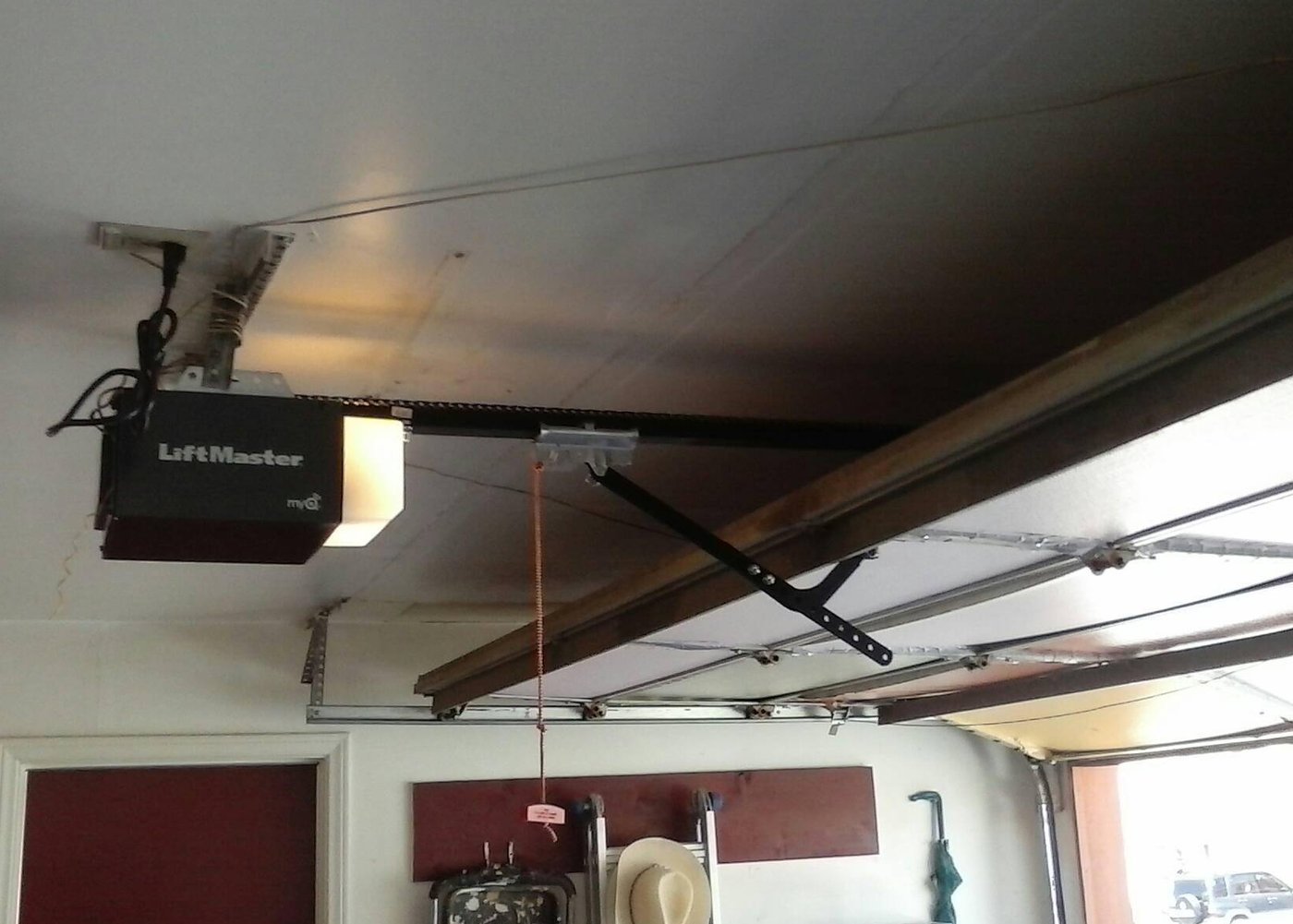
Before you pull the cord: three checks
The red cord disconnects the door from the opener. Once you pull it, nothing but the springs and your hands holds the door. So check three things first.
1. Is the door fully closed? Chamberlain, the maker of LiftMaster openers, says to use the emergency release only with the door fully closed if possible. A closed door is resting on the floor, so it can't drop when it's released.
2. Are the springs whole? The springs, not the opener, carry the weight of a garage door. Look, but don't touch:
- Torsion spring: a tightly wound coil on a metal bar above the door. A broken one has a gap of an inch or two in the coil, where it snapped and unwound.
- Extension springs: long springs along the ceiling tracks on each side. A broken one is stretched out, hanging loose, or missing.
Chamberlain says not to proceed if you see damaged springs, cables or rollers, and warns that with weak or broken springs an open door can fall "rapidly and without warning." Genie gives the same first step: check that the springs are intact before you release the door.
3. Is the doorway clear? No people, pets, cars or bikes under the door. Chamberlain says never to use the release unless the doorway is clear.
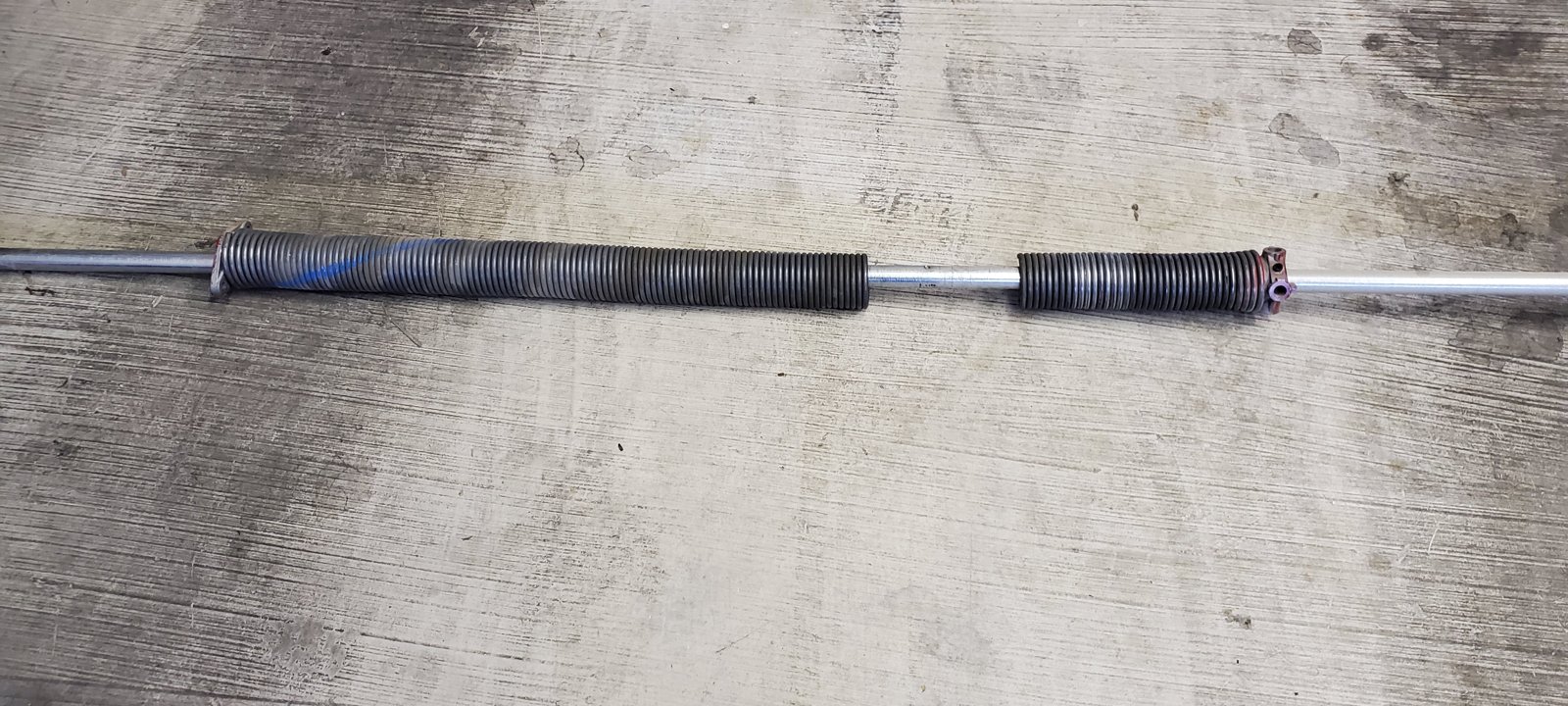
Photo: Garagedoorrepairlasvegas, Wikimedia Commons, CC BY-SA 4.0.
If you heard a loud bang from the garage, it was most likely a spring breaking. Stop here and read what to do if your car is stuck inside.
Can you open it by hand? Match your situation
| What's going on | Open it by hand? | What to do |
|---|---|---|
| Power is out, door closed, springs look whole | Yes | Follow the steps below |
| Opener is dead or the remote won't work, springs whole | Yes | Open by hand, then see the won't open guide |
| You heard a bang, or a spring has a gap | No | The door is carrying its full weight. Call |
| A cable is hanging loose, or the door hangs crooked | No | See cables off track and call |
| The door is open and the power went out | Only if the springs are whole, and with care | Release it, then lower it by hand (below) |
| You're outside and the garage has no other door | Only with an outside release kit | See "Opening it from outside" |
| The door lifts a few inches and feels like a deadlift | No | Lower it gently and call |
How to open the door from inside, step by step
- Unplug the opener if the power is on. If you're opening the door because the opener has failed, unplug it first. Genie warns that if power comes back while you're working, the carriage can move.
- Close the door all the way if you can, and check the springs as above.
- Unlock the door. If the door has a manual slide lock on the inside, slide the bar out of the track. Chamberlain's steps for wall-mount openers start with this.
-
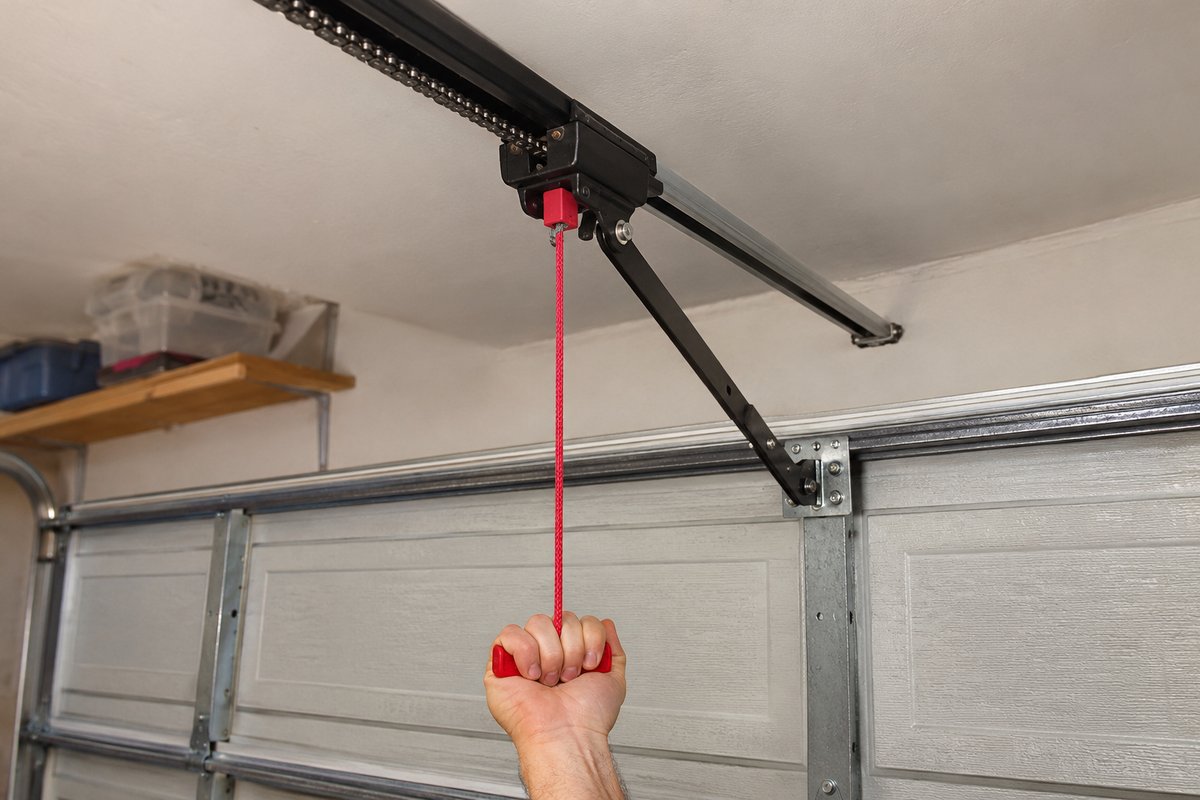
Pull the red cord straight down. Don't pull it toward the door or at an angle. On most chain and belt openers you'll feel the latch let go, and the trolley's release arm drops. On a LiftMaster or Chamberlain wall-mount opener (the motor sits beside the door on the end of the torsion bar), pull the handle down firmly until it clicks.
-
Lift the door from the bottom, using the lift handle or the bottom edge. Lift slowly and steadily with your legs, not your back, and keep your fingers off the seams between the panels.
- Lift it all the way up until it stops. A balanced door rides up with little effort and stays there.
- Drive out, then close the door the same way: grip the bottom, lower it slowly, and keep your feet clear.
Before you leave, Genie suggests making sure you have another way back into the house. With the opener disconnected, you'll need to open the door by hand again when you get back, and from outside that only works with a release kit.
How to lift a garage door safely
Most injuries with a manual door happen at the bottom edge and between the panels, where the sections fold as the door turns into the ceiling tracks. Chamberlain's instructions say to keep your hands and feet away from the door sections and hinges.
- Grip the lift handle or the bottom edge from the inside face of the door. Never put fingers between two sections, in the tracks, or on the rollers.
- Never use the red cord to pull the door up or down. Chamberlain says this in capitals. The cord is a release, not a handle.
- Lift with a steady pull, not a jerk, and don't let go of a moving door. Let it come to a stop first.
- Watch the door, not your feet. If it binds, shudders or tips to one side, lower it gently and stop.
- If it's too heavy, stop. A balanced door lifts easily for one person. Genie's advice is clear: if the door is too heavy to lift safely, or you'd need help to lift it, don't open it manually; call a professional. A door that takes two people to lift has a spring or cable problem, and a second pair of hands doesn't fix that. It only puts two people under it.
- Keep children away. They shouldn't operate the door or stand near it while it's moving.
Keeping the door open, and closing it again
A balanced door with good springs stays where you leave it, about halfway up or fully open. That's the test. If the door drifts down, won't stay open, or slams shut, the springs aren't doing their job. Chamberlain lists exactly these signs as a reason to stop and call a professional.
Don't prop it up. A ladder, a 2x4 or a trash can under the door can slip or tip, and the door comes down with it. If a door won't stay open on its own, close it and leave it closed until the springs are checked.
Locking it while the opener is disconnected. A connected opener is what normally holds a closed door shut. With the trolley released, the door can be lifted by hand. If you're leaving it disconnected for a while (during a long outage, for example), use the door's slide lock if it has one, and unlock it again before you run the opener. Chamberlain's T-rail openers also have a setting for this: pull the cord straight down, then back toward the opener, and the trolley stays released so you can run the door by hand as often as you need to.
Opening it from outside: emergency release key locks
If the garage door is the only way into the garage and the power is out, you can't reach the red cord. That's what an outside emergency release is for: a small round keyed lock in the top section of the door, connected by a cable to the release on the trolley inside.
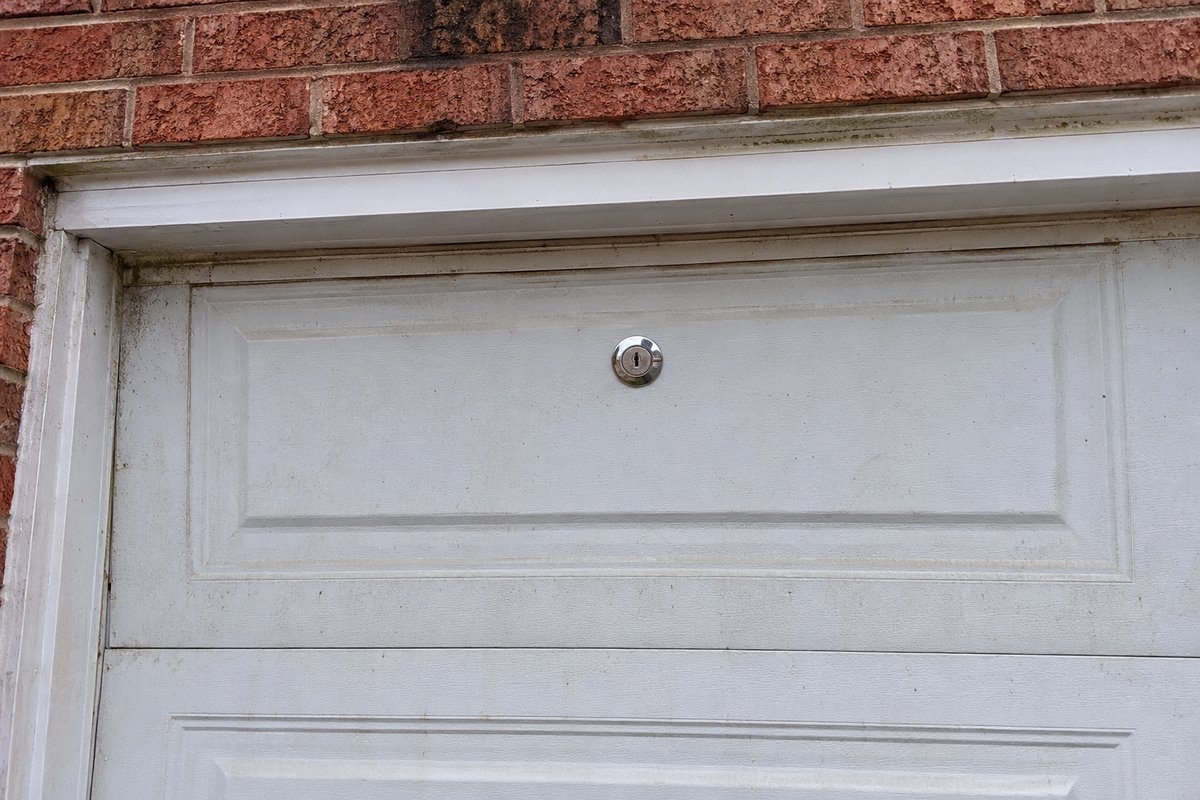
How it works: you turn the key, pull the lock cylinder out, and the cable behind it trips the release on the trolley. Then you lift the door by hand, with all the same checks and care as from inside. Chamberlain is clear about the limit: the outside release only disconnects the opener; it doesn't lift the door. And if the garage has no exterior release and no other way in, you can't open the door by hand from outside during an outage.
The kits:
- LiftMaster and Chamberlain: the Outside Trolley Release, part 1702LM or 7702CB. Chamberlain recommends it for garages with no access door, and notes that in many areas this kind of release is required for structures with no secondary access door.
- Genie: the Emergency Release Kit (GER-R). Genie says that if you don't have a service door into your garage, you should have it installed. Genie mounts the lock in the top section of a sectional door, directly beneath the opener's carriage release.
Have a technician fit it. Installing one means drilling through the top section of the door, routing a cable to the trolley, and setting the cable length so it trips the release without fouling the door. Genie's instructions note that the supplied cable can be too short on a modified door, and that tube-rail models need a change to the carriage release. Ask about one at your next tune-up if your garage has no side door.
After you use it: put the cable and cylinder back in the housing, turn the key to lock it, and take the key out. Then reconnect the opener (next section).
How to reconnect the opener (the trolley)
When the power is back or the repair is done, reconnect the door so the opener can run it again. Do it with the door closed. Directions vary by model, so check your manual if what you see doesn't match.
LiftMaster and Chamberlain
From Chamberlain's own instructions:
| Opener type | How you can tell | To reconnect |
|---|---|---|
| Square rail (chain or belt) | A square-section rail | Pull the cord toward the opener so the release arm goes back to horizontal. Run the opener through a full open and close cycle; the trolley reconnects on its own. If it doesn't, run one more cycle |
| T-rail (chain or belt) | A rail shaped like a T in cross-section | Pull the cord straight down, then run the opener. The door reconnects on the next up or down cycle |
| Wall-mount | Motor beside the door, on the end of the spring bar | Pull the handle straight down firmly until it clicks, then run the opener |
Chamberlain also notes that wall-mount openers tightly control how the spring bar turns. If moving the door by hand is hard or noisy, stop and call a trained technician.
Genie
Genie's guide gives two ways to re-engage the carriage: push the release lever back up (with a broom handle, or by hand from a ladder), or pull the red cord up toward the motor until it clicks. Then run the opener. On some models the carriage has to line up with the connector on the chain or belt, so the opener catches it on the next cycle. Genie screw-drive owner's manuals describe the same thing: the next normal run of the opener re-engages the release.
If the trolley won't catch
Run the opener once more with the door closed and watch the trolley. If it travels the rail and passes the door without latching, the spring-loaded catch in the trolley can be worn or broken. Don't force it. See cause 1 in our opener noise guide, which covers a trolley that won't reconnect. If the motor runs but the chain doesn't move, that's a different problem, also covered there.
After you reconnect, test the safety reverse. Lay a piece of wood flat on the floor under the door and close it. The door should reverse when it touches the wood. Then wave something through the safety sensor beam while the door closes; it should reverse again. If it doesn't, the sensors need attention: see garage door sensor problems.
Power outages: before, during and after
Before the next outage
- Know where your cord is and how your opener's release works, in daylight, before you need it.
- Think about battery backup. A battery backup runs the opener for a limited number of cycles with the power out, so you don't have to lift the door at all. Chamberlain notes that battery backup is available only on openers with DC motors, and that the battery lasts about 1 to 2 years with normal use. California has required backup batteries on residential openers sold or installed there since 2019, after people were trapped in garages during the 2017 wildfires. Georgia has no such rule, but the reason applies here too. Our guide to opener types explains which openers offer it.
- Test the battery once a year. On LiftMaster and Chamberlain belt-drive models, unplug the opener and run it. An orange light means it's running on battery; a red light with a beep means the battery no longer holds a charge.
- No side door into the garage? Ask about an outside release kit (above).
During the outage
Follow the steps for opening from inside. On a T-rail opener, use the lockout setting so the door stays released. Close and lock the door when you're done with it.
Georgia ice storms. Metro Atlanta doesn't see much winter weather, but when it comes it tends to arrive as ice. In the February 11–13, 2014 storm, the National Weather Service recorded 1/4 to over 1/2 inch of ice near Atlanta, and ice brings down power lines. Cold also thickens grease and stiffens seals, so a door that's hard to lift on a freezing morning is worth a second look. Our Atlanta winter garage door guide covers freeing a door that's frozen to the ground and getting the opener ready for cold weather.

Photo: Wikimedia Commons, public domain.
Generators and the garage: carbon monoxide
An open garage door doesn't make a garage a safe place to run a generator. The CDC is direct about it: never use a generator inside your home or garage, even if doors and windows are open. Run it outdoors, at least 20 feet from windows, doors and vents. The same applies to warming up the car. The CDC says never to run a car or truck inside a garage attached to a house, even with the garage door open.
Carbon monoxide has no color or smell. Put a CO alarm on every level of the home, and if one sounds, get everyone outside and call 911.
After the power comes back
- Close the door by hand if it's open, and reconnect the trolley (above).
- If the opener won't run, Genie suggests unplugging it, waiting up to 30 seconds, and plugging it back in. Still dead? Check the breaker and the outlet, then see the won't open guide.
- Run the safety reverse test. A power surge can damage an opener's electronics; Genie says to contact your opener supplier if you suspect surge damage.
How to open a garage door with a broken spring: should you?
This is the question most people search, and the honest answer is that you shouldn't try, for three reasons:
- You'd be lifting the door's full weight. The springs are what normally carry it. Without them, a two-car door is far more than one person should lift, and it won't stay up when you let go.
- It can fall. Both Chamberlain and Genie tell you to check the springs before releasing a door, and Chamberlain warns that a door with weak or broken springs can fall rapidly and without warning.
- The cables go slack. When a spring breaks, the lift cable on that side loses its tension. Lift the door and the cable can come off its drum or pulley, and a door that rises unevenly can jump its track. Then you have a spring repair, a cable repair and an off-track door.
Don't run the opener either. An opener lifting a door with a broken spring strains the motor and can strip the drive gear, and modern openers usually stop or reverse when they sense the extra weight anyway.
If your car is trapped, call us and say so. Spring replacement is a technician's job because of the stored tension, and new springs from us come with a written warranty: 3 years on torsion springs and 5 years on extension springs (see the warranty). Read more about garage door spring repair.
When the door won't lift: what it means
If you've released the door and it won't come up, or it's heavy, stop and lower it. The likely causes:
| What you notice | Likely cause | Next step |
|---|---|---|
| Very heavy, or slams down when you let go | A broken or weak spring | Call; see springs |
| One side rises faster, door tilts, a cable hangs loose | A cable off its drum or pulley, or a snapped cable | Stop; see cables off track |
| Door won't budge at all | The slide lock is engaged, or the door is frozen to the ground | Check the lock; in winter see the winter guide |
| Door moves but rollers scrape or pop out | Off track or a bent track | Stop and call |
| Door lifts, but harder than it used to | Springs losing tension | See why a garage door feels heavy |
What you can do yourself, and what to leave to a tech
| Job | DIY? |
|---|---|
| Pull the release and open a balanced door by hand | Yes |
| Reconnect the trolley | Yes |
| Test the battery backup and the safety reverse | Yes |
| Use the T-rail lockout during an outage | Yes |
| Install an outside release kit | Tech: drilling the door and setting the release cable |
| Replace or adjust a spring | No: stored tension |
| Rehang a cable or put a door back on track | No: the cables are under spring tension |
| Repair a trolley that won't latch, or a stripped gear | Tech, usually |
When to call us
Call us if a spring is broken, a cable is loose, the door hangs crooked, the door won't stay open, or your car is stuck inside. We have repaired garage doors and openers across Metro Atlanta since 1999, we're rated 4.9 on Google with Over 4,000 Five-Star Reviews, and our office is open seven days a week, 7 AM to 8 PM. We're an authorized LiftMaster dealer if you want an opener with battery backup.
Call (678) 271-8918 or book a visit online. You'll get a written price before we start. If the door is stuck open, or the car is trapped, see emergency garage door repair. For opener repair and new openers, see garage door openers.
Frequently asked questions
How do I open my garage door manually from inside?
Close the door fully if you can and check that the springs are whole. Unplug the opener, unlock the slide lock, and pull the red emergency release cord straight down. Then lift the door from the bottom with a steady pull, keeping your fingers away from the panel seams and tracks.
Can you open a garage door with a broken spring?
You shouldn't. Without the spring, you're lifting the door's full weight, it won't stay up, and Chamberlain warns it can fall without warning. Don't run the opener either. Leave the door closed and call a technician.
How do I open my garage door from outside without power?
Only with an outside emergency release: a keyed lock in the top section of the door, such as LiftMaster's 1702LM or Genie's Emergency Release Kit. Turn the key and pull the cylinder to release the opener, then lift the door by hand. Without one and with no side door, you can't open it by hand from outside.
How do I reconnect my garage door opener after pulling the release?
With the door closed: on a LiftMaster or Chamberlain square-rail opener, pull the cord toward the opener and run a full cycle. On a T-rail, pull the cord straight down and run the opener. On a Genie, push the lever up or pull the cord toward the motor until it clicks. The trolley latches on the next run.
Why won't my garage door stay open after I pull the release?
A balanced door stays where you leave it. If it drifts down or slams shut, the springs aren't carrying its weight, usually because one is broken or worn out. Close it, don't prop it, and have the springs checked.
Should I pull the emergency release with the door open?
Not if you can avoid it. Chamberlain says to use it only with the door fully closed if possible, because a door with weak or broken springs can fall when it's released. If you must, keep everyone out of the doorway and hold the door as it releases.
Is it safe to run a generator in the garage with the door open?
No. The CDC says never to use a generator inside a home or garage, even with doors and windows open. Run it outside, at least 20 feet from windows, doors and vents.