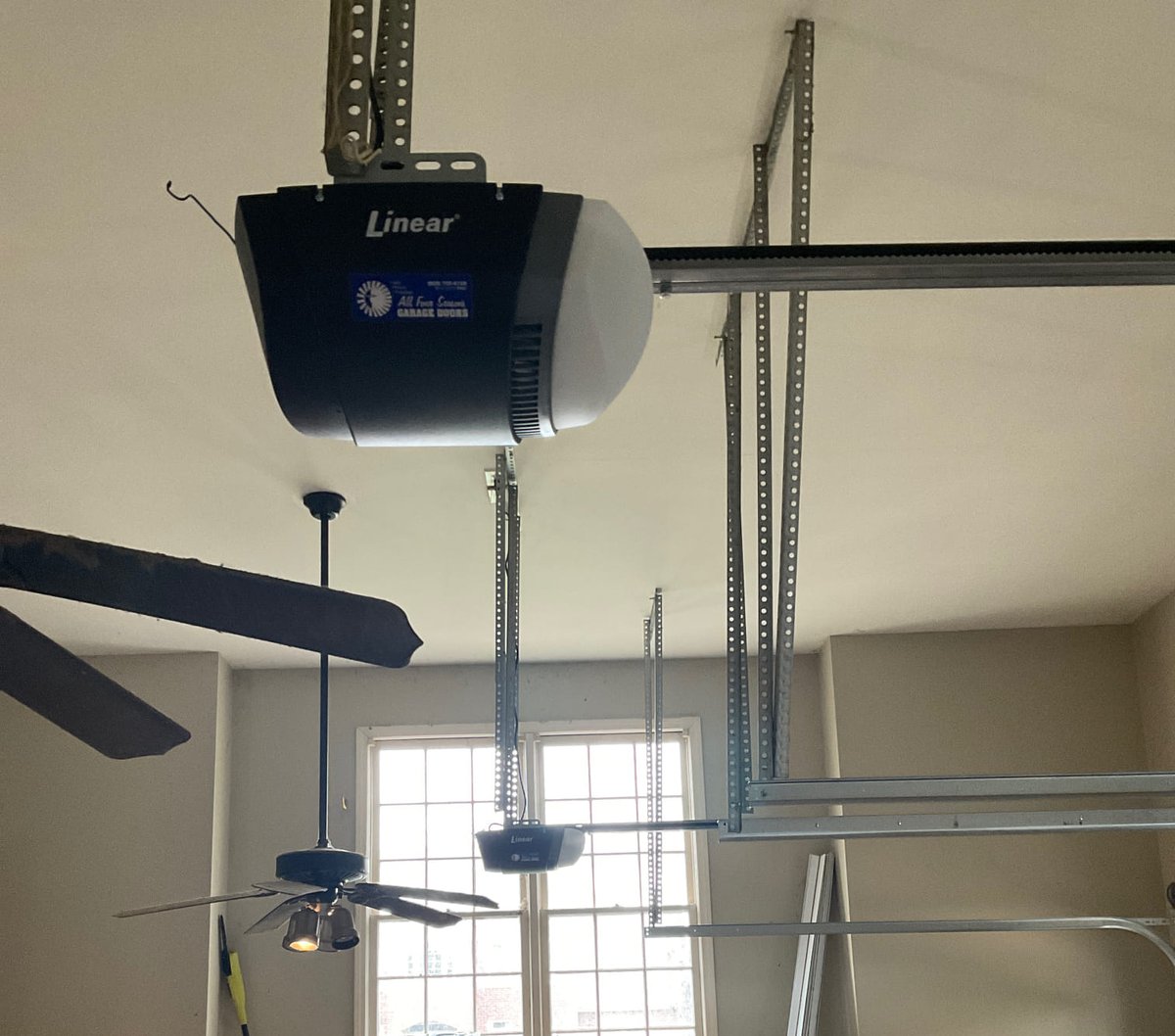
When the opener runs but the door stays put, the motor is working and something between the motor and the door has let go. Most of the time it is one of three things: the trolley is disconnected, the drive gear inside the opener has stripped, or the chain or belt has broken. A heavy door from a broken spring is the fourth, and it is the one to rule out first.
This guide walks you through each sound, a two-minute test that tells you which part has failed, and which fixes are safe to do yourself.
Before you touch anything
Three rules keep this a repair and not an injury:
- If you heard a loud bang earlier, or the door hangs crooked, stop here. A bang is usually a torsion spring breaking. A crooked door usually means a cable has come off its drum. Both hold enough tension to hurt someone, and running the opener against them burns out the gear you were trying to save. Read what to do when your garage door cables are off track and call a technician.
- Stop pressing the button. Every press against a stuck door strains the motor and chews the drive gear. Two or three tries tell you everything a tenth try will.
- Unplug the opener before you touch the rail, chain, belt or anything inside the cover. The wall button and the remotes can start it while your hand is on the chain.
What are you hearing? Match the sound to the cause
Stand under the opener while someone presses the wall button. Watch the chain or belt on the rail, and the trolley, the block that rides along the rail and connects to the door arm.
| What you hear and see | What it usually means | Safe to check yourself? |
|---|---|---|
| Motor runs, chain or belt moves, trolley rides along the rail, door doesn't move | The trolley is disconnected from the door. The red release cord was pulled, or bumped | Yes, see cause 1 |
| Motor runs, chain or belt does not move | A stripped drive gear or sprocket inside the opener | Check for the signs; the repair is usually for a tech |
| Motor runs, grinding or ratcheting sound | Worn gear teeth slipping, or a chain jumping the sprocket | Look only. Unplug before you touch it |
| Hum or buzz, nothing turns | The motor can't start: a failed start capacitor on older openers, a locked door, or a door too heavy to lift | Check the lock and the spring only |
| Chain moves, then slack chain slaps the rail | A broken chain or a chain off its sprocket | See chain came off the opener |
| Door rises a few inches, then stops or reverses | The opener is sensing too much weight: usually a broken spring or an unbalanced door | No |
| Screw-drive opener: rod turns, carriage doesn't move | A worn carriage or a broken coupler (common on Genie screw drives) | Check that the carriage is engaged; the part swap is for a tech |
| A single click from the motor, then nothing | The relay fires but the motor doesn't start: circuit board or capacitor | No. See clicking but not opening |
| Opener lights or arrows blink | The opener is reporting a fault code | Yes, read the code (below) |
If nothing happens at all, no motor and no light, this isn't your problem. Start with our garage door won't open guide, which covers power, Lock mode and remotes.
The two-minute test: is it the door or the opener?
Chamberlain, the maker of LiftMaster openers, gives this same test in its support guide for openers that won't travel. It splits every problem in this article into two groups: the door is the problem, or the opener is.
- Close the door all the way first. Never pull the release with the door open. If a spring is broken, an open door can drop.
- Unplug the opener.
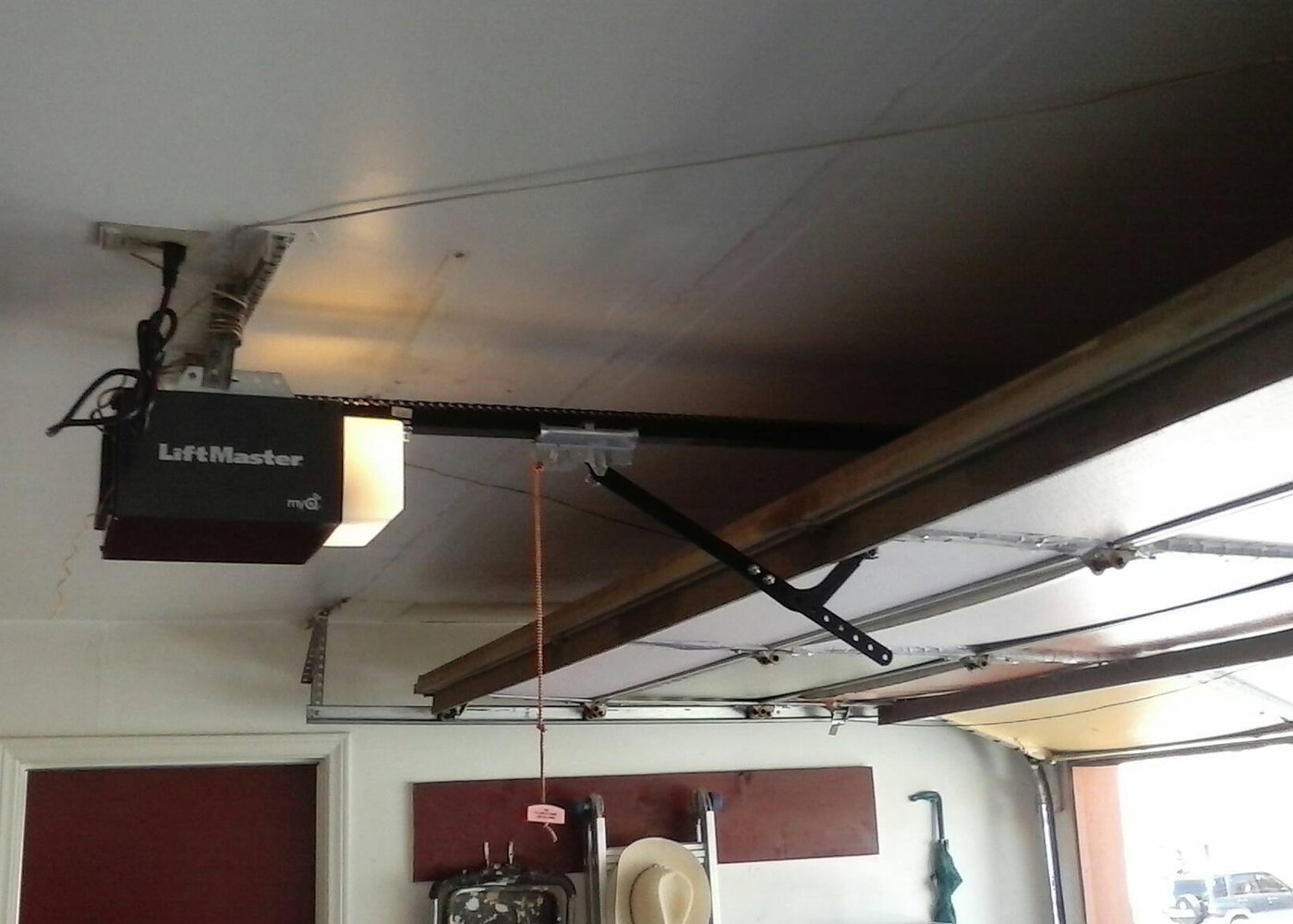
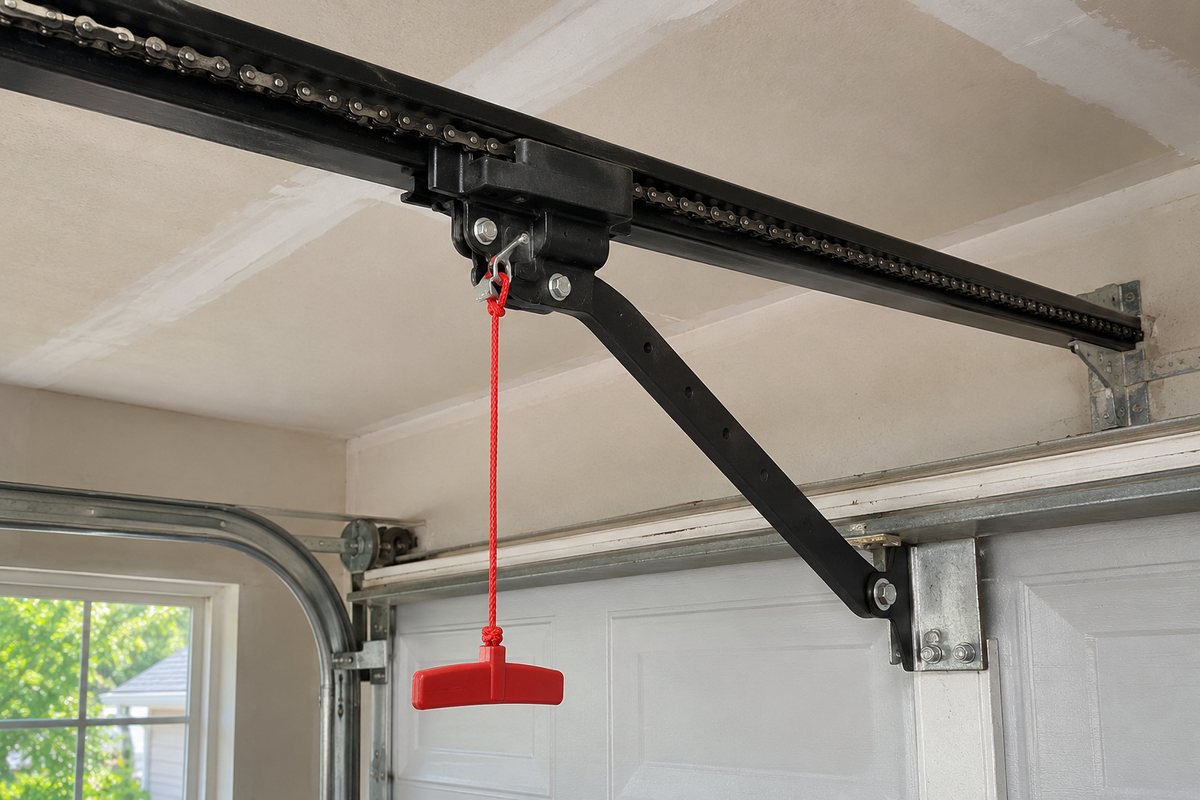
- Pull the red release cord straight down. The trolley lets go of the door.
- Lift the door by hand from the middle. A balanced door lifts with little effort and stays put when you let go about halfway up. If it feels very heavy, won't lift, or slams down, the door is the problem, most often the spring. Lower it gently and stop here.
- If the door moves freely, close it, plug the opener back in and press the button. With the door disconnected, watch the trolley.
- The trolley runs the full length of the rail: the opener is fine. Reconnect the door (cause 1).
- The motor runs but the chain or belt doesn't move: the gear or sprocket inside the opener has failed (cause 2).
- The chain or belt moves but the trolley doesn't: the trolley is broken or the chain has come off it.
The 7 causes, from easiest to hardest
1. The trolley is disconnected from the door
What you'll notice: the motor runs and the chain or belt moves, but the door doesn't. Sometimes the trolley slides to the end of the rail by itself.
Why it happens: someone pulled the red emergency release cord, or something stored on a shelf or the roof of a car caught it. After a power outage, people often pull it to open the door by hand and forget to reconnect it.
What to do: most chain and belt openers reconnect on their own. With the door closed, press the button and let the trolley run until it meets the door carriage and clicks back in. On some LiftMaster and Chamberlain models you pull the cord toward the opener, or back toward the door, to set the latch first. Genie's own troubleshooting guide gives the same fix in two words: re-engage the carriage. Your model's manual shows which way the handle goes.
If it won't latch: the spring-loaded catch in the trolley can wear or break. It's a part swap for a technician; don't force it.
2. The drive gear inside the opener has stripped
What you'll notice: the motor hums or runs at its normal pitch, the light comes on, but the chain or belt doesn't move at all. You often find white plastic dust or shavings on the floor or the car hood under the opener, and the sound of a motor spinning freely.
Why it happens: on most chain and belt openers from LiftMaster, Chamberlain and Sears Craftsman, the motor turns a steel worm gear that drives a white nylon gear. Nylon keeps the opener quiet, and it wears long before the steel parts around it. Every time the opener lifts a door that is heavier than it should be, or fights a door that is binding in its tracks, it wears the teeth on that gear. After enough of that, the teeth round off and the motor spins without moving anything.
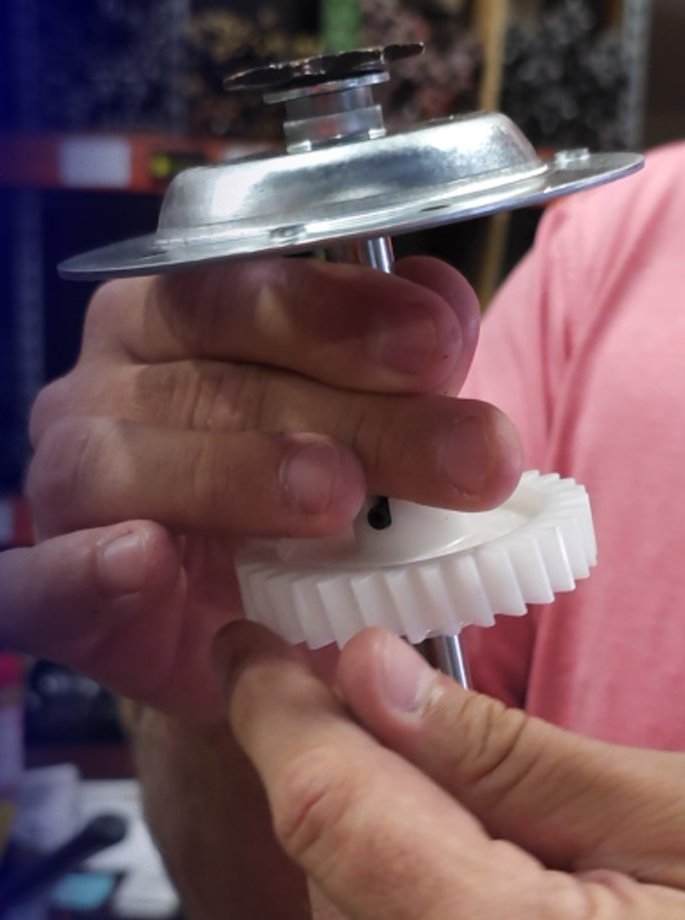
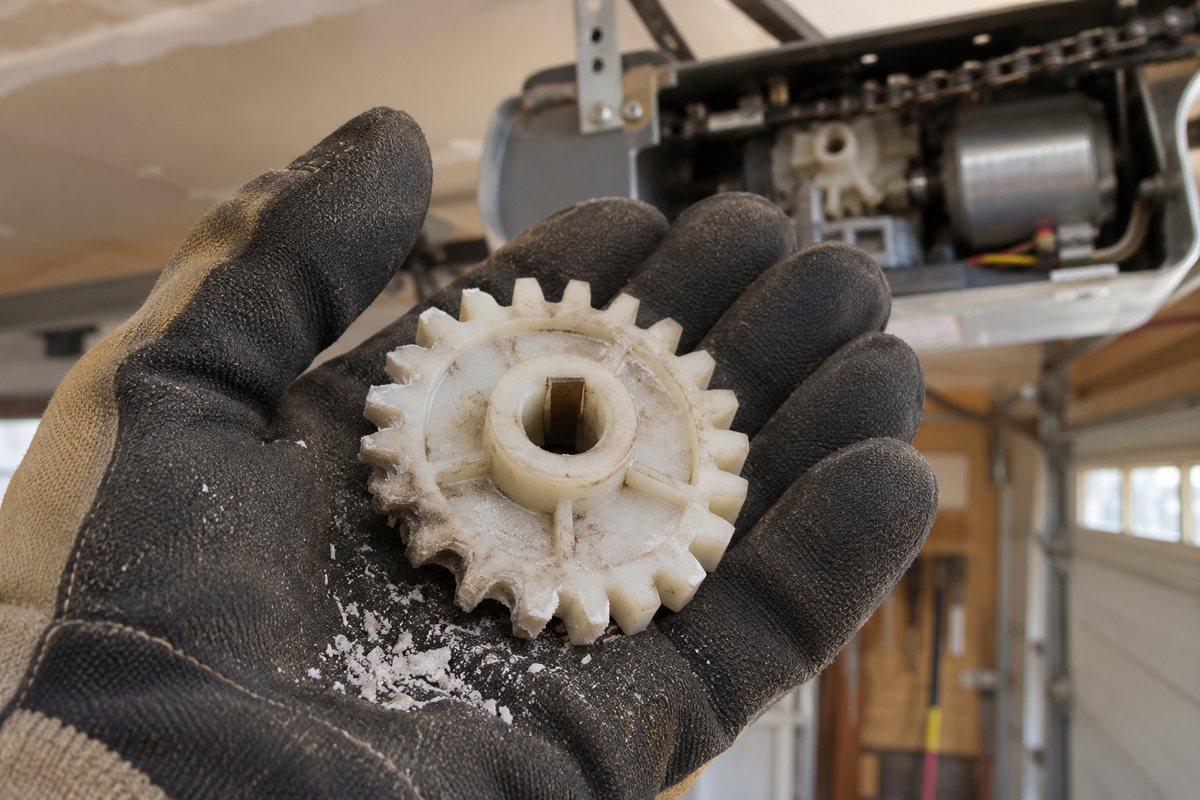
What to do: the gear and the sprocket are usually replaced together as a kit, and the job means taking the opener's cover off, removing the chain from the sprocket and pressing out a roll pin. Repair guides from parts suppliers show it as a DIY job, and handy homeowners do it. We still suggest a technician for two reasons:
- The new gear wears out the same way if the door that stripped the old one is still too heavy. The door has to be balanced first, and on most doors that means adjusting the springs, which isn't a DIY job.
- On an older opener, a gear kit is money spent on a unit that's near the end of its life anyway. See repair or replace below.
3. The chain or belt has broken or come off
What you'll notice: the motor runs and you hear a slapping or rattling. The chain hangs loose, lies on the rail, or has dropped to the floor. A belt is frayed or split.
Why it happens: a chain that's too loose jumps the sprocket. A door that's binding, or an opener running against a locked door, can snap a worn chain or strip a belt.
What to do: a chain that has only slipped off the sprocket can often be put back and tensioned. Our post on what to do when the chain came off the garage door opener walks through it. A broken chain, a damaged belt or a cracked sprocket needs the right replacement part for your model. Genie's guide lists the same set: broken chain, belt, sprocket or pulley.
4. Screw-drive openers: a worn carriage or broken coupler
What you'll notice: on a screw-drive opener (a long threaded rod instead of a chain), the motor runs and the rod turns, but the carriage doesn't travel. Or the motor runs and the rod doesn't turn at all. Grinding is common with both.
Why it happens: Genie's troubleshooting guide names the two parts: a worn carriage that no longer grips the screw, or a broken coupler between the motor and the screw.
What to do: first make sure the carriage is engaged, since a pulled release cord does the same thing on a screw drive. If it is engaged and the rod turns, the carriage needs replacing. If the motor runs and the rod doesn't turn, the coupler does. Both are model-specific parts.
5. The motor hums but nothing turns
What you'll notice: a steady hum or buzz from the opener, no movement at all, and sometimes the opener stops on its own after a short while.
Why it happens: there are three common reasons. On older AC-motor openers, the start capacitor, which gives the motor its first push, can fail; the motor gets power but can't start spinning. The door is locked, either by the manual slide lock on the inside of the door or a deadbolt-style lock on older doors. Or the door is too heavy, because a spring has broken.
What to do: check the slide lock and look up at the springs (see cause 6). If both are fine, stop pressing the button. A humming motor that can't turn overheats. Capacitor work means opening the motor housing, where the capacitor can hold a charge, so leave it to a technician.
6. The door is too heavy: a broken spring or an unbalanced door
What you'll notice: the door rises a few inches and stops, reverses, or doesn't move at all. The opener strains or hums. You heard a bang at some point, or you can see a gap in the torsion spring, the coiled spring on the bar above the door.
Why it happens: the springs, not the opener, carry the weight of a garage door, and a two-car door is far heavier than anyone should lift alone. When a spring breaks or loses tension, the opener feels that extra weight. Modern openers measure the force they're using and the speed of the motor, and they stop or reverse when either looks wrong. Chamberlain lists an out-of-balance door as the first thing to check when an opener won't travel.
What to do: don't use the opener and don't try to lift the door. Spring replacement is a technician job because of the stored tension. We cover both torsion and extension springs, and new springs come with our written warranty: 3 years on torsion springs and 5 years on extension springs (see the warranty).
7. The opener's electronics: RPM sensor, travel settings or logic board
What you'll notice: the opener starts, runs for a moment, then stops; or it runs but stops short of fully open; and the lights or arrows on the opener flash a pattern.
Why it happens: the opener counts motor turns with an RPM sensor to know where the door is. If that sensor is dirty, loose or failed, or if the force and travel settings are off, the opener thinks it has hit something and quits.
What to do: read the code first (next section). Force and travel adjustments are in your manual, and Chamberlain notes that sensor replacement is rare. If the sensor checks out, the next suspect is the logic board, which is a repair.
Is the opener blinking? Read the code
LiftMaster and Chamberlain openers report faults by flashing. Newer models with up and down arrows flash a two-part code; older models flash the LED next to the Learn button. These are the codes that match this article, from Chamberlain's diagnostic code chart:
| Code | Opener type | What it means |
|---|---|---|
| 5 flashes | Learn-button LED | No motor RPM detected in the first second of travel |
| 6 flashes | Learn-button LED | Motor circuit failure |
| 1-5 (arrows) | Up and down arrows | The opener didn't sense the motor turning after a command. Doesn't always mean the motor is dead |
| 4-1 (arrows) | Up and down arrows | Unexpected change in motor speed while closing, often a binding or heavy door |
| 1-1 (arrows) | Up and down arrows | A safety sensor is blocked, misaligned or unplugged |
To read the arrows, count the up flashes, then the down flashes: one up and one down is code 1-1. Chamberlain keeps the full chart for every model. Genie Excelerator models have their own self-diagnostic codes in the manual.
Brand notes: LiftMaster, Chamberlain, Craftsman and Genie
- LiftMaster, Chamberlain and older Sears Craftsman openers come from the same manufacturer, and many models share the same drive gear kit. The release handle, the trolley and the gear failure work the same way across all three. We are an authorized LiftMaster dealer.
- Genie makes chain, belt and screw-drive openers. On chain and belt models, check the carriage, then the chain or belt, sprocket and pulley. On screw drives, check the carriage, then the coupler.
- Other brands, such as Linear and Skylink, use their own parts. The two-minute test above still tells you whether the door or the opener is the problem.
Repair or replace the opener?
A stripped gear or a loose trolley is a reasonable repair on an opener in good shape (we go through every case in how to decide whether to repair or replace the opener). Replacement starts to make more sense when:
- The opener is old and noisy all round, not only at the gear. Parts for discontinued models get harder to find.
- It lacks today's safety features. Federal safety rules have required automatic reversing on residential openers since the early 1990s, and the U.S. Consumer Product Safety Commission recommends testing the reverse every month. An opener that doesn't reverse should be replaced, whatever else is wrong with it.
- It doesn't support rolling codes or the phone control you want. A newer opener adds rolling-code security, battery backup on many models, and app control such as LiftMaster myQ.
- The repair list is long: gear, plus capacitor, plus board on the same unit.
Either way, you get a written price before any work starts. Read more about opener repair and new openers, or about LiftMaster opener repair in Atlanta.
How to keep it from happening again
Most stripped gears start with a door that's working too hard. Three habits help:
- Test the balance a few times a year. With the door closed and the opener disconnected, lift it halfway by hand. It should stay put. If it drifts down or shoots up, the springs need adjusting.
- Test the auto-reverse every month, as the CPSC recommends. Lay a piece of wood flat under the door and close it. It should reverse when it touches the wood. Then wave something through the safety sensor beam while it closes; it should reverse again.
- Watch and listen. A new grinding noise, white dust under the opener, or a door that hesitates at the start are early warnings. Catching them is cheaper than a motor that runs and does nothing.
A yearly tune-up covers the balance check, the springs, cables, rollers and the opener settings in one visit.
When to call us
Call us if the two-minute test points to the door, if the gear has stripped, if the motor hums and won't turn, or if you'd rather not take the cover off an opener. We have repaired garage doors and openers across Metro Atlanta since 1999, we're rated 4.9 on Google with Over 4,000 Five-Star Reviews, and our office is open seven days a week, 7 AM to 8 PM.
Call (678) 271-8918 or book a visit online. You'll get a written price before we start. If the door is stuck open and won't close, see emergency garage door repair.
Frequently asked questions
Why does my garage door opener run but the door doesn't open?
The motor works, but something between the motor and the door has let go. If the chain or belt moves, the trolley is usually disconnected; reconnect it. If the chain doesn't move, the drive gear inside the opener has usually stripped. If the door rises a little and stops, a spring is usually broken.
What is the white powder under my garage door opener?
It's ground-off plastic from the nylon drive gear. Some dust over years is normal wear; a fresh pile, or shavings with a motor that runs and a chain that doesn't, means the gear has stripped.
Can I replace a stripped garage door opener gear myself?
Some homeowners do: the gear and sprocket come as a kit, and the job means removing the cover, the chain and a roll pin. The catch is that the gear usually stripped because the door is too heavy. Unless the door is balanced first, the new gear wears out the same way, and balancing the door means adjusting springs, which is a technician's job.
Why does my garage door opener hum but not open?
A hum with no movement means the motor is getting power but can't turn. On older openers it's often the start capacitor. It can also be a locked door or a broken spring making the door too heavy. Check the slide lock and the springs, then stop pressing the button so the motor doesn't overheat.
Why does the chain move but the door won't open?
The trolley is disconnected from the door, usually because the red emergency release cord was pulled. With the door closed, run the opener until the trolley reconnects, or set the latch by hand as your manual shows.
How do I know if it's the spring or the opener?
Close the door, unplug the opener and pull the release cord, then lift the door by hand. If it's heavy or won't stay halfway up, it's the springs. If it lifts easily, the problem is in the opener.
Is it worth repairing an old garage door opener?
A gear or trolley repair is worth it on an opener that otherwise runs well and reverses properly. If the opener doesn't reverse, is missing parts that are no longer made, or needs several repairs at once, a new opener is usually the better spend. We'll give you both prices in writing.