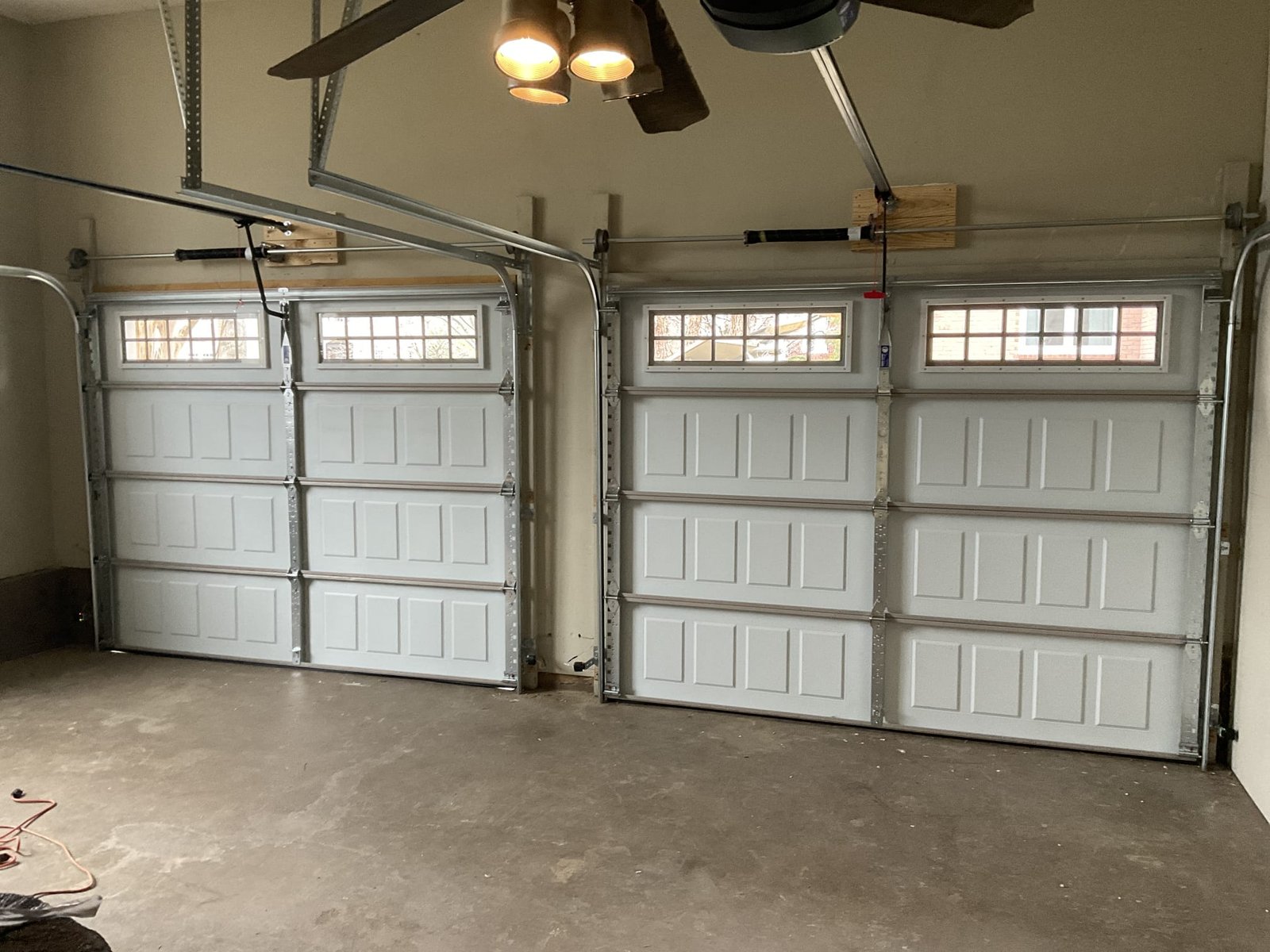
A garage door is the largest moving object in most homes, and it can hurt people in four ways: it closes on someone, it falls, a spring or cable lets go, or it pinches fingers. Two monthly tests, a wall button out of children's reach and leaving springs and cables to a technician prevent most of it.
This guide sets out what the federal safety data actually says, why the age of your opener matters, the two tests every household can run, and the parts nobody but a trained technician should touch.
How many people are hurt by garage doors?
There is no single, current federal count of every garage door injury that we can point you to. What the official sources do show is clear enough to act on:
| What the data shows | Source |
|---|---|
| About 73 children aged 2 to 14 were trapped and killed under automatic garage doors from March 1982 onward, about three deaths a year on average. Other children suffered brain damage or serious injuries when a closing door hit them and didn't reverse | U.S. Consumer Product Safety Commission (CPSC), Pub. 523, revised April 2011 |
| Fatal entrapments fell from 63 in the ten years before the federal entrapment rules to 20 in the ten years after, a 68% drop | UL Standards & Engagement, Pilot Impact Assessment of UL 325, June 2023, using CPSC incident and death certificate data |
| In the CPSC emergency-room sample (NEISS) the same study reviewed, about 4% of garage door injuries involved someone trapped under the door | UL Standards & Engagement, June 2023 |
| Openers made or imported for sale in the U.S. after January 1, 1991 must reverse; a second, external protection (photo eye or door edge sensor) was required from 1993 | CPSC Pub. 523; 16 CFR Part 1211 |
Two things follow from those numbers. First, the federal rules worked: openers that reverse and photo eyes that stop a closing door cut deaths sharply. Second, entrapment is only a small share of garage door injuries. Most garage door injuries happen some other way, which is why this guide also covers falling doors, springs and cables, and pinch points.
About the "30,000 injuries a year" figure. Our old version of this page used it, and it appears on many garage door websites. We couldn't trace it to a current CPSC publication, so we've dropped it. The CPSC's National Electronic Injury Surveillance System (NEISS) is where national estimates come from; when we quote an injury estimate, it will name the NEISS year it comes from.
Are garage doors dangerous?
A garage door that's working properly and tested monthly is a safe appliance. One that isn't can be dangerous, because of how much it weighs and how much energy its springs store. Clopay's installation manual notes that large doors can weigh as much as 500 pounds without spring tension, and single-car doors as much as 200. DASMA, the door manufacturers' association, calls the springs "arguably the most important and most dangerous part" of a door.
These are the main hazards, where they come from, and what prevents them:
| Hazard | How people get hurt | What prevents it |
|---|---|---|
| Entrapment | A closing door hits someone and doesn't reverse | An opener with working auto-reverse and photo eyes; monthly tests; door kept in sight until it's closed |
| A falling door | A door with a broken spring or cable drops, for example when someone pulls the emergency release with the door open | Release only with the door closed; stop using a door with a broken spring or cable |
| Springs and cables | Someone tries to adjust, loosen or replace a spring, cable or bottom bracket under tension | Leave them to a trained technician |
| Pinch points | Fingers between door sections, at the hinges or at the track as the door moves | Lift handles, hands off the section joints, children taught to keep clear |
| Remote and wall-button misuse | A child runs the door, or someone "races" under a closing door | Wall button mounted high, remotes kept away from children, nobody crosses a moving door |
| A door off its track | A door binds or hangs crooked and can come down unevenly | Stop using it and call; see garage door off track |
Why the age of your opener matters
The biggest single step in garage door safety happened in the early 1990s. UL 325, the safety standard for door operators, added a "dual entrapment protection" requirement in its December 31, 1991 revision, and the CPSC wrote it into federal law (16 CFR Part 1211), effective January 1, 1993. Since then, every residential opener sold in the U.S. has needed:
- An inherent reversing system. The opener senses resistance and reverses when the closing door hits something.
- An external protection device. In homes that's almost always a pair of photo eyes near the floor, sometimes a sensing strip on the door's bottom edge.
UL Standards & Engagement also notes that the standard now requires visible and audible warnings before a door closes when it's operated out of sight, for example from a phone app.
What to check: look at the bottom of the door tracks. If there are no photo eyes, the opener almost certainly predates 1993. The CPSC's advice is plain: replace openers that don't automatically reverse with ones that meet the federal standard. Our guide on whether to repair or replace a garage door opener covers the choice, and we're an authorized LiftMaster dealer if a new opener is the answer.
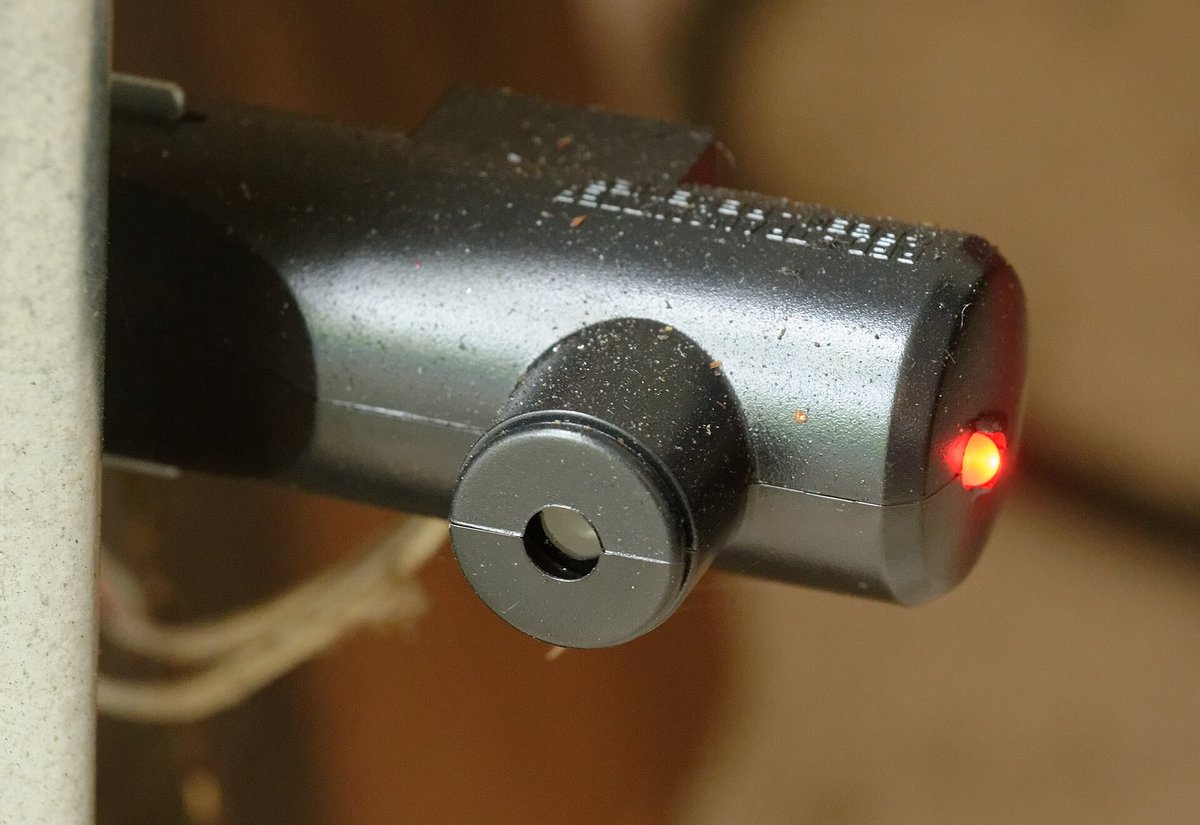
Photo: Jud McCranie, CC BY-SA 4.0, via Wikimedia Commons.
The two monthly tests every household should run
The CPSC recommends inspecting the door and opener every 30 days. LiftMaster's owner's manuals say the safety reversal system must be tested every month, and again after any adjustment or repair to the door or opener. Both tests are short and need nothing more than a 2x4 and a cardboard box.
Test 1: the auto-reverse test
- Open the door. Lay a 2x4 flat on the floor in the middle of the doorway. LiftMaster's manual specifies an object 1-1/2 inches high, which is a 2x4 laid flat.
- Close the door with the wall button or a remote.
- The door should reverse when it touches the board.
If it doesn't reverse, the CPSC says to disengage the opener until it's adjusted according to the owner's manual, repaired or replaced. Use the door by hand (with the door closed when you release it) until it's fixed, or call us. LiftMaster's manual also notes that the gap between the bottom of the door and the floor mustn't be more than 1/4 inch, or the reversal system can fail. A sunken or cracked slab is worth mentioning when you book.
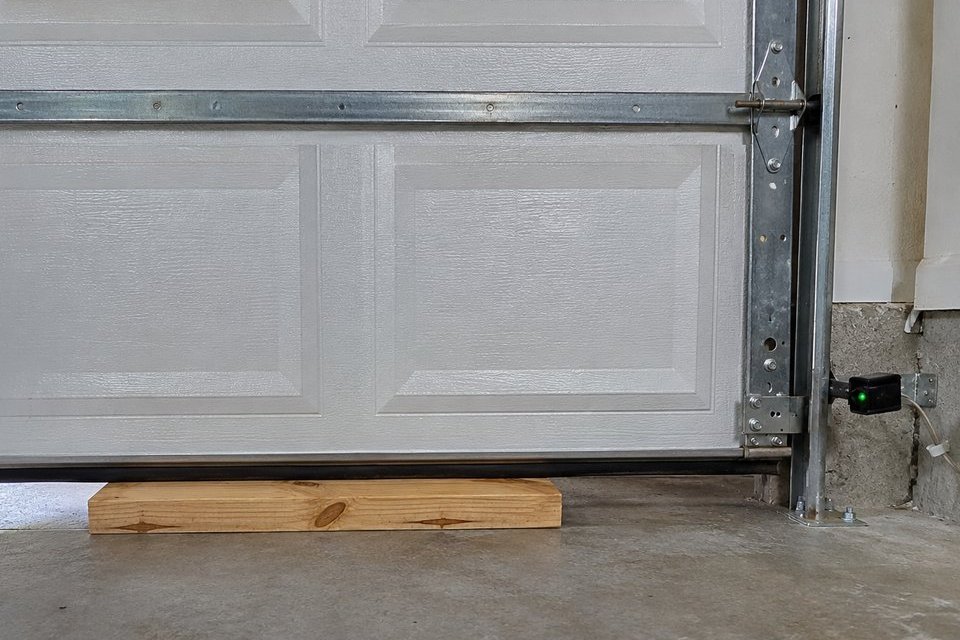
Test 2: the photo-eye test
- Open the door.
- Place an object in the doorway, in line with the two photo eyes. LiftMaster's manual uses the opener's carton.
- Press the button to close. The door shouldn't close; on LiftMaster openers it won't move more than about an inch, and the opener lights flash.
If the door closes anyway, or won't close at all with nothing in the way, the sensors need attention. The CPSC says photo eyes should sit 4 to 6 inches above the floor, and LiftMaster's manual says no higher than 6 inches. Sensors mounted higher than that can miss a small child lying or crawling under the door. Our garage door sensor problems guide covers alignment, wiring and sun glare.
While you're there: look, don't touch
From the floor, look at the springs above the door, both lift cables and the bottom corner brackets. A gap in a torsion spring, frayed or rusty cables, or a door that hangs crooked means stop using the door. The CPSC adds that a properly working door is "balanced": it stays in place when stopped partly open. A door that won't stay put, or that binds or sticks, should be serviced by a professional.
Garage door child safety
Every manufacturer's manual and the CPSC give the same core rules for children:
- Mount the wall button high. LiftMaster's manuals call for the wall control to be installed within sight of the door, away from all moving parts, and at least 5 feet above the floor, landing or step. The CPSC says as high as practical. If yours is at light-switch height, have it moved.
- Keep remotes away from children. Not on a key ring a child plays with, not loose in a car seat pocket. LiftMaster's manuals say never to let children operate or play with door controls or remotes.
- Teach the "never race the door" rule. Nobody crosses the path of a moving door, and nobody walks under a door that has stopped partly open.
- Keep the door in sight until it's fully closed. Don't press the button and drive off or walk inside while the door is still coming down.
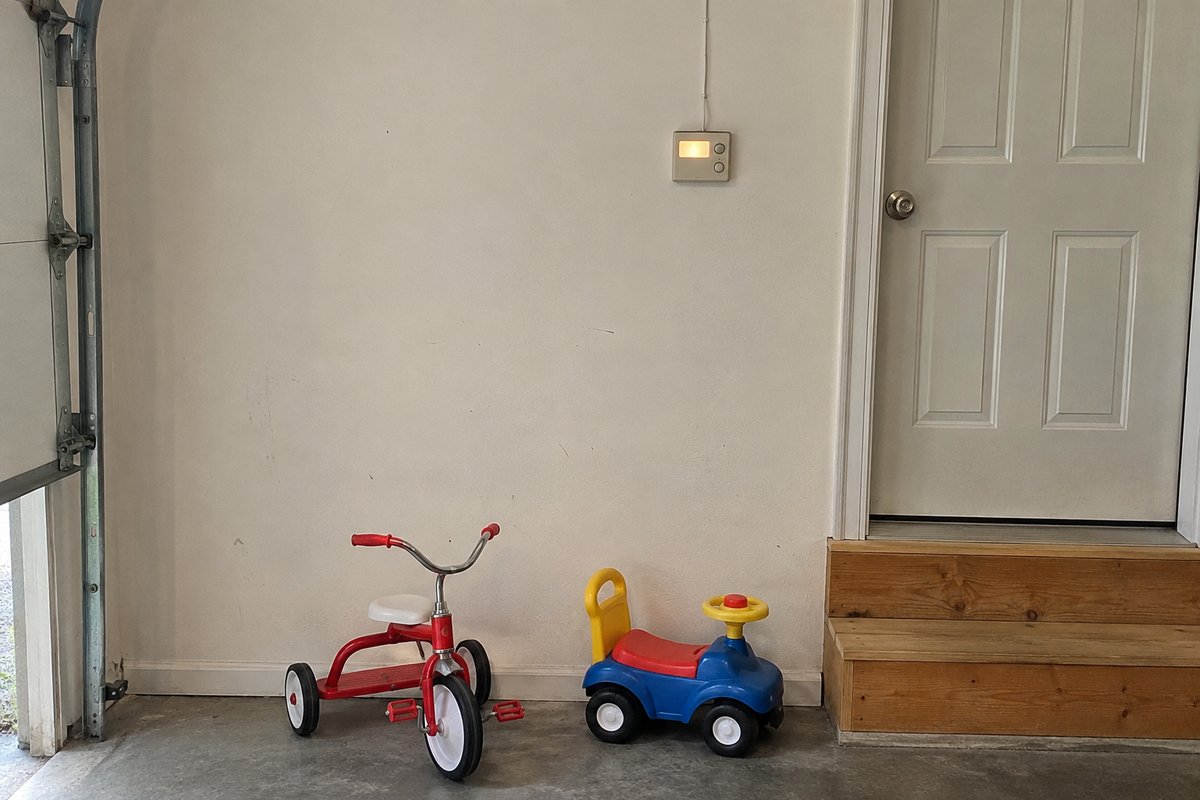
- Keep toys, bikes and bins out of the doorway. Anything left under the door can also hold it up on one side and leave a cable slack.
- Test monthly. Auto-reverse and photo-eye protection are what save a child who ignores the rules.
Is there a kid-friendly garage door opener? No opener makes the door safe to play with. What makes it safer for children is a working reverse system and photo eyes, a wall button they can't reach, remotes they can't get, and the household rules above. Many newer openers also let you check and close the door from a phone, which removes the temptation to leave a remote where children can reach it.
Springs and cables: the parts not to touch
The springs, not the opener, carry a garage door's weight. They're wound or stretched under high tension all the time, and that tension runs through the lift cables to the bottom brackets at the door's lower corners.
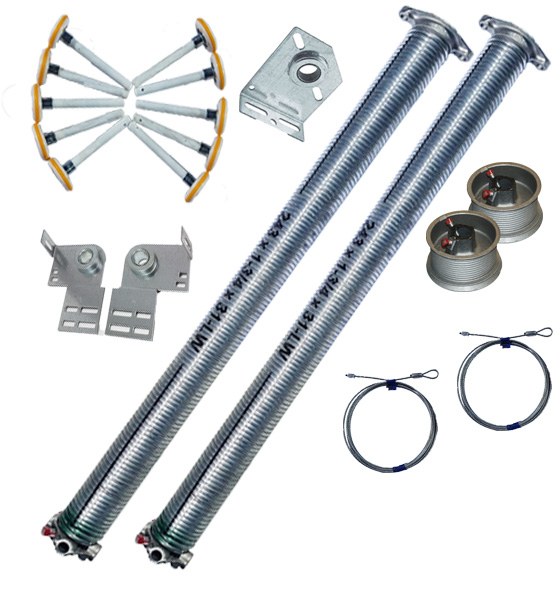
Photo: Blizzard6204, CC0, via Wikimedia Commons.
The manufacturers are unanimous:
- DASMA: frayed or worn cables are in danger of breaking, which can cause injury, and should be replaced only by a trained technician. Bottom brackets are under extreme spring tension and should be adjusted or loosened only by a trained door systems technician.
- Wayne Dalton: don't adjust, repair or alter springs, spring brackets, bottom corner brackets, fasteners or lift cables yourself.
- Clopay: don't loosen or remove the bottom bracket with spring tension engaged.
If a spring breaks, you'll usually hear a loud bang and find the door won't lift, or lifts only a few inches. Look up: a torsion spring will show a gap in its coil. Don't run the opener and don't try to lift the door. See garage door spring repair for what happens next.
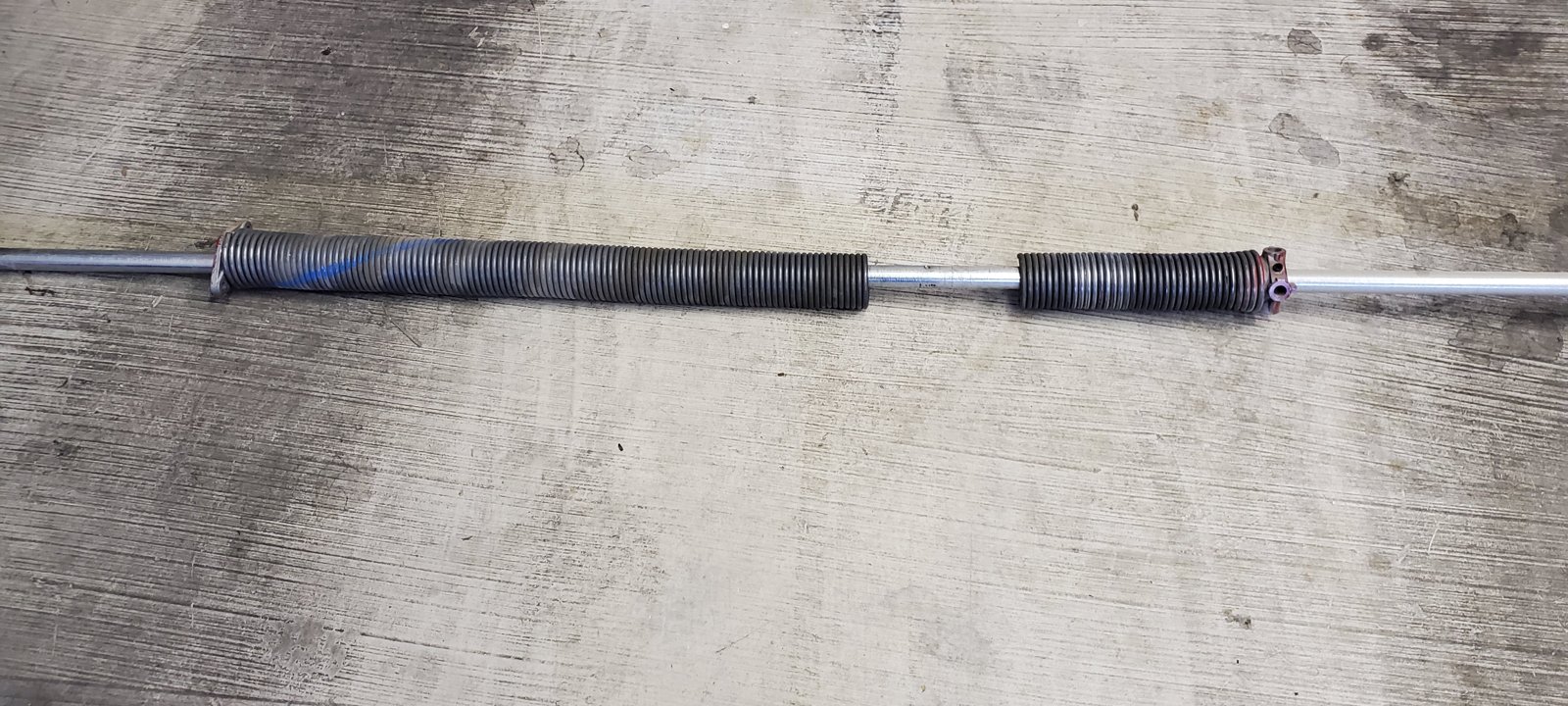
Photo: Garagedoorrepairlasvegas, CC BY-SA 4.0, via Wikimedia Commons.
If a cable is frayed, slack or snapped, stop using the door. Our guide to a broken or frayed garage door cable explains each sign.
Extension springs (long springs running along the ceiling above each track) should have a safety containment cable through them, to catch the spring if it breaks. DASMA says to call a dealer for a safety inspection if yours don't.
Pinch points: keeping hands safe
A sectional door folds at its joints as it rolls up, and those joints close like a hinge. DASMA's advice is short: never place your fingers between the door sections. When you have to move a door by hand, use the lift handles or the gripping points on the door, not the edges of the sections.
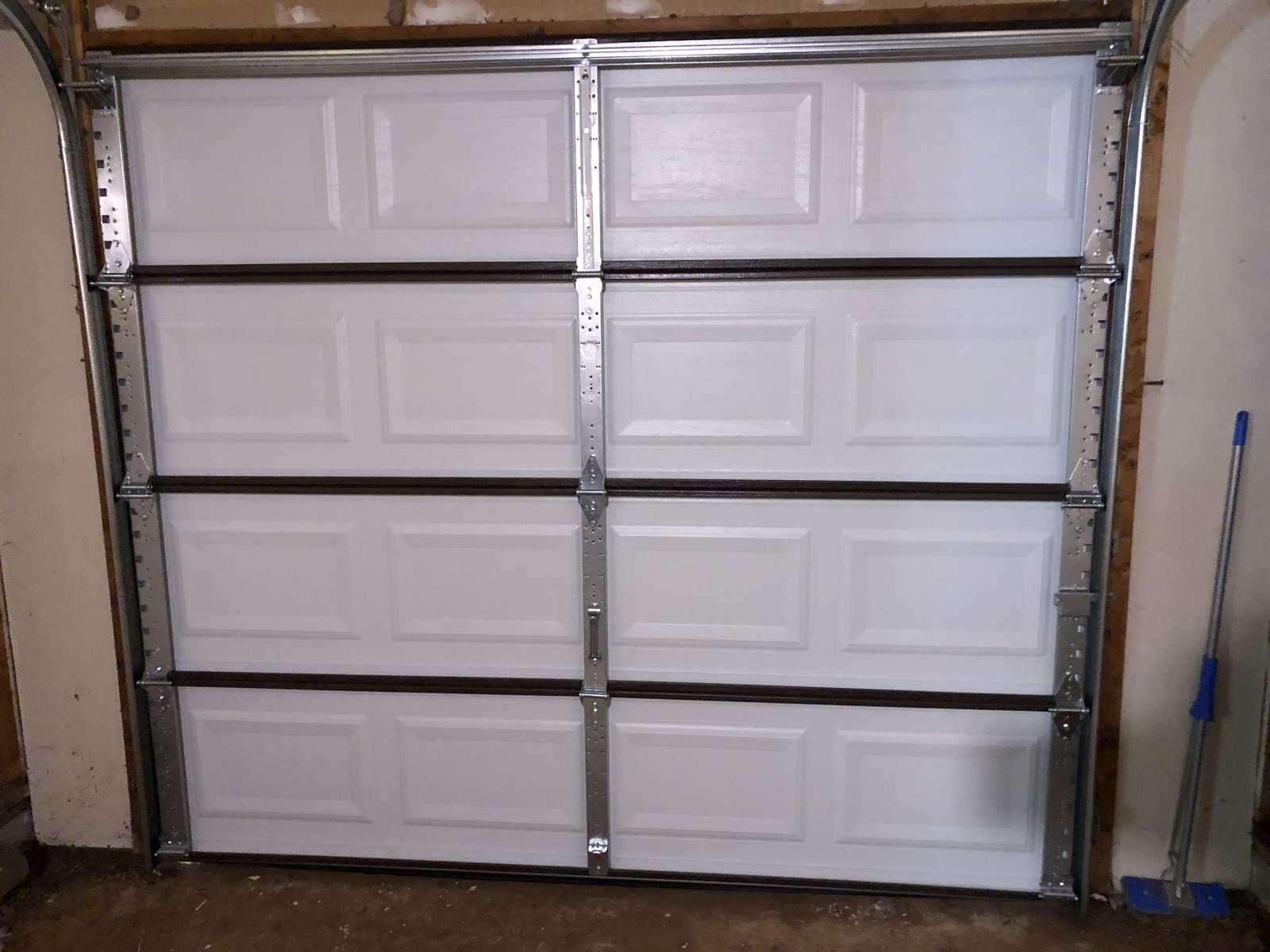
Photo: Famartin, CC BY-SA 4.0, via Wikimedia Commons.
Other pinch and crush points to keep hands away from: the rollers and the track, the cable at the bottom bracket, and the opener's chain or belt and sprocket. LiftMaster's manual warns to keep hands clear of the sprocket while the opener runs, and not to wear rings, watches or loose clothing while working near the opener.
Using the emergency release safely
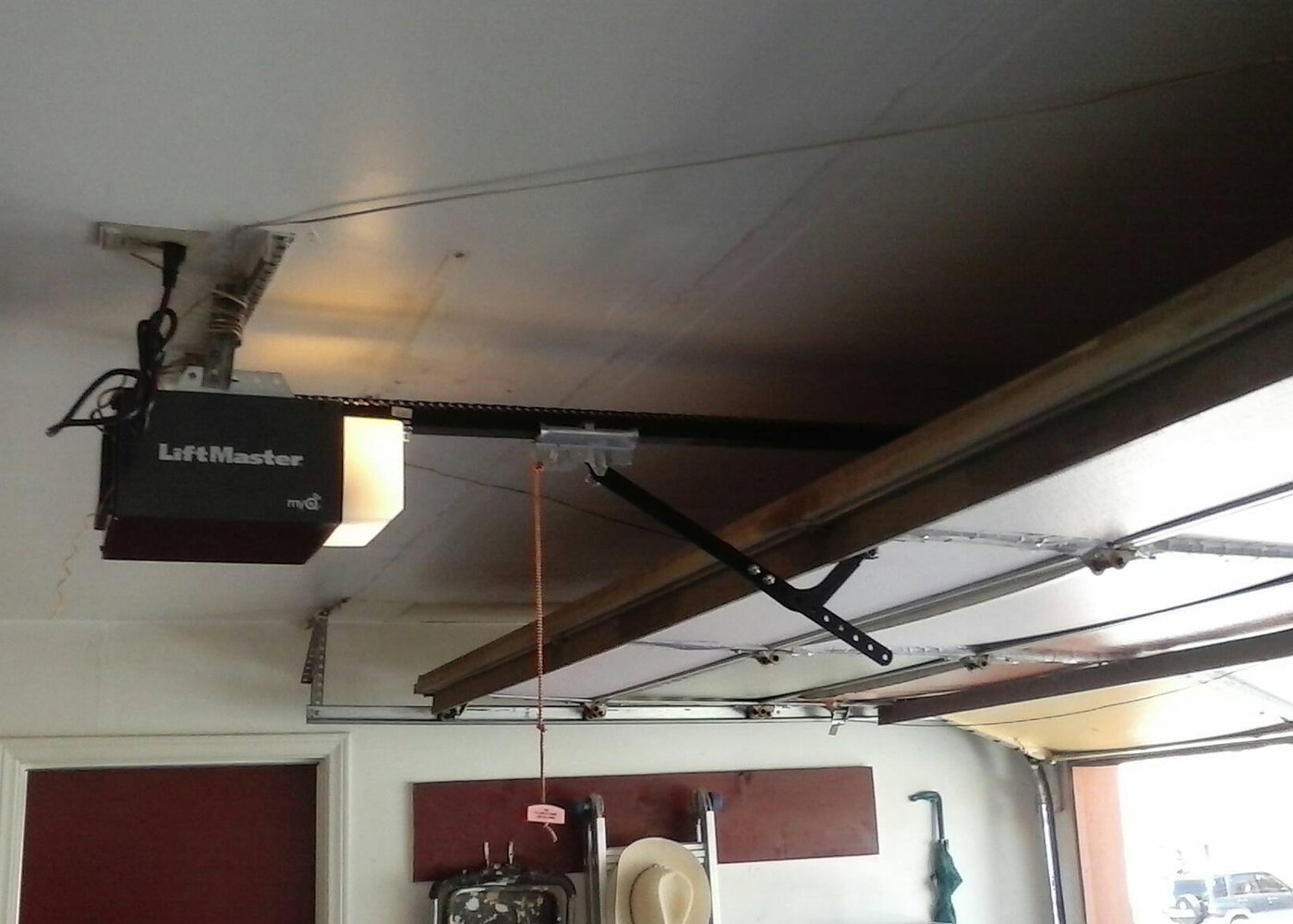
The red cord hanging from the opener disconnects the door from the opener so you can move it by hand, during a power cut for example. UL 325 requires one on the most common opener types. It's useful, but pulled at the wrong moment it can drop a door on someone.
LiftMaster's manuals set the rules:
- Pull it only with the door closed, if at all possible. Weak or broken springs or an unbalanced door can make an open door fall rapidly and unexpectedly.
- Only when the doorway is clear of people and objects.
- Never use the handle to pull the door open or closed.
If the door feels very heavy, won't stay open, or slams down when you lift it, stop: the springs aren't carrying the weight. Our step-by-step guide on how to open a garage door manually covers releasing and reconnecting the opener on different models.
Maintenance that keeps the door safe
DASMA recommends monthly safety checks plus an annual visit from a trained door systems technician. In practice:
| How often | What to do | Who |
|---|---|---|
| Every month | Auto-reverse test, photo-eye test, look at springs, cables and brackets from the floor, watch the door run for jerks, noise or a crooked travel | You |
| Twice a year | Lubricate hinges, steel rollers and bearings as your door's manual directs; clean the photo-eye lenses; check the wall button and remote batteries | You |
| Once a year | Full safety inspection and tune-up: spring tension and balance, cables, drums, bottom brackets, rollers, tracks, opener force and travel settings | A technician |
| As soon as you notice | A broken spring, frayed or snapped cable, door off track, or a door that fails either monthly test | A technician |
Our garage door maintenance checklist has the full list, season by season. Our garage door tune-up covers the annual items in one visit. A noisy door is often the first sign something has changed; see why a garage door makes noise.
What's safe to do yourself, and what isn't
| Task | DIY? | Why |
|---|---|---|
| Auto-reverse and photo-eye tests | Yes | CPSC and LiftMaster recommend them monthly |
| Clean and re-aim the photo eyes | Yes | Gentle adjustment by hand; retest after |
| Lubricate hinges, steel rollers and bearings | Yes | Follow your door's manual; not nylon rollers or the tracks |
| Move the wall button higher | Possible, with care | Low-voltage wire, but LiftMaster says the opener must be unplugged first; a technician can move it during a visit |
| Pull the emergency release | Yes, with the door closed and springs intact | Never with a broken spring or an open door |
| Adjust opener force or travel limits | Only by the manual, then retest | Too much force defeats the reversal system |
| Adjust, wind or replace springs | No | Stored energy can cause severe injury |
| Replace or tighten lift cables | No | Under spring tension; DASMA: trained technician only |
| Loosen bottom brackets | No | DASMA and Clopay: extreme spring tension |
| Install a new door | No | DASMA: very dangerous and not recommended for a novice |
A note on security
Garage door safety and garage door security overlap. A remote left in a car parked outside is a key to your house, and an open garage door at night invites trouble. Our garage door security tips cover remotes, rolling codes and locking up.
When to call us
Call us if your door fails the auto-reverse or photo-eye test, if you see a broken spring or a frayed, slack or snapped cable, if the door hangs crooked or slams down, or if your opener has no photo eyes. If the door is stuck open or a car is trapped, we provide 24/7 emergency garage door repair; our emergency guide explains how to make the door safe while you wait.
All Four Seasons is family-owned and has repaired garage doors across Metro Atlanta since 1999. We're rated 4.9 on Google with Over 4,000 Five-Star Reviews, and every job starts with a written price. New springs come with our written warranty: 3 years on torsion springs and 5 years on extension springs (see the warranty).
Call (678) 271-8918 or book a visit online.
Frequently asked questions
How many people die from garage doors each year?
No current federal source gives a single yearly total for all garage door deaths. For children, the CPSC reports about 73 aged 2 to 14 trapped and killed under automatic doors from March 1982 on, about three a year. A 2023 UL Standards & Engagement study found fatal entrapments fell from 63 to 20 in the decade after the 1993 federal rules took effect.
Can a garage door kill you?
Yes. A closing door that doesn't reverse can trap and kill, especially a small child, and a door with a broken spring can fall without warning. Clopay notes that large doors can weigh up to 500 pounds without spring tension. Working auto-reverse, photo eyes, monthly tests and leaving springs to a technician are what prevent it.
Are garage doors dangerous?
A properly working door that's tested every month is a safe appliance. The danger comes from an opener without auto-reverse or photo eyes, broken springs or cables, children playing with the controls, and pulling the emergency release with the door open.
How do I test my garage door's auto-reverse?
Lay a 2x4 flat on the floor in the doorway and close the door. It should reverse when it touches the board. Then put an object in line with the photo eyes and try to close the door; it shouldn't close. If either test fails, stop using the opener and have it adjusted or repaired.
How high should a garage door opener button be?
LiftMaster's manuals say at least 5 feet above the floor, landing or step, within sight of the door and away from moving parts. The CPSC says as high as practical, to keep it out of children's reach.
How often should a garage door be inspected?
Run the auto-reverse and photo-eye tests and look over the springs and cables once a month, as the CPSC and LiftMaster recommend. DASMA recommends a full inspection by a trained technician once a year.
Is it safe to use a garage door with a broken spring?
No. The spring carries the door's weight. With a broken spring, the door can fall, and running the opener can damage it. Leave the door closed, unplug the opener, don't pull the emergency release, and call a technician.