Wayne Dalton garage doors are made by Wayne Dalton, a division of Overhead Door Corporation, which is owned by Japan's Sanwa Holdings. Many Wayne Dalton doors use TorqueMaster Plus, a spring system sealed inside a steel tube that needs its own parts and winding method. We repair Wayne Dalton doors and springs across Metro Atlanta.
This guide covers who owns the brand, the main residential models with the insulation figures Wayne Dalton publishes, what its warranty actually says, how TorqueMaster works and why it's repaired differently, the repairs we're asked for most, and how to tell which Wayne Dalton door you have.
Wayne Dalton at a glance
| Question | Short answer | Source |
|---|---|---|
| Who makes Wayne Dalton doors? | Wayne Dalton, "a division of Overhead Door Corporation" | Wayne Dalton limited warranties (2015–2026) |
| Who owns Overhead Door Corporation? | Sanwa Holdings of Japan, since 1996. Sanwa lists it as 100% owned, based in Lewisville, Texas | Sanwa Holdings history and group pages |
| When did Wayne Dalton join Overhead Door? | 2009, when Overhead Door bought the door businesses of Wayne Dalton Corporation | Sanwa Holdings history |
| Where did it start? | Holmes County, Ohio, in 1954, founded by Emmanuel Mullet | Wayne Dalton About page |
| Where are the doors made? | "Multiple manufacturing facilities across the United States" (Wayne Dalton doesn't name them on its site) | Wayne Dalton About page |
| Signature feature | TorqueMaster Plus: springs enclosed in a steel tube, with an anti-drop device | Wayne Dalton TorqueMaster page and brochures |
| Sister brands | Overhead Door, Genie (openers), Creative Door, Horton | Sanwa Holdings group page |
Who owns Wayne Dalton?
The short version: Sanwa Holdings, through Overhead Door Corporation.
1954: an Ohio start. Wayne Dalton says it was founded in 1954 by Emmanuel Mullet in Holmes County, Ohio, and grew from "humble beginnings in a small garage."
1974 and 1996: Sanwa and Overhead Door. Sanwa Holdings, the Japanese door and shutter group, signed a technical tie-up with Overhead Door Corporation in 1974. In 1996 it set up Sanwa USA and bought Overhead Door outright.
2009: Overhead Door buys Wayne Dalton. Sanwa's history records that Overhead Door Corporation "acquired the door businesses of Wayne Dalton Corporation" in 2009. Since then, every Wayne Dalton warranty we've read begins "Wayne Dalton, a division of Overhead Door Corporation."
Now: one of several brands under one roof. Sanwa's group page lists Overhead Door Corporation, based in Lewisville, Texas, with brands that include Overhead Door, Wayne Dalton, Wayne Dalton Sales & Service and Genie openers. Wayne Dalton's own About page describes "strategic affiliations" with Genie and with OHDParts, a source for replacement parts, and says the brand has more than 2,000 team members across 65+ locations in the United States and Canada.
So Wayne Dalton and Overhead Door are sister brands made by the same company, and a Genie opener on a Wayne Dalton door comes from the same group. For how Wayne Dalton compares with Clopay, Amarr, C.H.I. and others, see our garage door brands comparison.
The main Wayne Dalton residential models
Wayne Dalton sells doors by model number rather than collection name, so the number on your paperwork tells you most of what you need. These are the residential models on its website when we checked them in November 2026, with the insulation figures Wayne Dalton publishes.
| Model | Type | Construction | Insulation | Published R-value (U-factor) |
|---|---|---|---|---|
| 8000 | Classic Steel, entry level | One layer: steel | None | – |
| 8200 | Classic Steel, entry level | Two layers: steel, insulation, vinyl back | Polystyrene | 7.4 |
| 8024 / 8224 | Classic Steel, polyester finish | 8024 one layer; 8224 two layers; 24-gauge steel | 8224: polystyrene | 8224: 7.4 |
| 9100 | Classic Steel | Three layers: steel, foam, ToughGard backer | Polyurethane, foamed in place | 9 (U 0.35) |
| 9605 | Classic Steel | Three layers with a steel backer; 6,000+ TruChoice custom colors | Polyurethane, foamed in place | 10 (U 0.35) |
| 8300 | Classic Steel | Three layers: steel, foam, steel | Polyurethane, foamed in place | 12.12 (U 0.21) |
| 8350 | Classic Steel, modern finishes | Three layers | Polyurethane | 12.12 (U 0.21) |
| 8500 | Classic Steel | Three layers, 2-inch steel panels | Polyurethane, foamed in place | 16.22 (U 0.18) |
| 8310 | Designer Steel | Three sections on 7-foot doors, large embossments | Polyurethane | 12.12 |
| 9405 | Carriage House Steel | Steel with pinch-resistant panels | Polyurethane | 10 (U 0.29) |
| 8600 | Carriage House Steel | Steel with DecaTrim II overlay boards | Polyurethane | 12.12 |
| 8670 | Carriage House Steel | Steel | Polyurethane | 11 (U 0.27) |
| 8800, 8850, 8450, 8855 | Aluminum and glass | Full-view frames; 8450 frameless; 8855 wind load rated | – | – |
| 8680 / 8700 | Fiberglass / vinyl | – | – | – |
| 7100, 7400, 100, 300, 40 series, custom | Wood | Rail and stile or flush | Optional polystyrene on some | – |
How to read the numbers. Wayne Dalton says it uses "a calculated door section R-value" for its insulated doors, the figure for the middle of a section. It also publishes U-factors, which it says are "based on independent testing and verified per ANSI/DASMA 105," the whole-door test, and Wayne Dalton is a member of DASMA's Thermal Performance Verification program. For U-factors, lower is better. Comparing U-factor to U-factor is the fairest way to line Wayne Dalton up against another brand.
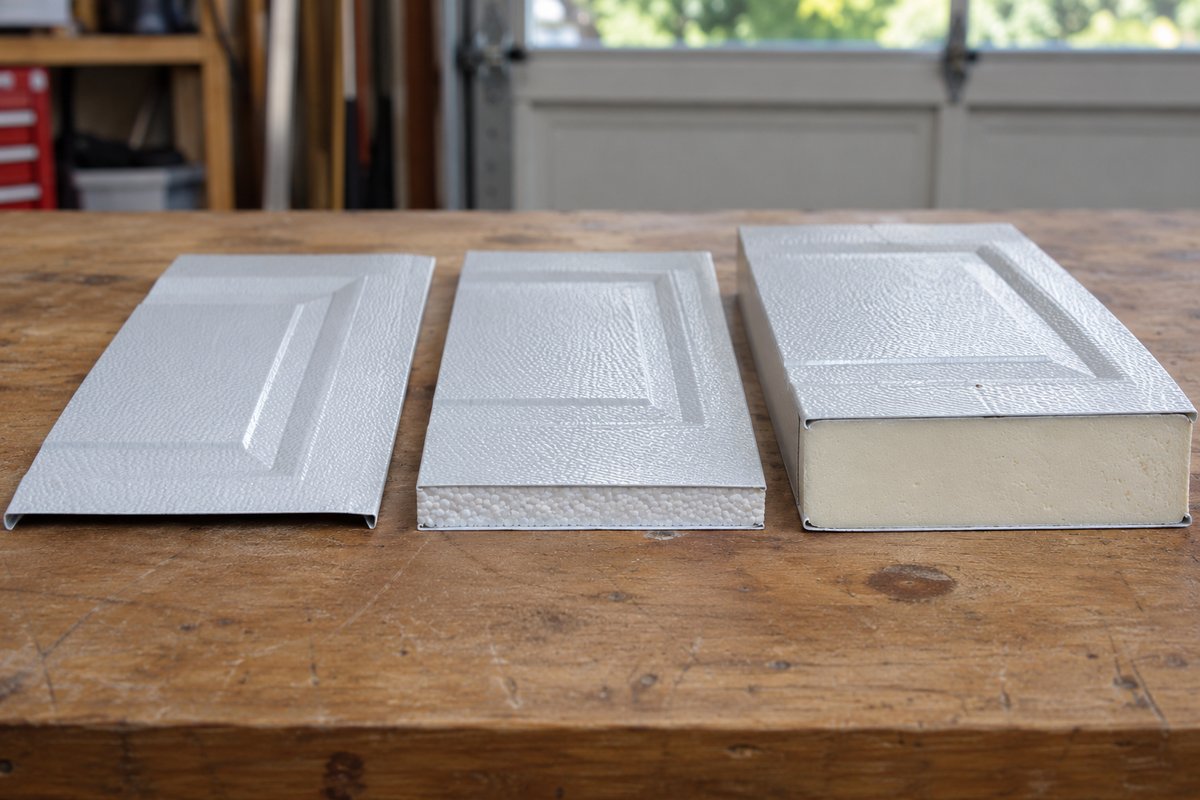
Which construction suits a Georgia garage? A one-layer 8000 is a door for a detached garage or shed. If the garage is attached, sits under a bedroom, or you work in it through an Atlanta summer, the three-layer polyurethane doors (9100 and up) are where the insulation and the quieter running start. Our guide to choosing garage door insulation goes further, and our garage door types guide covers styles and materials across brands.
Two more model details worth knowing:
- Wind load. Most of the steel models are offered with WindSafe reinforcement. Wayne Dalton notes that choosing the right door for local building codes is the homeowner's responsibility, so ask your installer what your county requires.
- The 25,000-cycle spring. On the 9100, 9605, 8300, 8500 and 8310, Wayne Dalton offers an optional 25,000-cycle spring, which it says delivers "more than twice the life of a standard torsion spring."
TorqueMaster Plus: what it is and why it's repaired differently
If you have a Wayne Dalton door, there's a good chance it doesn't have the open coil springs most people picture. Wayne Dalton calls TorqueMaster Plus its "exclusive garage door counterbalance system that safely contains the springs inside a steel tube."
How to tell if your door has TorqueMaster
Look at the wall above the closed door, from inside the garage.
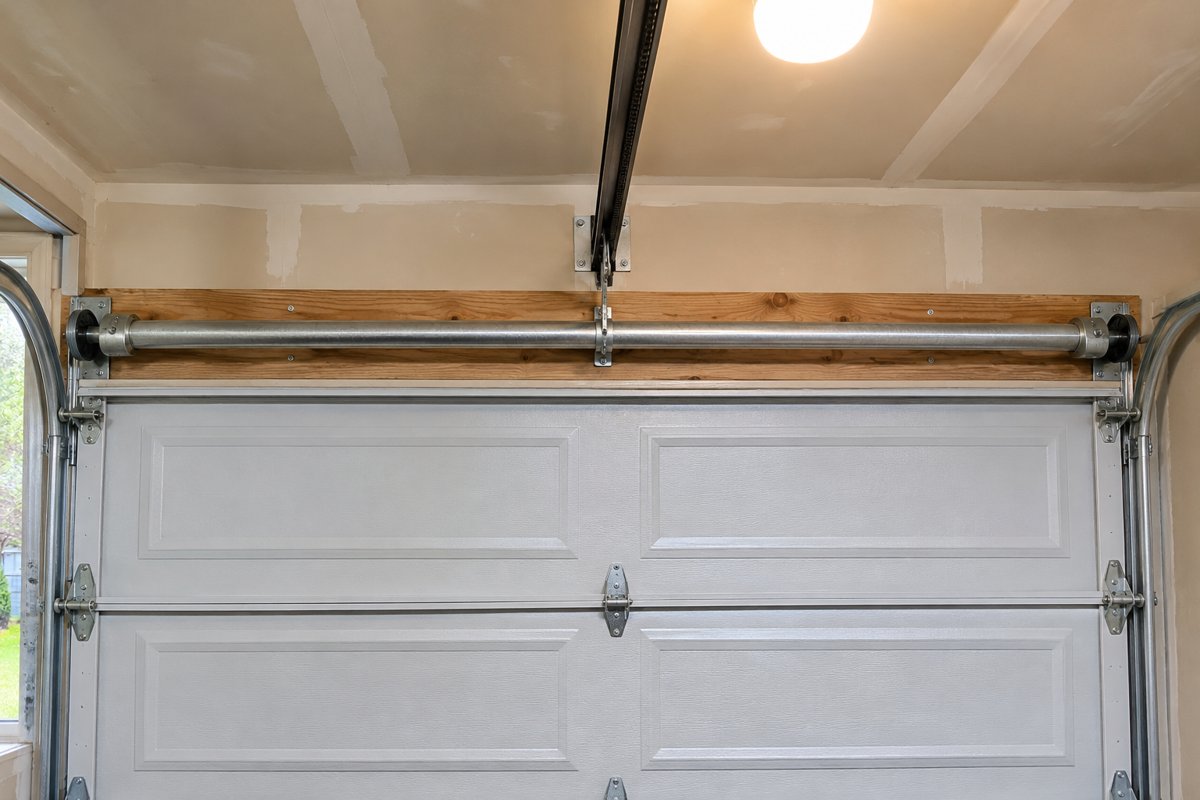
- TorqueMaster Plus: one round steel tube runs across the top of the door. You won't see any coils. At each end there's a bracket on the track with a cable drum beside it, and a warning tag on the end bracket.
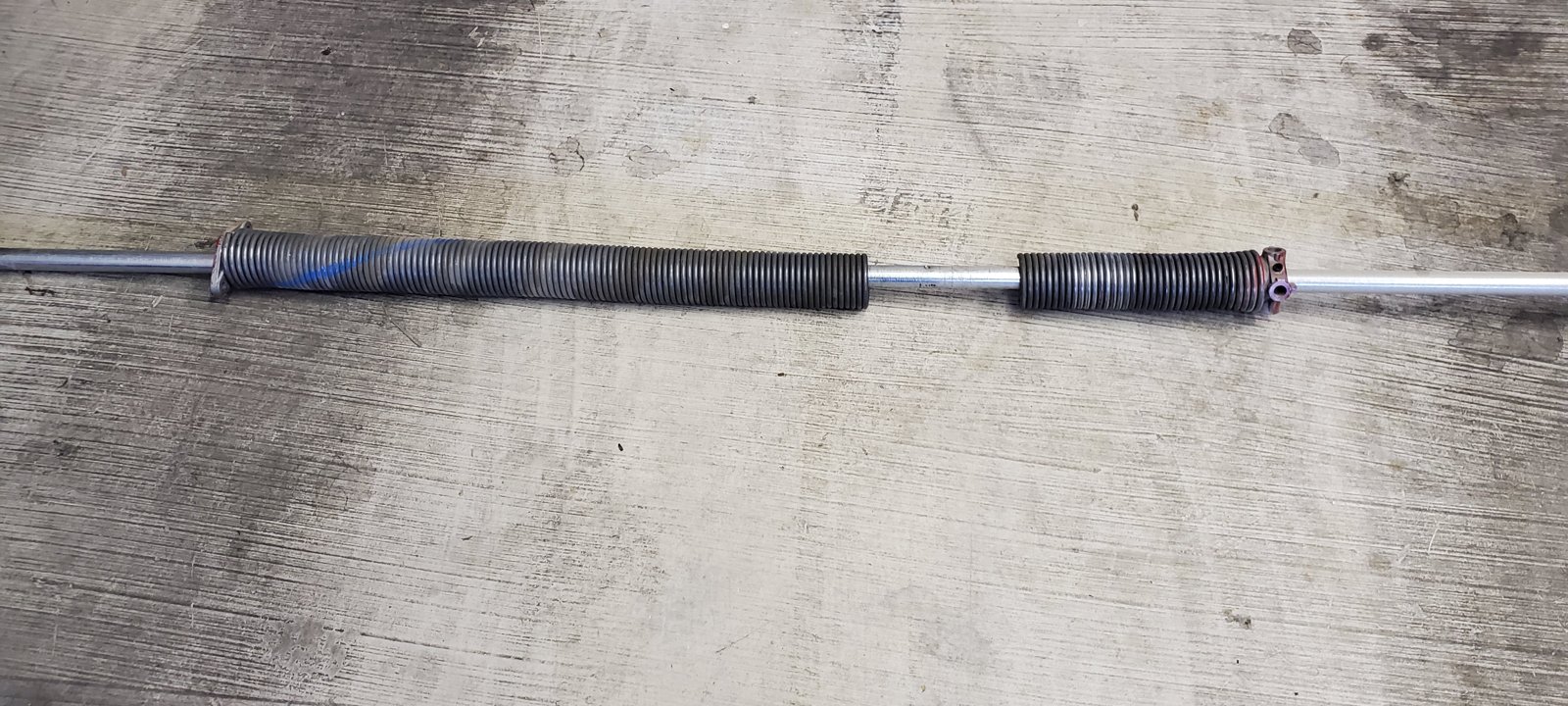
- Standard torsion springs: a steel shaft runs across the door with one or two large coil springs on it, usually near the middle.
- Extension springs: long springs run alongside the horizontal tracks toward the back of the garage.
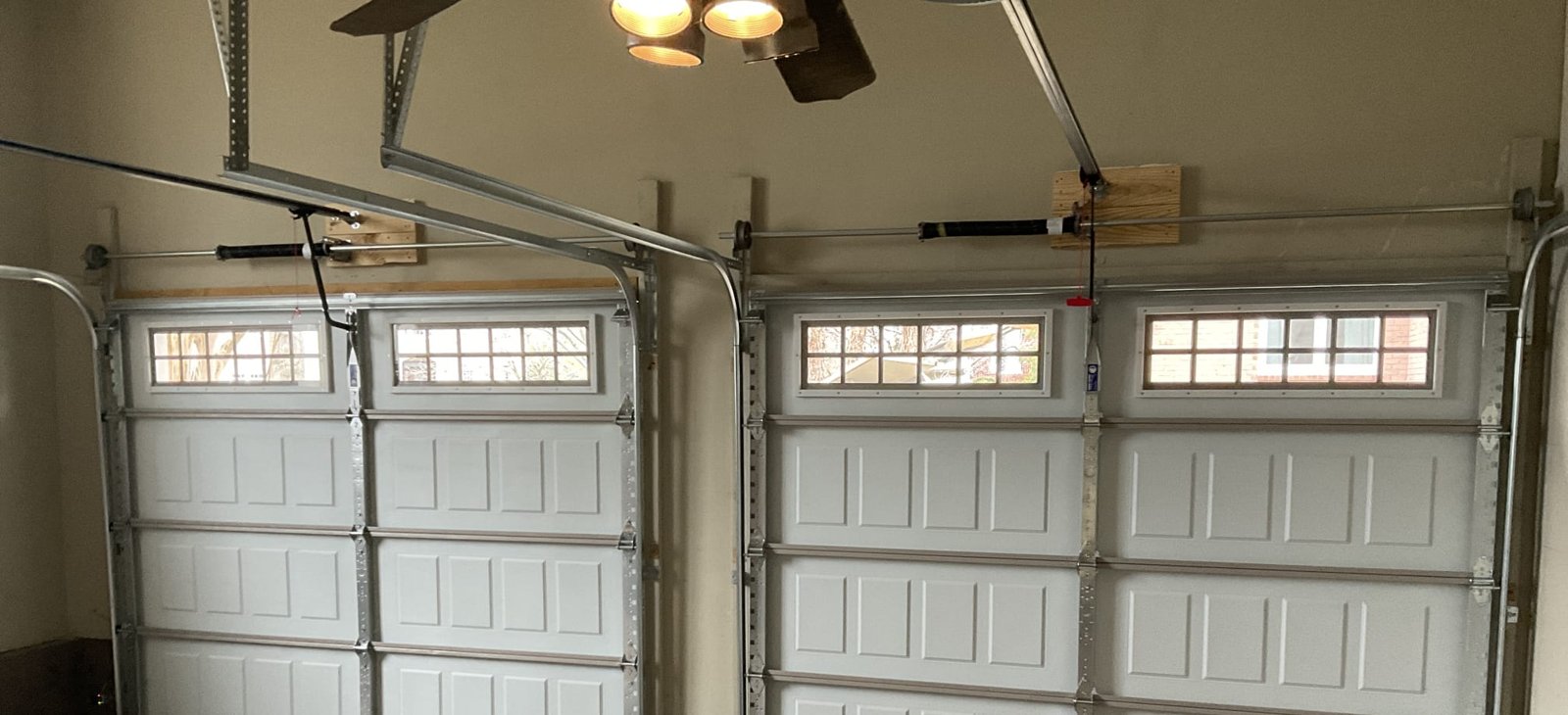
The photo above shows standard torsion springs on two doors. On a TorqueMaster door, the springs sit inside the tube instead. Wayne Dalton's brochure for Models 9100 and 9605 says they "come standard with the TorqueMaster Plus," and its pages for the 8000 and 8200, 9405, 8670 and 8310 also list it. The same brochure adds that "certain door configurations require standard torsion or extension springs," and Wayne Dalton publishes 8000 and 8200 installation manuals for TorqueMaster, standard torsion and extension springs. So the model number alone doesn't settle it: look at the wall.
Our guide to torsion vs extension springs explains the open spring types in more detail.
What Wayne Dalton says about TorqueMaster safety
- Enclosed springs. The tube helps "prevent injury to the installer or homeowner that could result from the accidental release of tension."
- Anti-drop device. "If a spring should happen to break while the garage door is in the up position, the anti-drop device will stop the garage door from going into a free fall."
- Cycle testing. Wayne Dalton says it has cycle-tested more than 250 TorqueMaster Plus springs and that, on average, they exceed the 10,000-cycle minimum in ANSI/DASMA 102 by 15%.
- Recognition. In January 1998 the U.S. Consumer Product Safety Commission commended Wayne-Dalton for "a system that encases potentially dangerous garage door springs in a steel tube."
Why it needs specific parts and know-how
The installation manual for Models 9100 and 9605 shows how different TorqueMaster is from a standard torsion system:
- The springs come pre-assembled inside the tube, already lubricated. You can't see a broken coil, so a technician diagnoses it from how the door behaves and what the hardware shows.
- The cable drums are marked left and right hand and are "cam shaped to fit together only one way" with the spring tube. Drums from a standard torsion system don't fit.
- It winds with a ratchet, not winding bars. The spring is wound at the end bracket with a ratchet wrench, a 5/8-inch socket and a 3-inch extension, counting turns on a ratchet wheel. The number of turns comes from a chart by door height (16 turns for a 7-foot door, 18 for an 8-foot door in that manual), and Wayne Dalton notes the balance can differ from the chart by a turn either way.
- The end brackets carry a pawl knob. The pawl stops the door from dropping if a spring fails. When it has engaged, Wayne Dalton's tag says the door opens with "a distinct 'clicking' noise" and can refuse to close, and it warns against running the opener in that state.
- Some doors have one spring. On single-spring doors there's no spring on the left side of the tube, but the left cable still has to be set to the right tension.
Wayne Dalton's TorqueMaster tag is plain about who should touch it: "Reset, adjustment or repair of TM Plus bracket, ratchet, cables, or springs must be done by a trained door systems technician." That's our job. We repair TorqueMaster doors, and we'll tell you on site what the door needs and give you the price in writing before any work starts.
The Wayne Dalton warranty, in Wayne Dalton's words
These are Wayne Dalton's warranties, quoted from its current documents. They're separate from anything we warrant. Each model has its own document, and every period runs from the date of installation.
| Model (warranty revision) | Sections | Hardware and tracks | Finish | Everything else |
|---|---|---|---|---|
| 8300, 8300AG, 8500, 8500AG (Rev. 11.2024) | Limited lifetime against rust-through and foam separation | Limited lifetime, except springs | 10 years on standard paint and digital wood-look prints; 5 years on Black, Black Frost, Silver, Dark Bronze, Walnut, Mission Oak and Golden Oak | 1 year |
| 9100 and 9605 (Rev. 09/2024) | Limited lifetime against rust-through, foam separation, and peeling, cracking or chalking of the factory coating | Limited lifetime, except springs | 5 years against peeling or fading of all paint finishes | 1 year |
| 8000, 8200, 8024, 8224 (W999-1815, 09.2026) | 10 years against rust-through, foam separation and defective paint | 10 years, except springs | 5 years against fading on Black, Almond, Taupe and Brown | 1 year |
| 8600 (Rev. 11.2023) | Limited lifetime against rust-through, foam separation and defective paint | Limited lifetime, except springs | 2 years on the overlay boards | 1 year |
| 9405 (Rev. 03.2015) | Limited lifetime against rust-through, foam separation and coating failure | Limited lifetime, except springs and decorative hardware | 2 years on the overlay material | 1 year |
"Limited lifetime" is Wayne Dalton's term, and it has a definition: "for so long as the original purchaser owns the home in which the Product was originally installed."
The fine print that matters most:
- Springs get one year. Every document above takes springs out of the long hardware cover, which leaves them under the one-year line for "component parts... not covered by the preceding provisions."
- Labor isn't included. Wayne Dalton repairs or replaces the defective part at its option; "any labor charges are excluded and will be the responsibility of the purchaser."
- Original purchaser only. The warranty "is not transferable or assignable," so it doesn't pass to the next owner when the house sells.
- Homes only. It doesn't cover doors installed in commercial or industrial buildings.
- What voids it: unauthorized alteration or repair, misuse, neglect, accidents, "failure to provide necessary maintenance," normal wear and tear, and exposure to blowing sand, salt water, salt spray or chemical fumes. The TorqueMaster tag adds that damage from wrong opener force settings isn't covered.
- How to claim. Claims go "promptly after discovery," in writing, to "the authorized distributor or installer whose name and address appear below" on your copy, and Wayne Dalton must get a chance to inspect the door before it's removed or altered. Wayne Dalton's FAQ says you "must contact an authorized Wayne Dalton dealer for warranty determination," and that missing parts go back to the place of purchase.
Keep your invoice and the filled-in warranty sheet. The model number on them decides which row applies.
Common Wayne Dalton repairs we see
Most calls on Wayne Dalton doors are the same jobs we do on any brand, with a few TorqueMaster twists.
| Problem | What you notice | What it usually means |
|---|---|---|
| Broken spring | Door feels very heavy, opener strains or stops after a few inches, door sits crooked | A broken or worn-out spring. On TorqueMaster you won't see the break; the anti-drop pawl can engage and the door clicks as it opens |
| Cable off the drum | Cable hanging slack, door crooked in the opening | Often follows a broken spring or an obstruction. TorqueMaster drums are specific to the system |
| Door won't close after a spring break | Door opens with a clicking noise, then won't come down | The anti-drop device has engaged. Don't run the opener; call for a reset and repair |
| Worn rollers and hinges | Grinding, shaking, a door that runs rough | Worn roller wheels or bearings, loose hinges |
| Dented or damaged section | A crease from a car bumper, a cracked panel | Needs a matching section from the same model and color, so the model number matters |
| Opener struggling | Opener reverses, hums or labors | Often a balance or spring problem rather than the opener |
For each of these, our service pages go into the details: garage door spring repair, cable repair, roller replacement and section replacement. If a door suddenly feels heavy, read why your garage door feels heavy first.
If the door is stuck open with a broken spring, leave it where it is, keep cars and people out from under it, and don't keep pressing the opener button. We offer emergency repair, day or night; see our emergency garage door repair page.
What you can do yourself, and what's for a technician
Wayne Dalton's owner's manual asks you to inspect the door every month and to have it professionally inspected once a year. Here's how that splits.
| Job | You or a technician | Wayne Dalton's guidance |
|---|---|---|
| Look over the door and hardware for worn or broken parts | You, monthly | "Visually inspect door and hardware monthly" |
| Wash the door with a mild detergent | You | "Do not use a pressure washer on your garage door" |
| Lubricate hinges, steel rollers and bearings | You | Use a non-silicone lubricant; don't lubricate nylon rollers, plastic idler bearings or the track |
| Keep the TorqueMaster pawl knobs engaged | You can check | They stop the door from dropping if a spring fails |
| Balance test (opener released, lift by hand) | You can test; a technician adjusts | Adjustment only by a trained technician if in question |
| Springs, cables, drums, end brackets, bottom corner brackets | Technician | "Do not adjust, repair or remove springs or parts to which springs are connected" |
| Reset a TorqueMaster after the anti-drop engages | Technician | Reset "must be done by a trained door systems technician" |
| Opener force settings after a repair | Technician | Damage from improper force settings isn't covered by the warranty |
Our garage door maintenance checklist lays out the monthly routine for any door, and a yearly tune-up covers the professional inspection Wayne Dalton recommends.
How to find out which Wayne Dalton door you have
The model number decides the warranty, the replacement section and, often, the spring system. Wayne Dalton doesn't publish one standard place for a model label on every door, so use these clues:
- Check your paperwork first. The invoice and the warranty sheet carry the model number, and the warranty sheet has the dealer or installer's name filled in.
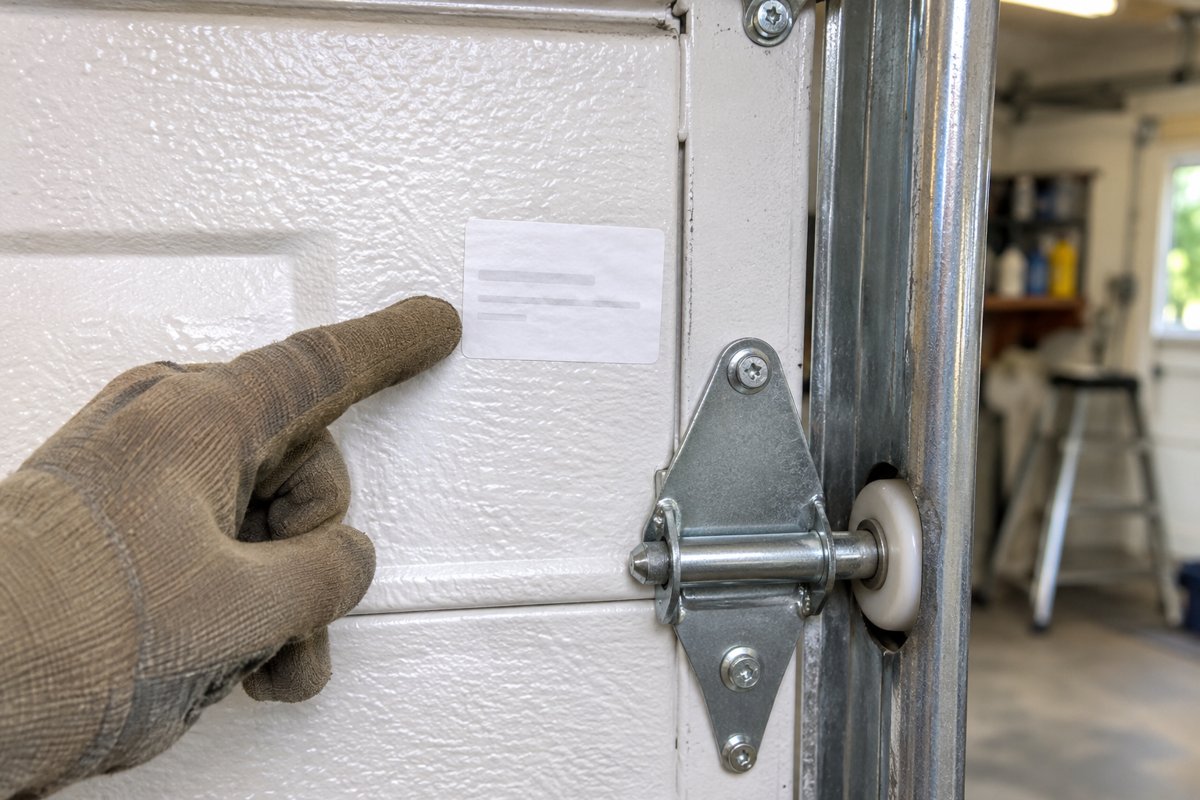
- Look at the inside of the door. Wayne Dalton's manual shows warning labels on the end stiles (the vertical edges of the sections), including at the bottom corner brackets. Photograph any label or sticker you find.
- Check the hinges. Wayne Dalton's manual says the hinges at the top of each section are stamped with a number that identifies the section's place in the stack.
- Look at the springs. A steel tube across the top with no visible coils points to TorqueMaster Plus, which only Wayne Dalton makes. The end bracket tag has a space where the installer writes the number of spring turns.
- Measure and photograph. Measure the thickness of a section edge, note whether the back is bare steel, vinyl or steel, and take photos of the outside panel design and windows.
Send us the photos and we'll help you work out the model and what parts it takes.
Are we a Wayne Dalton dealer?
No. All Four Seasons is an authorized LiftMaster dealer for openers, and that's the only dealer authorization we claim. We service and repair all major garage door brands, Wayne Dalton included: springs (TorqueMaster and standard torsion), cables, rollers, sections, tracks and openers.
That matters in two cases:
- Warranty claims. Wayne Dalton says warranty determination goes through an authorized Wayne Dalton dealer, or the distributor or installer named on your warranty sheet. Its website has a dealer locator. If your door is past its one-year cover on springs, or the problem isn't a defect, we can repair it directly.
- Buying a new door. If your Wayne Dalton door is past repair, we'll measure the opening and price a replacement in writing. See our garage door installation page and browse our garage doors, or read how long garage doors last if you're weighing repair against replacement.
When to call us
Call us if your Wayne Dalton door has a broken spring, a cable off the drum, a TorqueMaster that clicks and won't close, a dented section, or an opener that's struggling. We've repaired garage doors across Metro Atlanta since 1999, we're rated 4.9 on Google with Over 4,000 Five-Star Reviews, and our office is open seven days a week, 7 AM to 8 PM, with 24/7 emergency service. Springs we install carry our written warranty: 3 years on torsion springs and 5 years on extension springs (see the warranty).
Call (678) 271-8918 or book a free estimate online. You'll get a written price before we start.
Frequently asked questions
Who makes Wayne Dalton garage doors?
Wayne Dalton, a division of Overhead Door Corporation. Overhead Door has been owned by Japan's Sanwa Holdings since 1996, and it bought the door businesses of Wayne Dalton Corporation in 2009. Wayne Dalton was founded in 1954 in Holmes County, Ohio.
Is Wayne Dalton the same company as Overhead Door?
They're sister brands made by the same company, Overhead Door Corporation of Lewisville, Texas. Genie openers belong to the same group. Each brand keeps its own models and dealers.
Do you repair Wayne Dalton TorqueMaster springs?
Yes. We repair Wayne Dalton doors, including TorqueMaster Plus springs, cables and drums, as well as standard torsion and extension springs. Wayne Dalton says TorqueMaster work must be done by a trained door systems technician, because the springs are under high tension inside the tube.
How do I know if my garage door has TorqueMaster springs?
Look above the closed door from inside the garage. A single round steel tube across the top, with no coils showing and a bracket and cable drum at each end, is TorqueMaster Plus. Visible coil springs on a shaft are standard torsion springs.
Does the Wayne Dalton warranty cover springs?
For one year. Wayne Dalton's long cover on hardware excludes springs, so they fall under the one-year term for other parts. Labor isn't covered, and the warranty applies only to the original purchaser.
Is the Wayne Dalton warranty transferable?
No. Each Wayne Dalton residential warranty we checked says it's made to the original purchaser only and "is not transferable or assignable." "Limited lifetime" means for as long as the original purchaser owns the home.
Which Wayne Dalton door has the highest R-value?
The Model 8500, a 2-inch, three-layer steel door with foamed-in-place polyurethane, at a published R-value of 16.22 and a tested U-factor of 0.18. The 8300, 8350, 8310 and 8600 come next at R 12.12.
Are you an authorized Wayne Dalton dealer?
No. We're an authorized LiftMaster dealer for openers, and we service and repair all major door brands, Wayne Dalton included. For a warranty claim, Wayne Dalton asks you to contact an authorized Wayne Dalton dealer or the installer named on your warranty.