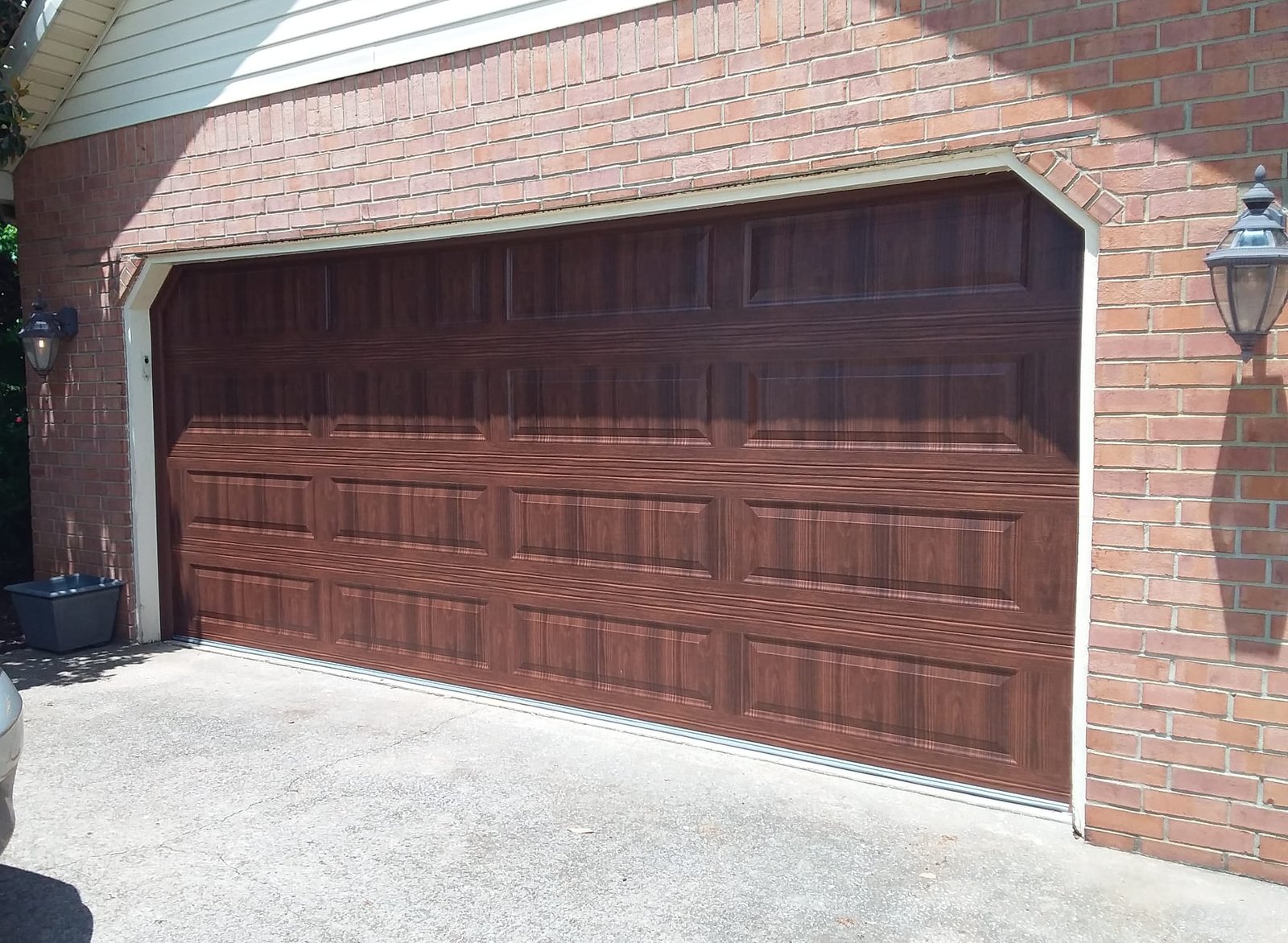
An insulated garage door keeps an attached garage, and the rooms beside and above it, closer to the temperature of the house. You can add a kit to a plain steel door or buy a door with insulation built in. Either way, the door's weight changes, the springs must match, and the seals matter as much as the foam.
This guide covers what insulation does and doesn't do in a Metro Atlanta garage, how to tell whether your door is already insulated, polystyrene versus polyurethane, what an R-value on a garage door really measures, and how a DIY kit compares with an insulated door.
What insulating the garage door does, and what it doesn't
On a plain steel door, the largest wall of the garage is a single sheet of metal. Insulation slows the heat coming through it. That matters most when the garage is attached to the house: the garage acts as a buffer for the kitchen, laundry room or bonus room next to it, and a cooler or warmer buffer means less heat moving into those rooms. Our guide to choosing a door for an attached garage or workshop covers the other checks.
| Insulating the door does | Insulating the door doesn't |
|---|---|
| Slow heat coming through the door in summer and leaving through it in winter | Turn the garage into heated and cooled living space |
| Keep the garage closer to the house temperature, which helps the rooms beside and above it | Fix air leaking around the door: that's the job of the weather seals |
| Make the door stiffer and quieter, on doors built with insulation between two steel skins | Insulate the walls, ceiling or the door into the house |
| Give you a more comfortable workshop, gym or laundry corner | Make it safe to run a car or generator in the garage |
Two other parts of the garage do as much for the house as the big door does.
- The wall and ceiling shared with the house. The U.S. Department of Energy's Building America Solution Center treats the walls and ceilings between an attached garage and the house as part of the home's envelope, the boundary between conditioned and unconditioned space. Its guide to air sealing an attached garage calls for sealing the gaps where wiring, pipes and ducts pass through, and the joints at the top and bottom of the shared wall.
- The door into the house. The same guide calls for a self-closing, insulated, fire-rated door with a good weather seal and a tight sweep. If you only fix one thing this year, start there.
The air sealing isn't only about comfort. The Building America guide says isolating an attached garage from the living space is critical for keeping carbon monoxide and other contaminants out of the house. The CDC says never to run a car inside an attached garage, even with the garage door open, and an insulated door changes nothing about that rule.
If you want to insulate the garage walls and ceiling as well, see our DIY garage insulation guide. Planning a workout space? Read how to turn your garage into a gym. The rest of this page is about the door.
Why it matters in a Georgia garage
Atlanta needs both heating and cooling, and the garage door takes the brunt of each. The NOAA 1991–2020 climate normals for Atlanta's airport station show it.
| Measure (NOAA 1991–2020 normals, Atlanta Hartsfield) | Average |
|---|---|
| July average high | 90.1°F |
| Days a year at 90°F or hotter | about 47 |
| January average low | 35.6°F |
| Nights a year at 32°F or colder | about 36 |
| Heating degree days a year | 2,531 |
| Cooling degree days a year | 2,051 |
Degree days are the standard measure of how much heating or cooling a climate calls for. Atlanta's two figures are close, which is the point: a garage door here works against summer heat for months and against cold through the winter. A door that faces west takes the afternoon sun on top of that.
Dark insulated doors in full sun. The door makers' trade group, DASMA, explains that doors with insulation bonded between two skins bow slightly when one side is much hotter than the other. A dark door facing the afternoon sun with a cool garage behind it bows more than a light one, and wide doors more than narrow ones. DASMA says this isn't a defect, but if you want a dark color on a double door with a western exposure, ask about reinforcement when you get a price.
For the cold-weather side of the same door (seals, lubrication and freezing), read our Atlanta winter garage door guide. For summer, our post on whether leaving the garage door open makes the house hotter covers the heat.
Is my garage door already insulated? How to tell
Look at the inside face of the door.
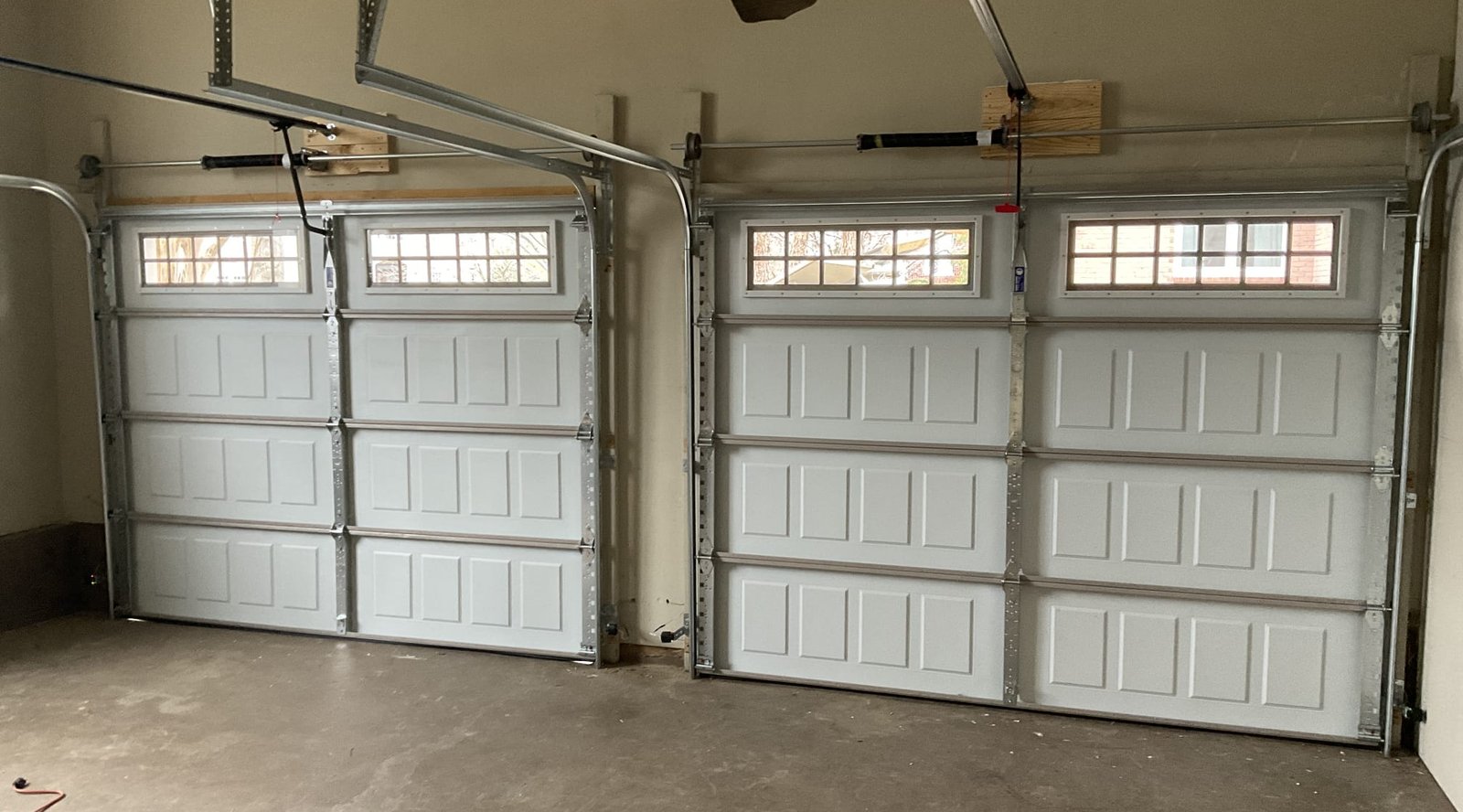
- You see the back of the stamped panels, with steel stiles running up between them: it's a single-layer steel door with no insulation. This is the door a DIY kit is made for.
- You see white foam board with a vinyl or plastic sheet over it: it's a two-layer door, steel with polystyrene insulation behind it. Some homeowners also find foam panels added later by a previous owner.
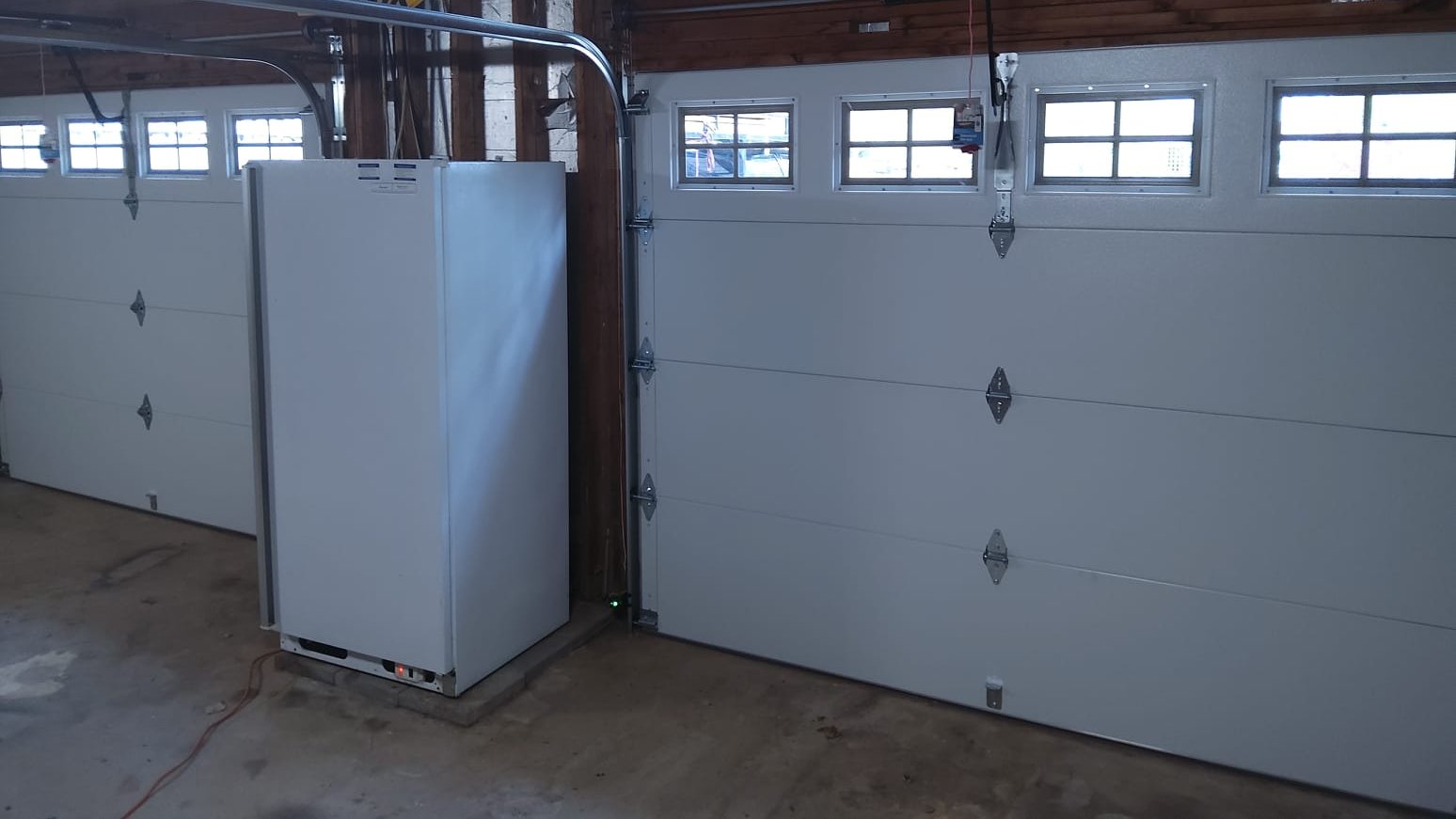
- You see a smooth, closed steel skin, with the hinges bolted straight onto it: it's a three-layer door, steel on both sides with insulation between. Look at the edge of a section where it meets the track to see the thickness.
If you still have the paperwork from the install, the model number usually tells you too. Amarr's model numbers, for example, end in the number of layers: a 1000 is single-layer steel, a 2000 has a vinyl back, and a 3000 is steel on both sides with insulation between. Our Amarr garage doors guide has the full list.
Layers and steel gauge: how an insulated door is built
Most steel garage doors come in three builds.
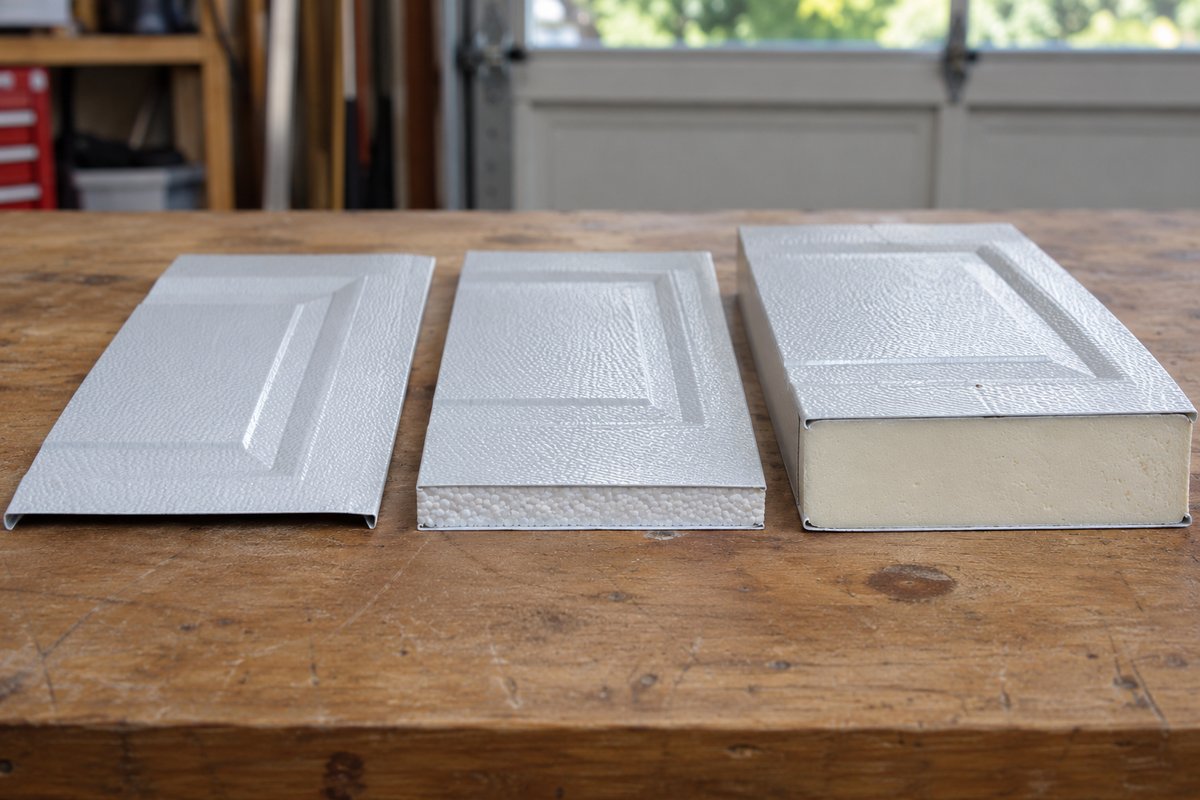
| Build | What it is | Insulation | Good fit |
|---|---|---|---|
| Single layer | One steel skin, open at the back | None | Detached garages and sheds used only for parking or storage |
| Two layer | Steel skin with insulation behind it and a vinyl or plastic backing | Polystyrene board | Garages you want a little quieter and less drafty |
| Three layer | Steel skin, insulation, steel back skin | Polystyrene board or polyurethane foam | Attached garages, rooms above the garage, workshops and gyms |
Steel gauge. Steel thickness is sold by gauge, and DASMA's definition is the one to remember: the larger the number, the thinner the steel. A 24-gauge skin is thicker than a 25- or 26-gauge one. Clopay notes that thinner-gauge doors dent more readily, and DASMA notes that gauge is only one part of how a door performs. Amarr describes its three-layer doors, with steel on both sides, as stiffer and harder to dent than single-layer ones.
Our steel garage doors page shows the steel doors we install, and the garage door types guide compares steel with wood, aluminum, fiberglass and composite.
Polystyrene vs polyurethane insulation
Almost every insulated garage door uses one of two cores.
| Polystyrene | Polyurethane | |
|---|---|---|
| What it is | Rigid foam board cut to fit and laid or bonded into the section | Liquid foam injected between the skins at the factory, where it expands and fills the section |
| How it's held | Clipped, glued or bonded behind the steel; a vinyl back or steel back covers it | Foamed in place, bonded to both steel skins (DASMA's term is "foamed-in-place") |
| R-value for the same thickness | Lower | Higher |
| Where you find it | Two-layer and many three-layer doors | Higher-end three-layer doors |
One maker's figures show the gap. Clopay's 2026 brochure for its three-layer steel doors lists a calculated R-value of 18.4 for a 2-inch polyurethane door and 9.0 for a 2-inch polystyrene door, and 12.9 against 6.5 for the 1-3/8-inch versions. Clopay's technical sheet on thermal properties adds that its polyurethane doors also test better on the whole-door measure, U-factor, than equivalent polystyrene doors.
Each maker publishes its own figures, and they don't all measure the same way. Our garage door brands comparison puts Clopay, Amarr, Wayne Dalton, C.H.I., Raynor, Haas and Windsor side by side, including the highest insulation figure each one publishes and how it was measured.
What R-value means on a garage door, and how makers measure it
ENERGY STAR defines R-value as a measure of insulation's ability to resist heat traveling through it: the higher the number, the better it insulates. On a garage door, though, there are two different numbers, and DASMA's technical data sheet 163 (revised July 2022) explains why they can't be compared.
| Calculated R-value | Tested U-factor | |
|---|---|---|
| What it covers | One door section, through the middle of the insulation | The complete door as installed: sections, joints, end stiles, seals, windows |
| How it's found | Calculated: insulation thickness divided by the foam's thermal conductivity, plus fixed values for the air on each face | Tested: a full-size door is built into a test chamber and the heat flowing through it is measured, under the standard ANSI/DASMA 105 |
| Which way is better | Higher | Lower |
| What it leaves out | Section joints, stiles, thermal breaks, seals and windows | Nothing on the door; that's the point |
A few details from TDS 163 are worth knowing when you read a brochure:
- The steel counts for nothing. DASMA treats the R-value of steel facings as negligible. The number is almost all foam.
- The air on each face adds 0.85. Every calculated R-value includes a fixed 0.85 for still air on the inside face and a 15 mph wind on the outside.
- The foam is measured at 40°F. The thermal conductivity behind the calculation comes from lab tests (ASTM C177 or C518) at an average material temperature of 40°F.
- They're not reciprocals. You can't divide 1 by a door's R-value to get its U-factor. DASMA says the two are obtained by entirely different methods.
- Building codes use U-factor. DASMA notes that codes deal with garage door thermal performance in U-factor, and that a tested whole-door U-factor gives the highest degree of confidence.
Clopay's technical sheet explains what happens between the two numbers. Section joints and end stiles let heat take a shortcut around the foam. A thermal break, a gap between the inside and outside steel at the section joints, blocks that path. Windows raise a door's U-factor, and insulated glass loses less than single-pane glass.
How to compare two doors:
- Compare polyurethane with polyurethane and polystyrene with polystyrene, at the same thickness.
- Treat R-values as section values, not whole-door values. A gap of one or two points between makers' calculated figures doesn't tell you much.
- If both makers publish a tested U-factor, use it. Lower is better.
- Ask whether the door has thermal breaks and seals between the sections.
Is there an ENERGY STAR garage door? No. ENERGY STAR's specification for residential doors (Version 7.0) defines a door as a sliding or swinging entry system, so garage doors aren't covered and there's no ENERGY STAR label to look for. Use the maker's R-value and, where it's published, the U-factor.
How to insulate a garage door: DIY kit or an insulated door?
You have two ways to get an insulated door: add a kit to the door you have, or replace the door with one built with insulation. If you replace it, see what happens when a new door is installed.
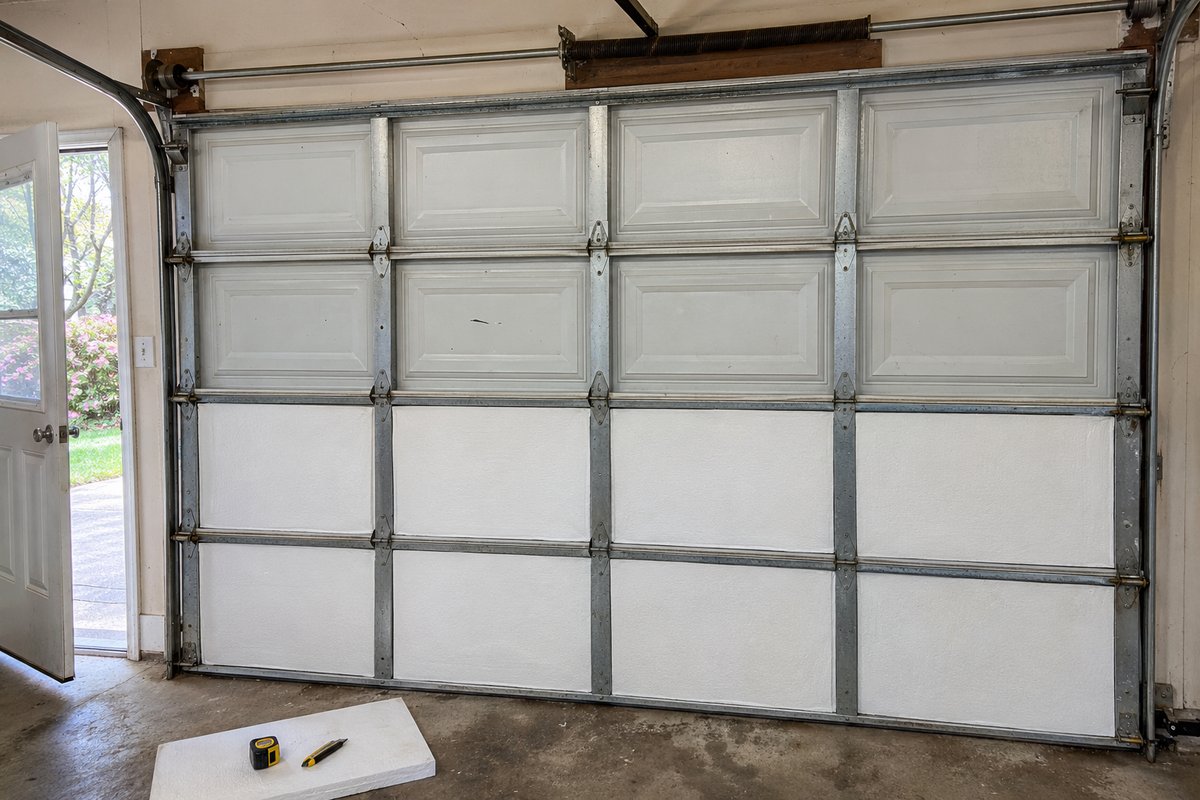
What a kit is. Kits are panels you cut and press into the bays between the steel stiles of a single-layer door. Owens Corning's garage door insulation kit is one example: eight fiberglass panels with a washable white vinyl facing, rated R-8 (tested to ASTM C177), sized for a single-car door up to 9 feet wide by 7 feet 4 inches high, and made for uninsulated metal doors with exposed steel channels. Foam-board and reflective kits from other makers work the same way. Garage door insulating blankets, the roll or batt kind sold as "door blankets", go over the inside of the door instead of into the bays; like a kit, they add weight and leave the edges and the stiles uncovered.
| DIY kit on your current door | Insulated door | |
|---|---|---|
| How the insulation sits | Panels in the bays; the steel stiles and struts stay bare | Foam fills the section, edge to edge, often with steel on both sides |
| Published rating | The kit's material R-value, for the panels only | The door maker's section R-value, and sometimes a tested U-factor |
| Stiffness and dents | No change to the outside skin | Two-skin doors are stiffer and harder to dent |
| Weight | Adds weight the springs weren't set for | Springs are sized for the door's weight when it's installed |
| Seals | Whatever seals the old door has | New bottom seal, and new stop molding if you replace it |
| Who does the work | You install the kit; a technician should re-balance the door | Installed and balanced by the installer |
| Good fit | A sound single-layer door, a garage you want a bit more comfortable, a limited budget | A door near the end of its life, an attached garage with rooms beside or above, a workshop or gym |
The weight problem. This is the part most kit instructions skip. DASMA's technical data sheet 176, "Adding Weight to a Garage Door Assembly," says door springs are designed for the original weight of the door. Weight added afterward can unbalance the door, damage or break the springs, and overwork the opener's motor or stop it working. DASMA strongly advises against untrained people attaching material to a door without the maker's instructions, and notes that door warranties usually limit alterations. That's why our guide to why a garage door feels heavy lists an insulation kit as one of the causes.
So if you add a kit, plan for the springs to be adjusted to the new weight. Spring adjustment is a technician's job. A torsion spring, the tightly wound spring on the bar above the door, carries the door's weight under high tension, and adjusting it takes winding bars and training. Read more about garage door springs and spring repair.
Check the balance after any change to the door
A balanced door stays put when you let go of it partway up. Run this check after adding insulation, and once or twice a year anyway. It follows Chamberlain's balance test.
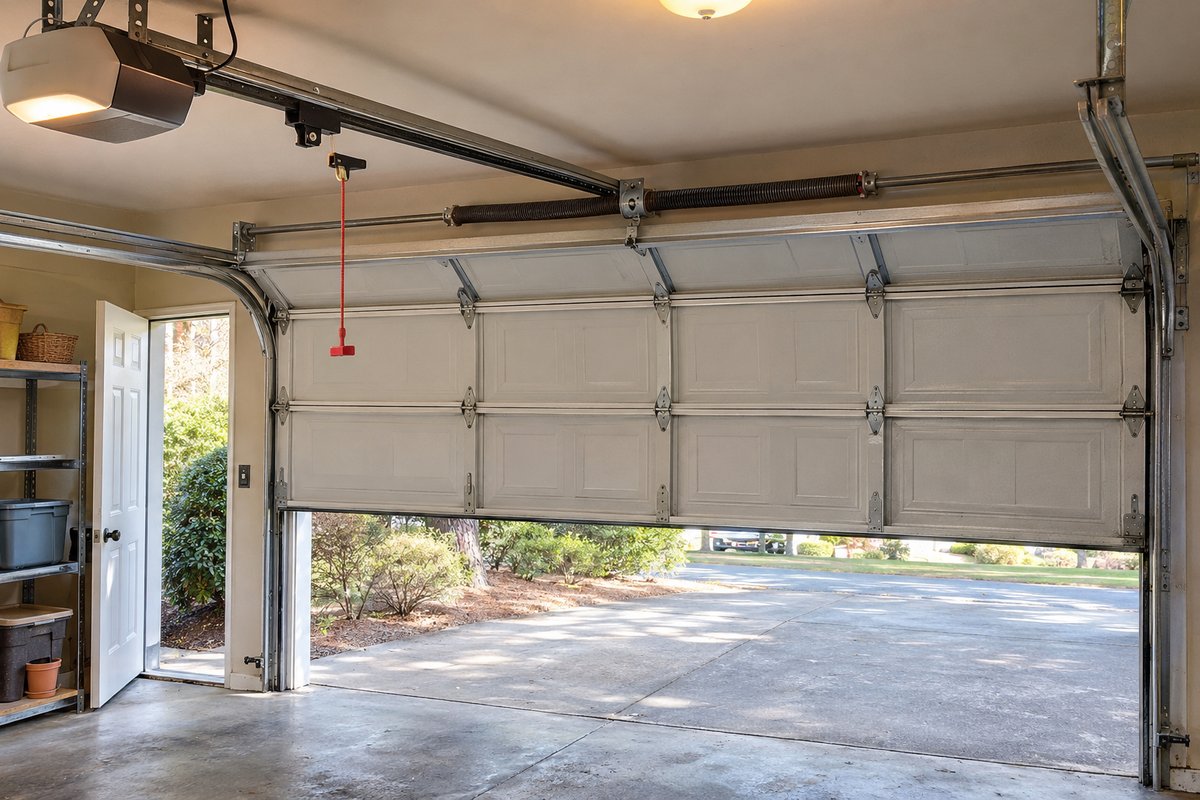
- Close the door first. Never pull the emergency release with the door open: if the springs are weak, a door let go of the opener can drop.
- Pull the red release cord to disconnect the door from the opener.
- Lift the door by hand from the middle of the bottom section. Chamberlain says a balanced door moves easily with one hand.
- Raise it 3 to 4 feet and let go, keeping your hands and feet clear. A slow rise or a gentle drift down is acceptable. If it drops hard or shoots up, the door is out of balance.
- Close the door and reconnect the opener.
If the door is out of balance, stop using the opener and call a technician. Chamberlain warns that an unbalanced door can fail to reverse when it should, and the opener is built to guide a balanced door, not to lift a heavy one. Don't adjust the springs, cables or bottom brackets yourself.
Seal the gaps: insulation without weatherstripping leaks
DASMA's TDS 163 counts weather seals among the parts of a door that resist heat flow. A door with R-18 foam and a gap under the bottom section still lets in summer heat, winter wind and water. Check these seals before you spend money on insulation.
| Seal | Where it is | DIY? |
|---|---|---|
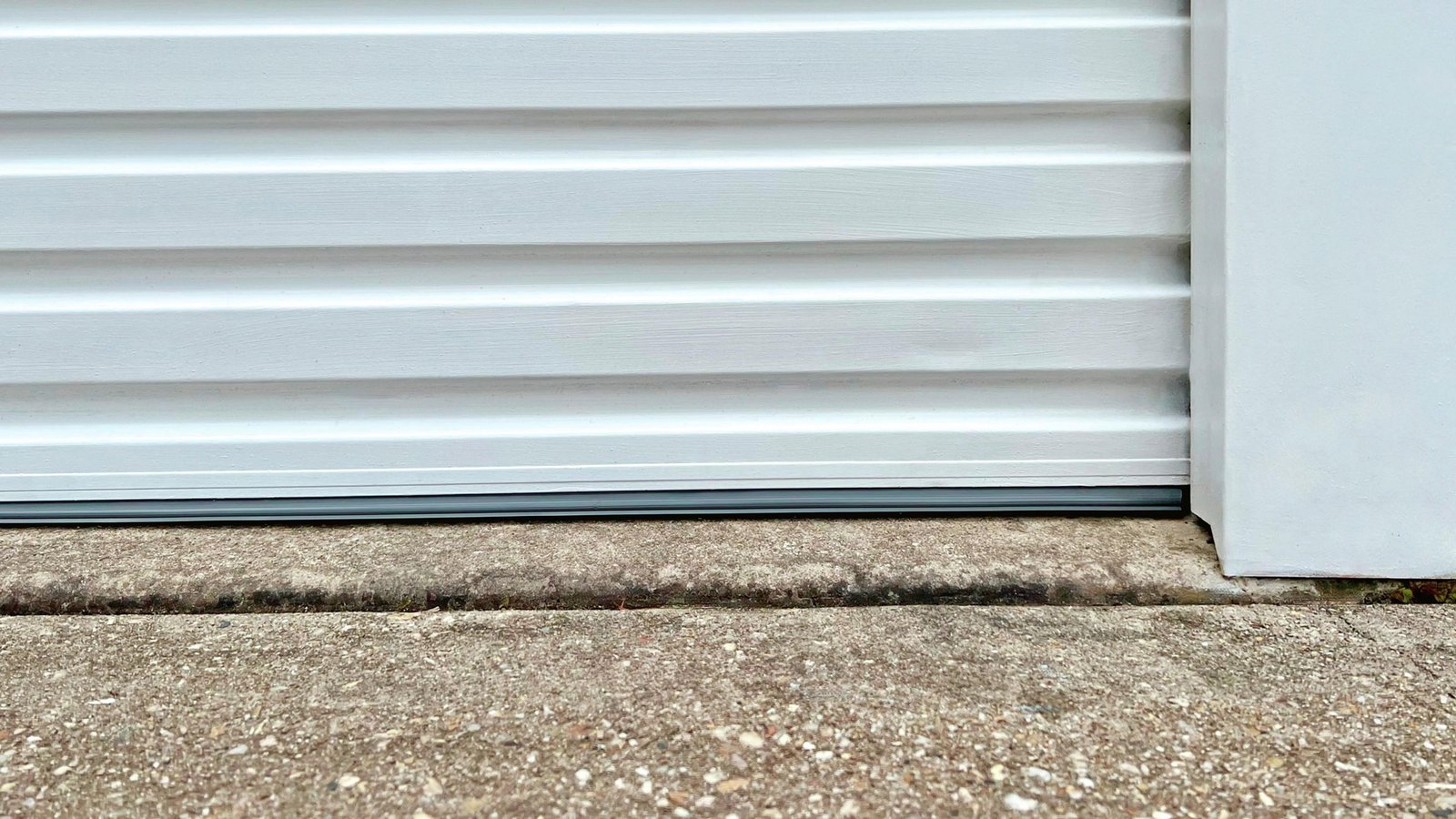
| Bottom seal | Along the bottom edge of the door, in an aluminum retainer on most steel doors | Yes |
| Stop molding | On the side jambs and the header, with a soft flap against the door face | Yes |
| Threshold seal | Glued to the concrete where the door lands, for uneven floors | Yes |
| Section joint seals | Between the sections on some insulated doors | Model-specific: ask the maker or a technician |
Close the door on a sunny day, turn off the garage light and look for daylight along the bottom and sides. Daylight means air. It can also let in mice and insects, so check the garage for pest entry points while you are looking. Our step-by-step guide shows how to install and replace garage door weather stripping, or we can replace your weather seals for you.
Which option fits your garage
| Your situation | What we'd look at |
|---|---|
| Detached garage, used for parking and storage | Good seals first. Insulation is optional; a two-layer door is plenty if you're replacing anyway |
| Attached garage, the house door opens into the kitchen or laundry | Seals, the house door and the shared wall first, then a two- or three-layer door |
| Bedroom or bonus room above or beside the garage | A three-layer door, polyurethane if the budget allows, plus air sealing of the ceiling and shared wall |
| Workshop, gym or hobby space you use most days | A three-layer polyurethane door, good seals, and insulated walls |
| Sound single-layer door, limited budget | A kit, with the springs re-balanced afterward |
| Door is old, dented or rusting at the bottom | Replace with an insulated door instead of insulating a door near the end of its life |
To judge how much life your current door has left, read how long garage doors last. If you're replacing it, our Metro Atlanta garage door buying guide covers styles, materials and what to ask for in a quote.
What you can do yourself, and what needs a technician
| Job | DIY or technician |
|---|---|
| Check whether your door is insulated | DIY |
| Look for daylight and drafts around the door | DIY |
| Replace the bottom seal, stop molding or threshold seal | DIY with basic tools |
| Install an insulation kit on a sound single-layer door | DIY, if you follow the kit maker's instructions |
| Run the balance test | DIY, with the door closed before you pull the release |
| Adjust or replace springs after adding weight | Technician |
| Replace cables, bottom brackets or drums | Technician |
| Replace a section, or the whole door | Technician |
When to call us
Call us if the door got heavier after you added insulation, if it fails the balance test, if you'd like an insulated door priced, or if you want someone to look at the door, the seals and the springs together. We have installed and repaired garage doors across Metro Atlanta since 1999, we're rated 4.9 on Google with Over 4,000 Five-Star Reviews, and our office is open seven days a week, 7 AM to 8 PM. Our torsion springs carry a 3-year warranty and our extension springs a 5-year warranty.
Call (678) 271-8918 or request a free consultation and estimate. You'll get a written price before any work starts. For new doors, see our garage door installation page.
Frequently asked questions
Is it worth insulating a garage door in Atlanta?
For an attached garage, usually yes. Atlanta averages about 47 days a year at 90°F or hotter and about 36 nights at freezing or below, and the garage door is the largest wall of the garage. Insulation keeps the garage closer to the house temperature, which helps the rooms beside and above it. For a detached garage used only for parking, good seals matter more.
What R-value should a garage door have in Georgia?
There's no single required number for an unheated garage. For an attached garage, look at three-layer doors. As one example, Clopay's 2026 figures run from R 6.5 to 9.0 for its polystyrene doors and R 12.9 to 18.4 for its polyurethane doors, depending on thickness. Compare doors calculated the same way, and use a tested U-factor where one is published.
Is polyurethane or polystyrene better for a garage door?
Polyurethane gives a higher R-value for the same thickness. It's foamed in place at the factory and bonds to both steel skins; polystyrene is a foam board laid or bonded into the section. Clopay's 2026 figures, for example, are R 18.4 for 2-inch polyurethane against R 9.0 for 2-inch polystyrene.
Do garage door insulation kits work?
They add insulation to the panel bays of a single-layer steel door, which makes the garage somewhat more comfortable. They don't cover the steel stiles, don't stiffen the door and don't fix gaps at the seals. They also add weight, so the springs have to be adjusted afterward.
Will insulating my garage door affect the springs or the opener?
Yes. DASMA says springs are designed for the original weight of the door, and added weight can unbalance it, damage or break the springs, and overwork or stop the opener. Run the balance test after installing a kit, and have a technician adjust the springs to the new weight.
Is the R-value on a garage door the same as for wall insulation?
No. A garage door's R-value is calculated for the middle of one insulated section and leaves out the joints, edges, seals and windows. DASMA says it shouldn't be used for the complete door. A tested U-factor covers the whole door; lower is better.
Can I insulate a wood or aluminum garage door?
Kits are made for steel doors with exposed channels on the back; Owens Corning's kit, for example, is sold for uninsulated metal doors. For a wood door or a full-view aluminum and glass door, ask the door maker first: DASMA advises against adding material to any garage door without the original maker's instructions. Clopay suggests an aluminum door with an insulated core if comfort matters.