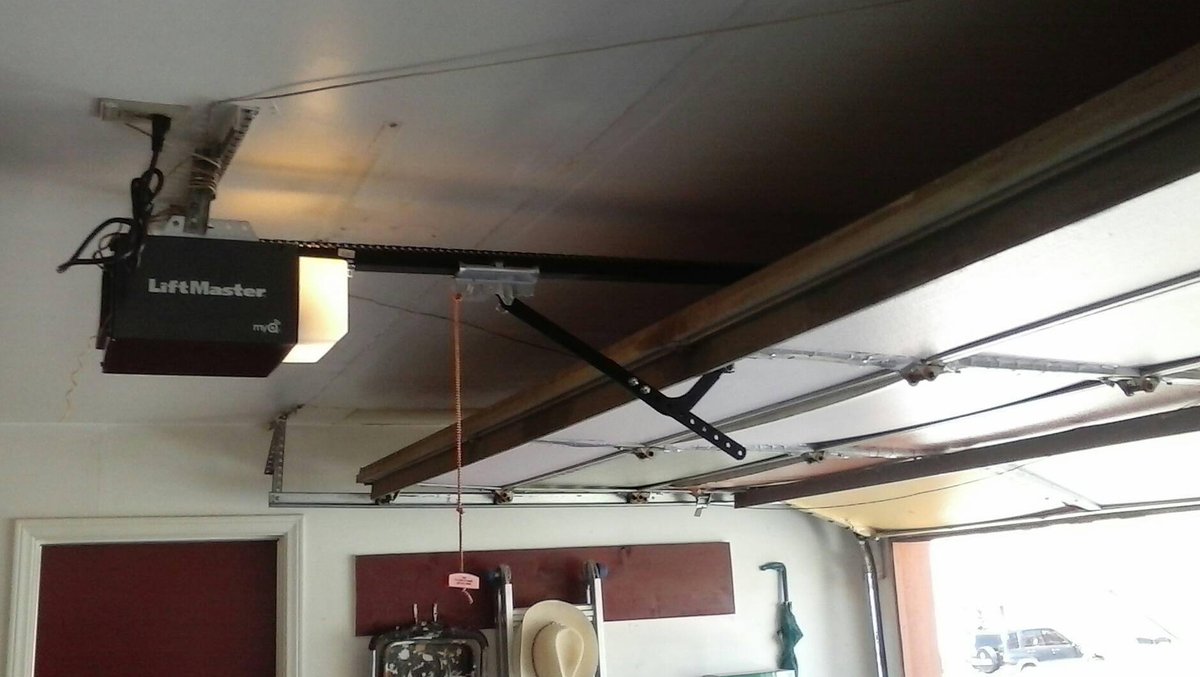
There are four main types of garage door openers: chain drive, belt drive, screw drive and wall-mount (also called jackshaft), plus a less common direct-drive design. They differ in noise, the space they need, and the doors they suit. The motor, the power rating and the door's balance matter as much as the drive.
This guide compares all five side by side, explains DC motors and horsepower labels, and matches each type to the garages we see across Metro Atlanta: rooms over the garage, detached garages, tall ceilings and heavy wood doors.
The five types at a glance
| Chain drive | Belt drive | Screw drive | Direct drive | Wall-mount (jackshaft) | |
|---|---|---|---|---|---|
| How it lifts | A metal roller chain pulls a trolley along a ceiling rail | A steel-reinforced rubber belt pulls the trolley | The motor turns a long threaded steel rod; the trolley rides the thread | The motor itself travels along a fixed chain in the rail | Mounts on the wall beside the door and turns the torsion bar directly |
| Noise | The loudest, though DC models with soft start and stop are much quieter | The quietest ceiling-mounted type | In between | Quiet; the chain doesn't move | Quiet; nothing runs across the ceiling |
| Ceiling space | A rail runs from the header to about 10 to 13 feet back, depending on door height | Same as chain | Same footprint, slightly shorter rails | Same footprint | No rail; frees the ceiling over the door |
| Suits | Detached garages, heavy doors, rooms where noise doesn't matter | Attached garages and rooms over the garage | Heavy doors where temperatures stay fairly even | Owners who want few moving parts | Tall or vaulted ceilings, storage racks, car lifts, high-lift tracks |
| Won't work with | Very low ceilings | Very low ceilings | Very low ceilings | Very low ceilings | Doors with extension springs; some low-headroom tracks |
| Upkeep | Chain tension and lubrication per the manual | Little; check belt tension | Depends on the model; older screw drives need the right grease | Little | Little; the door's cables and springs still need checks |
The sections below explain each column. Where a figure comes from a manufacturer, we say which one, and the full source list is at the end.
Chain drive: the workhorse
A chain-drive opener pulls the door with a metal roller chain, the same idea as a bicycle chain, running along a steel rail on the ceiling. The chain drags a trolley, the block that connects to the door through the door arm.
Genie calls chain openers the least expensive and most common type, and describes them as durable and dependable. The trade-off is sound: the chain rattles over its sprocket and the rail carries vibration into the framing. Genie recommends chain drives for detached garages for that reason, and notes that newer chain models with a DC motor and soft start and stop are much quieter than the older ones.
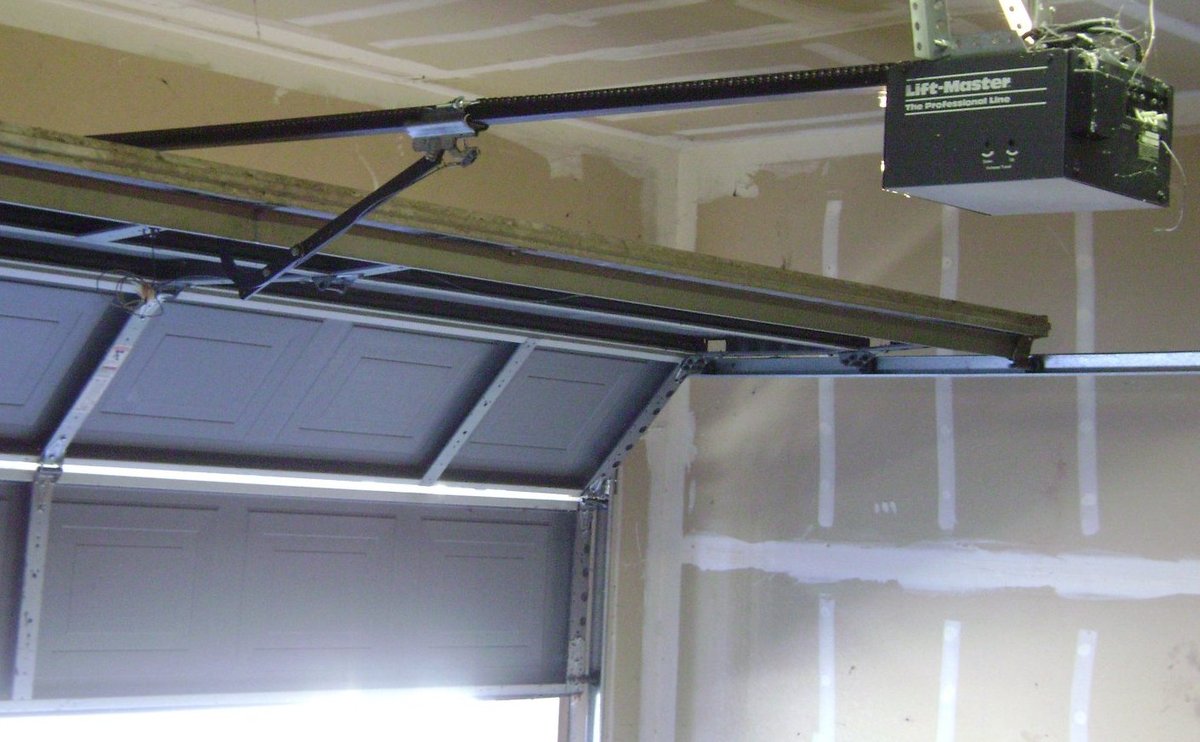
Photo: Oleg Alexandrov, Wikimedia Commons, public domain.
Good fit: a detached garage or workshop, a garage with no room above it, or a heavy door. Less suited: a bedroom or home office over the garage, unless you choose a DC model with soft start.
If the chain on yours has slipped or is slapping the rail, see our guide to a chain that came off the garage door opener.
Belt drive: the quiet one
A belt-drive opener works exactly like a chain drive, but a steel-reinforced rubber belt replaces the chain. Genie calls belt openers the quietest of all its types and says they are ideal for attached garages close to living spaces. The belt doesn't clank over the sprocket, so there is far less vibration through the ceiling.
Good fit: an attached garage, a bonus room or bedroom over the garage, a garage that opens off the kitchen, and early or late commutes. Less suited: a detached garage where noise doesn't matter and a chain drive does the same job.
Belt drives share the chain drive's footprint: the same ceiling rail, the same trolley, the same red release cord.
Screw drive: few moving parts
A screw-drive opener turns a long threaded steel rod. The trolley rides along the threads like a nut on a bolt. Genie, the brand most linked to screw drives, says the motor connects directly to the screw with no gears, so there are fewer parts to wear out, and calls screw drives ideal for heavy doors.
Two cautions from Genie's own guides:
- Temperature. Genie's buyer's guide calls screw drives temperature sensitive and advises against them where seasonal temperature swings are large.
- Grease. Genie's current screw-drive design comes pre-lubricated from the factory and needs no added lubrication. For Genie screw drives made before 2010, Genie says to clean and lubricate the screw and carriage and to use a low-temperature lubricant in winter. Using the wrong grease on an older unit is a common cause of noise and slow travel.
Good fit: a heavy door in a garage that stays fairly even in temperature. Ask first: an uninsulated detached garage that gets cold in January.
Direct drive: the motor moves, not the chain
A direct-drive opener turns the usual design inside out. The chain is fixed inside the rail and doesn't move; the motor rides along it and carries the door with it. Sommer, the maker most associated with this design, lists "only one moving part" on its spec sheet. With no chain or belt running back and forth, there is little to adjust and little to rattle.
Direct drives take the same ceiling space as a chain or belt drive.
Wall-mount (jackshaft): clear ceilings and tall doors
A wall-mount opener, often called a jackshaft or side-mount opener, doesn't hang from the ceiling at all. It mounts on the wall beside the door and connects to the end of the torsion bar, the steel shaft above the door that carries the torsion springs. It opens the door by turning that bar. Genie says this frees at least 48 inches of ceiling space, and there is no rail, chain or trolley overhead.
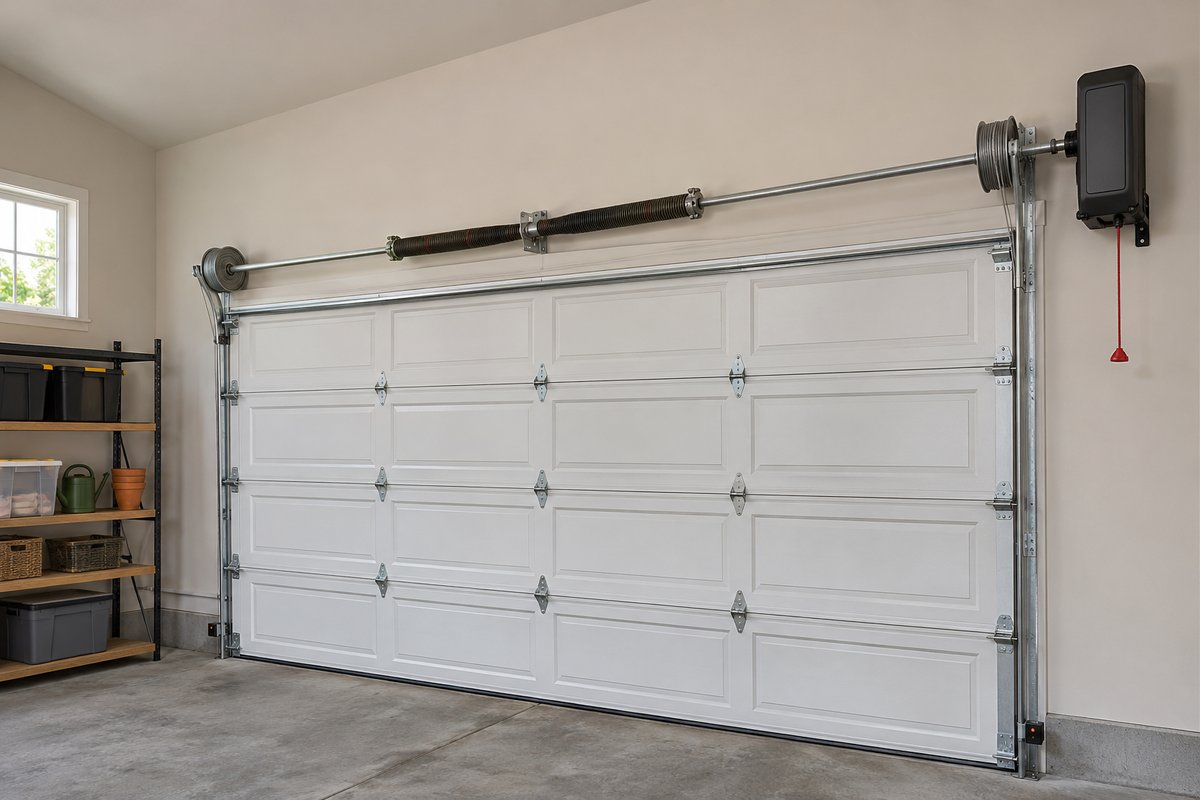
That makes it the answer for garages where a ceiling rail is in the way:
- Tall or vaulted ceilings, where a ceiling opener would hang on long brackets.
- High-lift and vertical-lift tracks, where the door runs up the wall before it turns.
- Overhead storage racks, a car lift, or a ceiling fan in the path of a rail.
- Wide doors. Chamberlain's wall-mount models are rated for doors up to 14 feet high, 18 feet wide and 180 square feet.
A wall-mount opener has strict requirements. From Chamberlain's pre-purchase checklist for its wall-mount openers:
| Requirement | Chamberlain wall-mount checklist |
|---|---|
| Door type | Sectional doors with torsion springs only. Not for doors with extension springs |
| Track | Not for low-headroom tracks with outside pickup drums |
| Side space | At least 8.5 inches between the side wall (or any obstruction) and the end of the torsion bar |
| Above the bar | At least 3 inches from the ceiling to the center of the torsion bar |
| Torsion bar | 1-inch bar, extending at least 1-1/2 inches past the bearing plate, undamaged |
| Drums | Not compatible with reverse-wound drums; smaller drums limited to doors up to 430 lbs |
| Power | A 120-volt outlet within 6 feet of the opener |
| Floor gap | No more than 1/4 inch under the closed door, or the reversal system can't work properly |
Wall-mount openers watch the cables too. Chamberlain's models use a cable tension monitor that detects slack in the door cables. If your door has extension springs (long springs that run along the horizontal tracks), a wall-mount opener isn't an option until the springs are converted to torsion. Our post on torsion vs extension springs explains the difference.
DC vs AC motors
The motor matters as much as the drive. Older openers, and some current ones, use an AC motor. Many current openers use a DC motor instead. For background, read the history of the electric garage door opener.
What a DC motor gives you, according to the manufacturers' own descriptions:
- Soft start and stop. The door eases into motion and slows before it reaches the floor or the top. Genie credits DC motors with soft start and stop for making newer chain drives much quieter.
- Battery backup. A DC motor can run from a battery, which is why battery backup comes on DC models. LiftMaster's wall-mount and DC belt and chain models offer it, built in or as an add-on battery depending on the model.
- Quieter running. Genie pairs its belt drives with a DC motor for that reason.
An AC opener in good shape still does the job; a DC motor is an upgrade, not a repair.
Horsepower ratings: what the numbers mean
Opener boxes carry a horsepower figure, and it is less precise than it looks.
On AC openers, the figure is a motor rating such as 1/2 HP or 3/4 HP. On DC openers, makers use a comparison rating instead. Genie labels its DC openers "HPc," horsepower comparable. Genie explains that a 1 HPc opener meets Genie's lifting-force specification for a 1 horsepower opener. In other words, it lifts like a 1 HP opener; it doesn't contain a 1 HP motor. Other brands use their own labels for the same idea, such as "HPS" on many Chamberlain models.
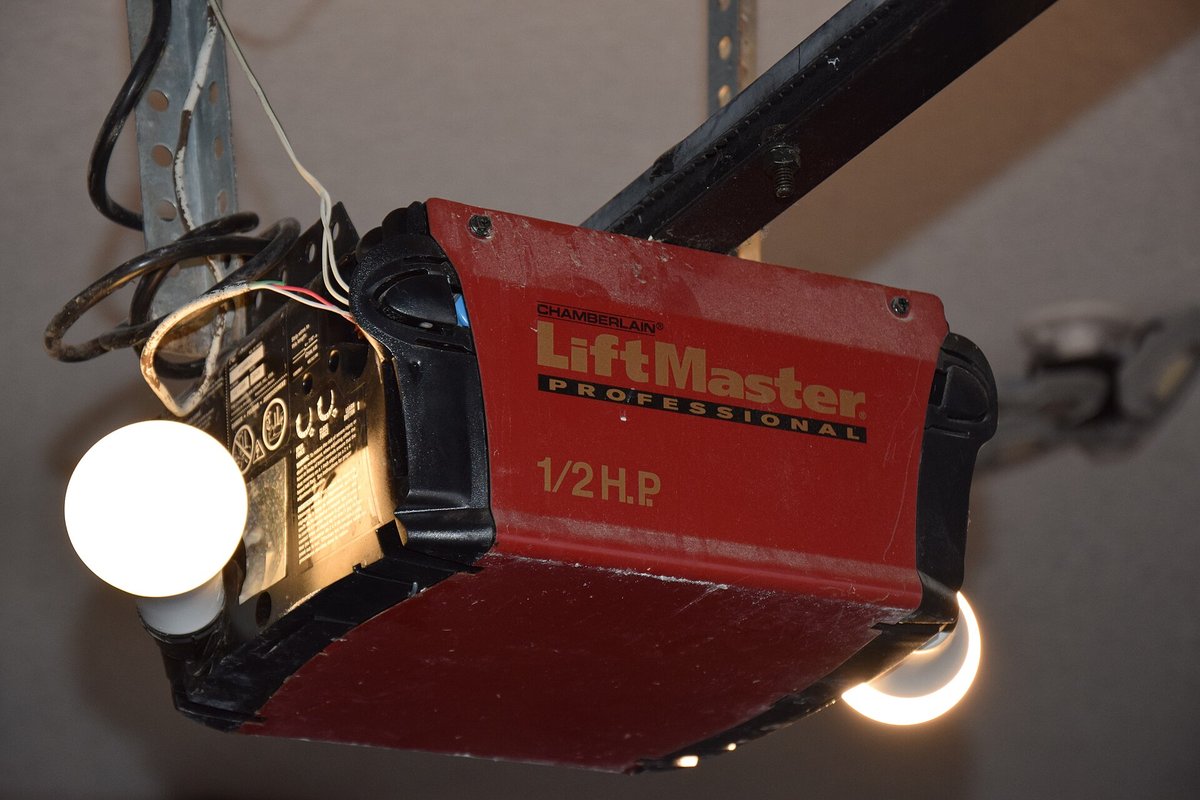
Photo: sheffieldb, Wikimedia Commons, CC BY 2.0.
What that means when you choose:
- Compare ratings within a brand, not across brands. A 3/4 HPc Genie and a 3/4 HP AC opener from another maker aren't measured the same way.
- Heavier doors call for the higher-rated models. Chamberlain points owners of heavy carriage-house doors to a 3/4 HP model with a stronger I-beam rail. Solid wood, double-wide doors and doors with heavy overlays fall in this group.
- More horsepower doesn't fix a heavy door. The springs, not the opener, carry the weight of a garage door. An opener pulling an out-of-balance door wears out early whatever its rating. Fix the balance first.
Noise: what makes an opener loud
Noise comes from four places, and only one of them is the drive type:
- The drive. Chain is loudest, belt and direct drive are the quietest ceiling types, and a wall-mount opener puts nothing overhead.
- The motor. A DC motor with soft start and stop is quieter than an AC motor that starts at full speed.
- The mounting. A rail fixed to the framing under a bedroom carries vibration into the room, which is why the drive type matters most there.
- The door. Worn rollers, dry hinges and an out-of-balance door make more noise than any opener. A tune-up covers all three.
If an opener has started making a new noise, that's a different problem. Our guide to an opener making noise but not opening matches each sound to its cause.
Headroom and ceiling depth
Every ceiling opener needs two kinds of space: depth, for the rail, and a little headroom above the door's highest point of travel. Check the headroom figure in your model's installation manual, since it varies by model and track.
Depth is easy to check. Chamberlain lists how far its rails reach back from the header wall:
| Door height | Chain drive rail | Overall length with motor unit |
|---|---|---|
| 7 feet | 116 inches | 124 inches |
| 8 feet | 128 inches | 136 inches |
| 10 feet | 152 inches | 160 inches |
So a standard 7-foot door needs a little over 10 feet of clear ceiling behind the header, and Chamberlain says that space should be free of beams, poles and other obstructions. Belt and screw drives are within a few inches of the chain figures.
Low ceiling, or something in the way? That's the case for a wall-mount opener, as long as the door has torsion springs and meets the checklist above. Tall doors on 8- and 10-foot openings need the longer rails, and a 10-foot door on a ceiling opener needs more than 13 feet of depth.
Battery backup
A battery backup runs the opener for a limited number of cycles when the power goes out, so you can get the car out without pulling the release and lifting the door by hand. California has required it since July 1, 2019: its law (SB 969) requires a backup battery on residential openers sold or installed in the state, after people were trapped in garages during the 2017 wildfires. Georgia has no such rule, but the reason it exists applies here too during an ice storm or a summer outage.
Battery backup is a DC-motor feature. Some LiftMaster models have it built in; on others it's an add-on battery. Backup batteries wear out over time, so the battery is a part you replace, not a one-time purchase.
Smart features and LiftMaster myQ
Newer LiftMaster openers have myQ, LiftMaster's app connection, built in; older ones can add it with a separate controller. LiftMaster describes what it does:
- See whether the door is open or closed from your phone, and open or close it from anywhere.
- Get alerts when the door opens or closes, or when it has been left open.
- Warning before a remote close: when you close the door from the app, the opener flashes and beeps for eight seconds before the door moves, so anyone in the garage has time to step clear.
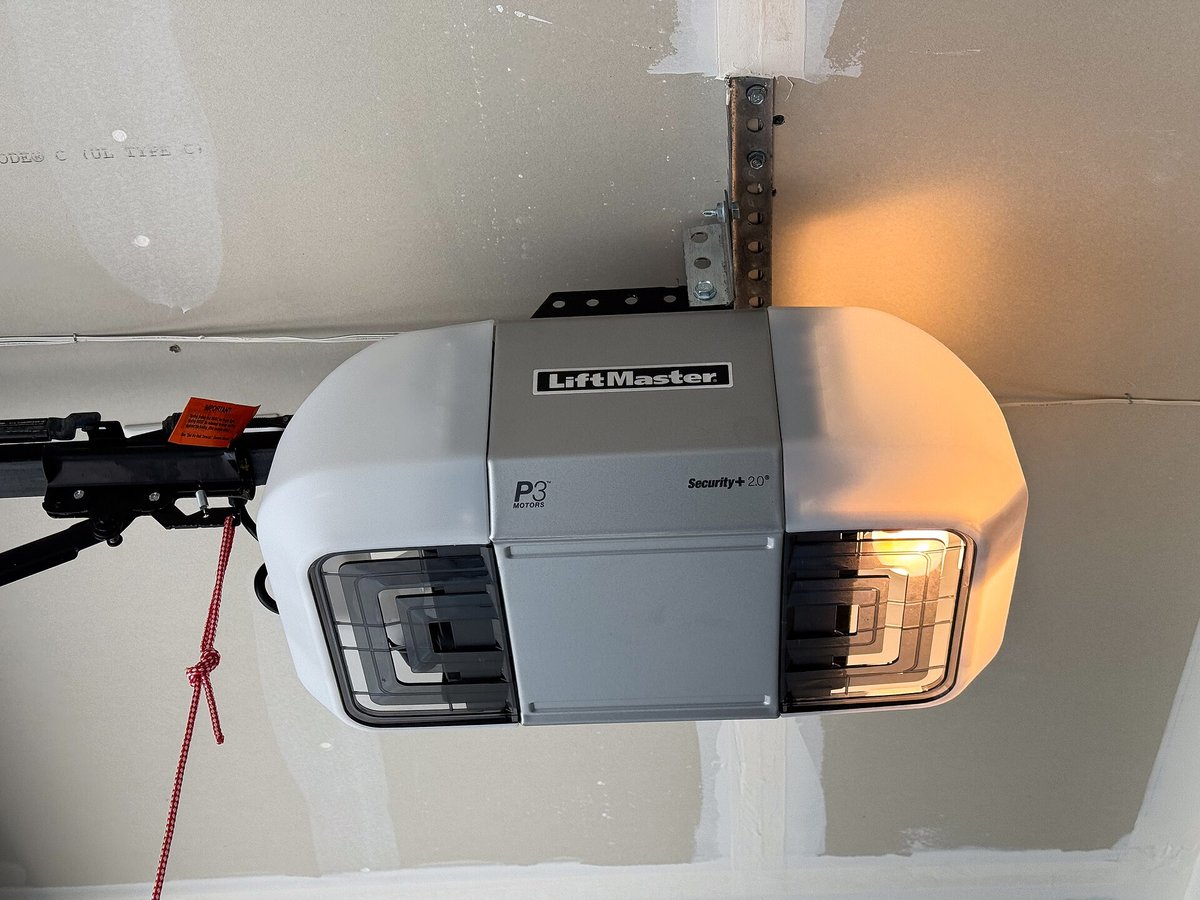
Photo: Tony Webster, Wikimedia Commons, CC BY 2.0.
Two things to know before you rely on app control. Chamberlain says remote operation and timer-to-close should be enabled only on sectional doors, not one-piece doors. And app control doesn't replace a keypad or remotes; most households use all three. If you're adding a keypad, see how to set a strong garage door keypad code.
Safety: photo eyes, auto-reverse and the monthly test
Every opener sold in the United States has to meet the same safety rules, whatever the drive type. They come from federal law and the UL 325 safety standard:
- Automatic reverse. The U.S. Consumer Product Safety Commission (CPSC) requires a reversing system on every opener made or imported for sale after January 1, 1991. The door reverses when it hits something while closing.
- A second, external protection. Since 1993, openers also need an external entrapment protection: photo eyes, a door edge sensor, or equivalent. UL 325 requires at least two of these protections on residential openers.
- Photo-eye height. The CPSC says photo eyes, the two small sensors near the floor on each side of the door, belong 4 to 6 inches above the floor.
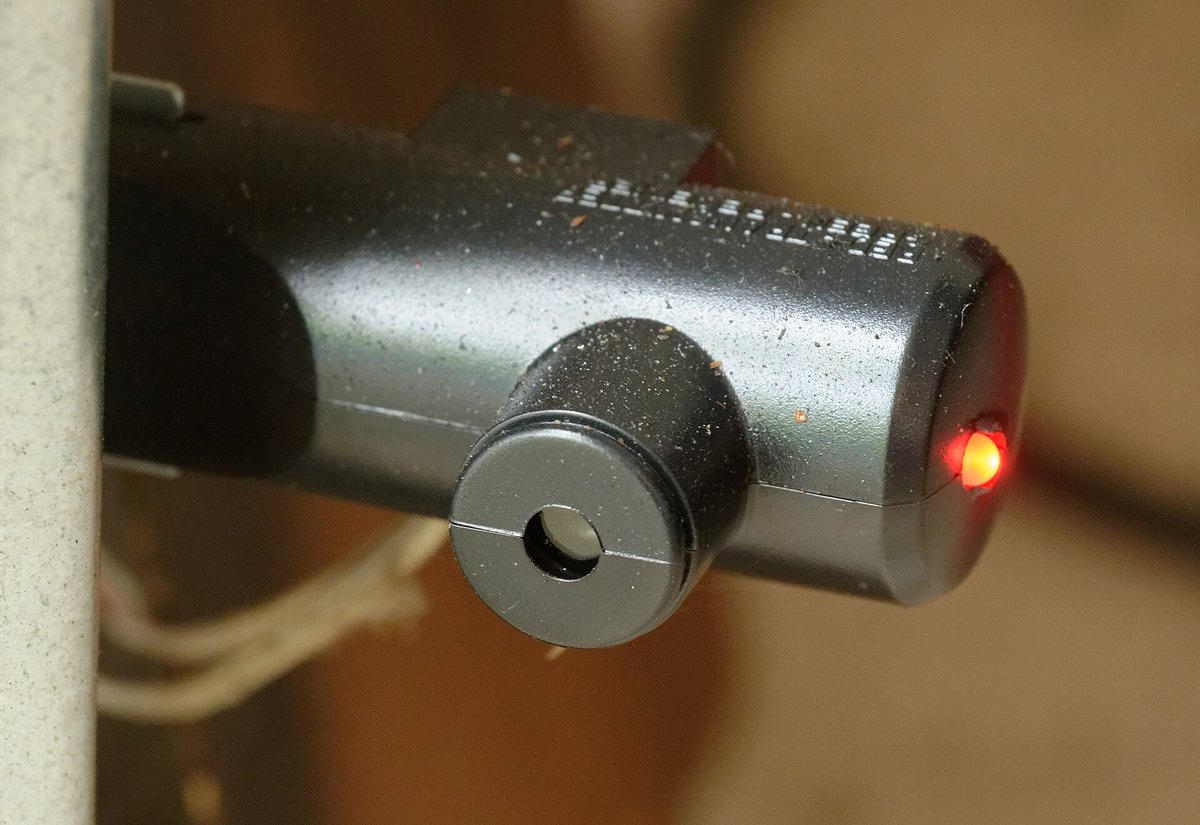
Photo: Jud McCranie, Wikimedia Commons, CC BY-SA 4.0.
The test the CPSC recommends. Inspect the door and opener every 30 days:
- Reverse test. Lay a 2x4 flat on the floor in the door's path and close the door. It should reverse when it touches the board. If it doesn't, stop using the opener until it's adjusted per the manual, repaired or replaced.
- Photo-eye test. While the door closes, pass something through the beam near the floor. The door should reverse.
- Balance test. With the door closed, pull the release cord and lift the door by hand to about halfway. A balanced door stays put. If it drops or shoots up, or binds and sticks, have it serviced.
The CPSC also advises mounting the wall button high enough that children can't reach it and keeping remotes away from them. An opener that doesn't reverse should be replaced, whatever its type or age.
Which opener suits your garage?
| Your garage | What usually works | Why |
|---|---|---|
| Bedroom, office or bonus room over the garage | Belt drive with a DC motor, or wall-mount | Quietest ceiling type, or nothing on the ceiling at all |
| Attached garage off the kitchen or hallway | Belt drive | Quiet, and the same footprint as a chain drive |
| Detached garage or workshop | Chain drive with a DC motor | Durable, and noise matters less away from the house |
| Tall or vaulted ceiling, high-lift track | Wall-mount | No long drop brackets or rail; fits high-lift doors |
| Storage racks, car lift or a fan in the rail's path | Wall-mount | Clears the ceiling |
| Heavy wood or carriage-house door | A higher-rated chain or belt model with a sturdy rail, or a wall-mount rated for the door | More lifting power, once the springs are sized for the door |
| Door with extension springs | Chain or belt drive | Wall-mount needs torsion springs |
| Frequent power outages | Any DC model with battery backup | Keeps the door working without power |
| You want app control and alerts | A LiftMaster with built-in myQ | Phone control, alerts and a warning before remote closing |
A heavy wood garage door or carriage-house door is the case where the door counts most. The springs have to be sized for its weight first; then the opener only has to move a balanced door, not lift a heavy one.
What affects how long an opener lasts
A National Association of Home Builders study put the typical life of a garage door opener at 10 to 15 years, but the same model lasts very different lengths of time in different garages. These are the things that decide it:
- Door balance. This is the big one. An opener lifting an out-of-balance door strains its gear and motor on every cycle. Chamberlain lists an out-of-balance door as the first thing to check when an opener struggles.
- Matching the opener to the door. An opener rated too low for a heavy door works at its limit every day.
- How often the door runs. A garage used as the main entry cycles many times a day.
- Upkeep the manual calls for. Chain tension, the right grease on older screw drives, and the monthly safety tests. See how to keep an opener from wearing out early.
- Installation. A rail that is level, a door arm set at the right angle, and force and travel limits set to the door all reduce wear. On a new door, these are part of the balance and opener checks at installation.
A stripped drive gear usually starts with a door that's working too hard. A yearly tune-up checks balance, springs, cables, rollers and the opener settings in one visit, and we cover both types of garage door springs with a written warranty: 3 years on torsion springs and 5 years on extension springs.
Brands: LiftMaster, Chamberlain, Craftsman and Genie
- LiftMaster is the professional line from Chamberlain Group, sold through authorized dealers and designed for professional installation. We are an authorized LiftMaster dealer. See our LiftMaster garage door openers page.
- Chamberlain openers come from the same company and are sold through home-improvement stores for do-it-yourself installation.
- Craftsman openers sold through Sears were also made by Chamberlain Group, and many share parts with LiftMaster and Chamberlain models.
- Genie makes chain, belt, screw-drive and wall-mount openers and is the name most linked to screw drives. See Genie garage door openers.
Get help choosing
We've installed and repaired openers across Metro Atlanta since 1999, and we're rated 4.9 on Google with Over 4,000 Five-Star Reviews. A technician can measure your ceiling, check the springs and the door's balance, and tell you which types fit before you choose. If your old opener still reverses and needs only one part, we'll tell you whether a repair makes more sense; see LiftMaster opener repair in Atlanta, or start with the garage door won't open guide if yours has stopped. You get a written price before any work starts.
Call (678) 271-8918, Monday to Sunday, 7 AM to 8 PM, or book a visit online. See all our garage door opener services.
Frequently asked questions
What are the main types of garage door openers?
Chain drive, belt drive, screw drive and wall-mount (jackshaft). A fifth, direct drive, moves the motor along a fixed chain. Chain is the most common, belt is the quietest ceiling type, screw has the fewest moving parts, and wall-mount frees the ceiling.
Which is quieter, a chain or a belt drive?
A belt drive. Genie calls belt openers the quietest of its types and recommends them for attached garages near living spaces. A chain drive with a DC motor and soft start and stop is much quieter than an older chain drive, but a belt is still quieter.
Which type of garage door opener should I get?
It depends on the garage. A room over the garage points to a belt drive or a wall-mount. A detached garage suits a chain drive. A tall ceiling, high-lift track or overhead storage points to a wall-mount, if the door has torsion springs. A heavy wood door needs a higher-rated model, after the springs are sized for it.
What horsepower garage door opener do I need?
Match the opener to the door's weight and size, and compare ratings within one brand. DC openers carry comparison ratings such as Genie's HPc, which means the opener lifts like an opener of that horsepower. Heavy wood and carriage-house doors call for the higher-rated models. No rating makes up for a door that is out of balance.
What is a jackshaft garage door opener?
Another name for a wall-mount opener. It mounts on the wall beside the door and turns the torsion bar directly, so there is no rail on the ceiling. It needs a sectional door with torsion springs and enough wall space beside the bar: Chamberlain's checklist calls for at least 8.5 inches.
Do I need battery backup on my garage door opener?
Georgia doesn't require it, but it keeps the door working during a power outage. California has required battery backup on new openers since 2019. Battery backup comes on DC-motor openers, either built in or as an add-on.
How do I test my garage door opener's safety features?
Every 30 days, as the CPSC recommends: lay a 2x4 flat in the door's path and close the door; it should reverse. Then pass something through the photo-eye beam while the door closes; it should reverse again. If either test fails, stop using the opener until it's adjusted or repaired.