Garages for cars appeared in the United States in the early 1900s. Owen L. Dautrick filed for an overhead garage door patent in 1919. He and C.G. Johnson went into business selling overhead doors in 1921.
Those dates tell two stories. One is about where Americans put their cars as they brought them home. The other is about how a door that once swung across the driveway came to slide over the car, then open at the push of a button.
The history of garages and garage doors at a glance
| When | What changed | Where the date comes from |
|---|---|---|
| Early 1900s | Americans adapted carriage houses for cars and built detached garages. | National Park Service account of early garages |
| 1919 | Owen L. Dautrick applied for a patent for a flexible door that lifted near the ceiling. | U.S. Patent 1,408,174 |
| 1921 | Dautrick filed for a hinged-section door and went into business with C.G. Johnson in Detroit. | U.S. Patent 1,530,762 and DASMA history |
| 1926 | Herbert Cady Blodgett filed for a patent for an electric door control and helped bring it into production with Johnson. | U.S. Patent 1,677,129 and Overhead Door's history |
| Late 1920s | Attached and built-in garages appeared in plans for small houses. | National Park Service, Historic Residential Suburbs, pp. 56–57 |
| 1954 | Alliance Manufacturing began making its Genie radio-controlled residential opener. | The Genie Company history |
| 1991 and 1993 | Federal entrapment protection requirements for automatic residential openers took effect and were strengthened. | CPSC account of the 1991 and 1993 requirements |
Where did people keep cars before they had garages?
Some early car owners used a barn or carriage house, a building that had sheltered horse-drawn vehicles. Many early cars had open tops, so a covered bay gave them a place out of the weather. Builders also began putting up detached garages specifically for automobiles, often behind the house or off an alley. A driveway or the alley connected the building to the street. The National Park Service describes this shift in its history of American residential suburbs.
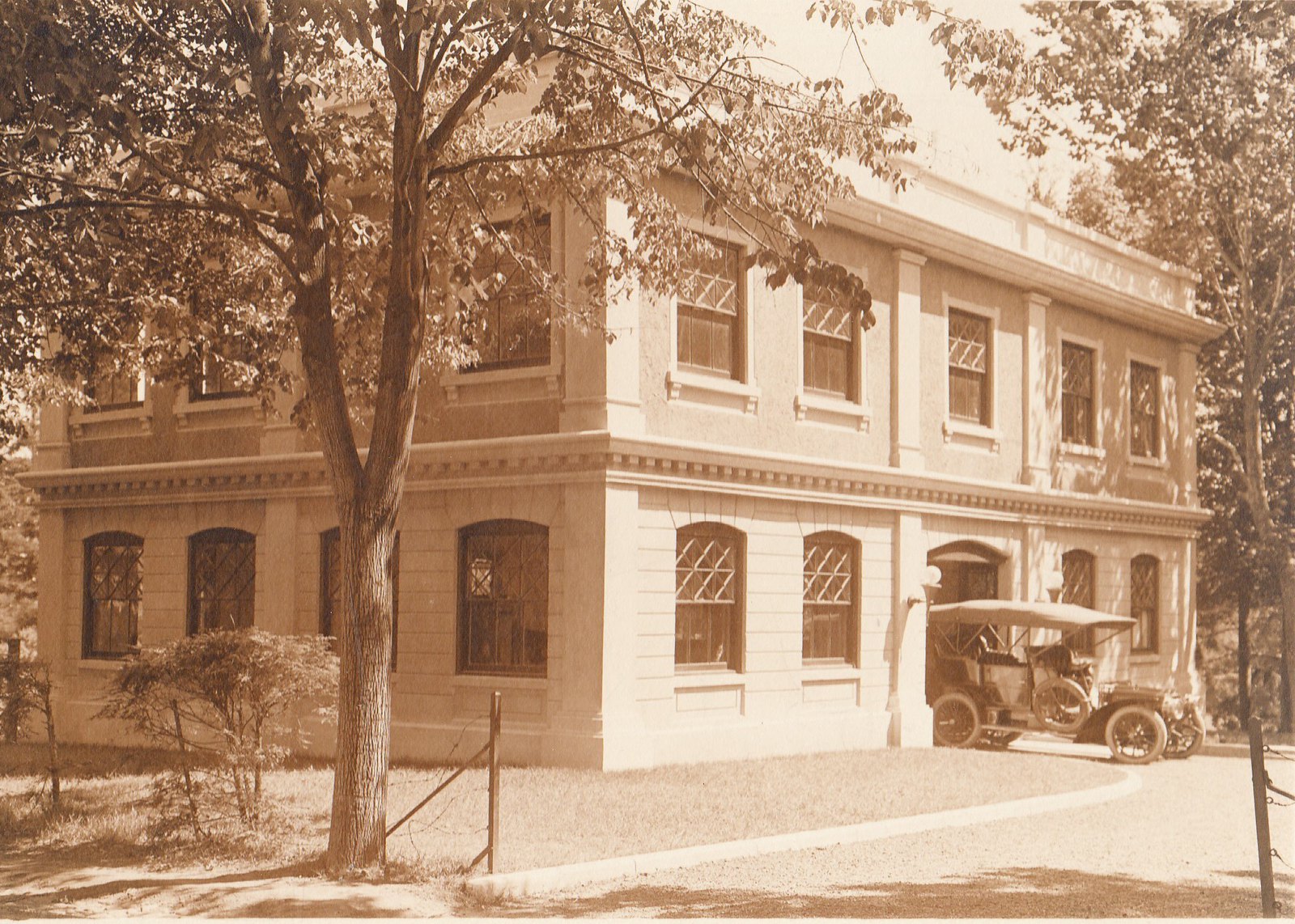
The car in the photo above is parked at Glenmont, the Edison family's estate in West Orange, New Jersey. The family built the concrete garage in 1908–09 to store and service its cars. It replaced a carriage house that had stood nearby. That makes Glenmont a documented example of the change from horse-drawn transportation to purpose-built automobile storage. In 1910, William A. Radford put out a catalog devoted to garages. Companies that sold pre-cut houses also began offering garages by mail, with styles and materials that matched their house plans. National Park Service records for Glenmont and the residential suburbs bulletin.
Garages appeared in town as well as in backyards. In Habersham County, the National Register of Historic Places records 1910 as a significant year for the Clarkesville Garage on North Washington Street. The Georgia Archives holds an early photo of the business with a gasoline pump out front. It shows another use of the word garage: a place that served motorists as well as housed cars. National Register listing and Georgia Archives photograph.
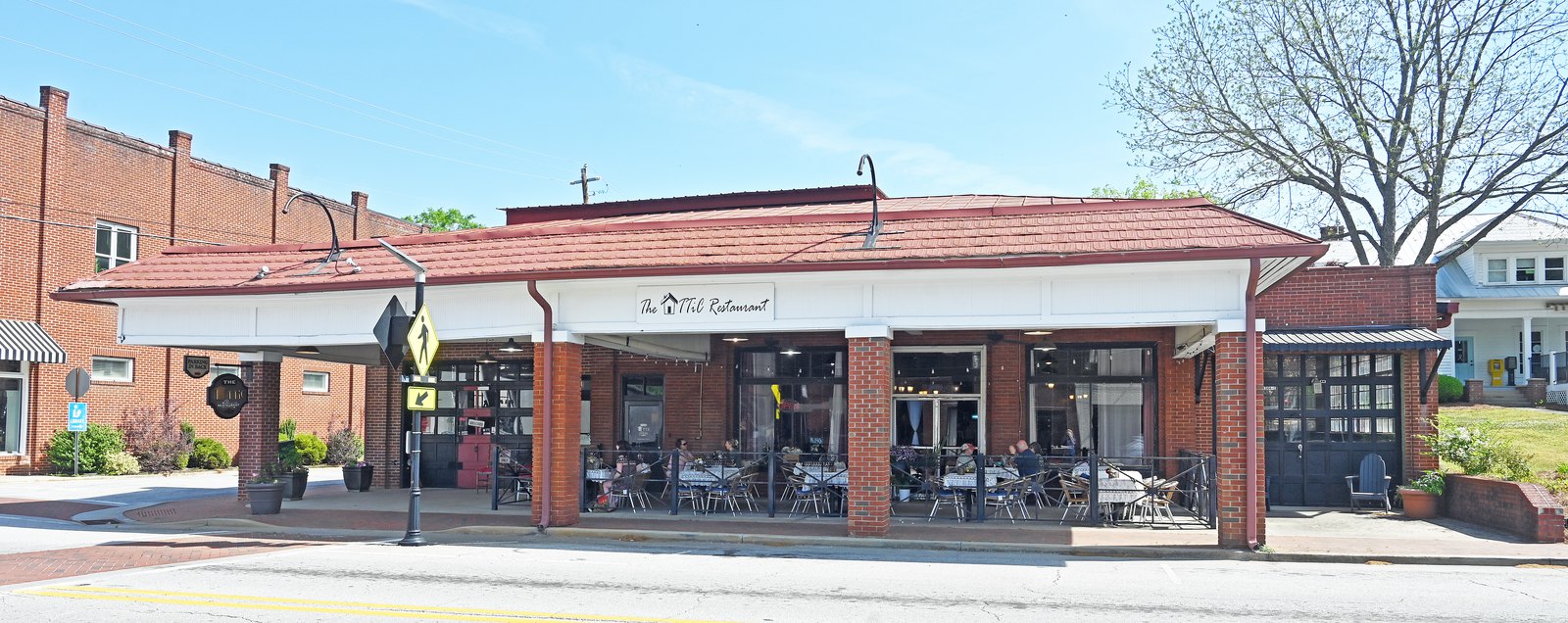
The former Clarkesville Garage now houses a restaurant. Photo by Bubba73, resized from Wikimedia Commons, CC BY-SA 4.0.

Who invented the overhead garage door?
Owen L. Dautrick is the named inventor on two early U.S. patents for overhead garage doors. C.G. Johnson was his business partner and a co-inventor on a later patent. Overhead Door's company history starts with their work in 1921. Dautrick's first filing in 1919 puts the design work earlier. Overhead Door company history and Dautrick's first patent.
Think about pulling up to a pair of side-hinged doors. If they swing out, you need room between the car and the garage for both doors to clear the bumper. The same doors need clear space along their arc when you open them from inside. Dautrick set out to move the door into space above the car. His 1919 application described a flexible door that rose up near the ceiling and left the vehicle's path clear. The U.S. Patent Office granted that patent in 1922. U.S. Patent 1,408,174.
In 1921, Dautrick filed again, this time for a door built from wide panels connected by hinges. Rollers at the sides guided the panels along tracks that curved into the garage. Johnson witnessed the application, which named Dautrick as the inventor. That filing became a patent in 1925. Between those dates, in 1922, Dautrick, Johnson and carpenter Arthur Kraska filed jointly for improvements to an overhead door. Their joint patent was granted in 1924. Dautrick's hinged-section patent and the three inventors' joint patent.
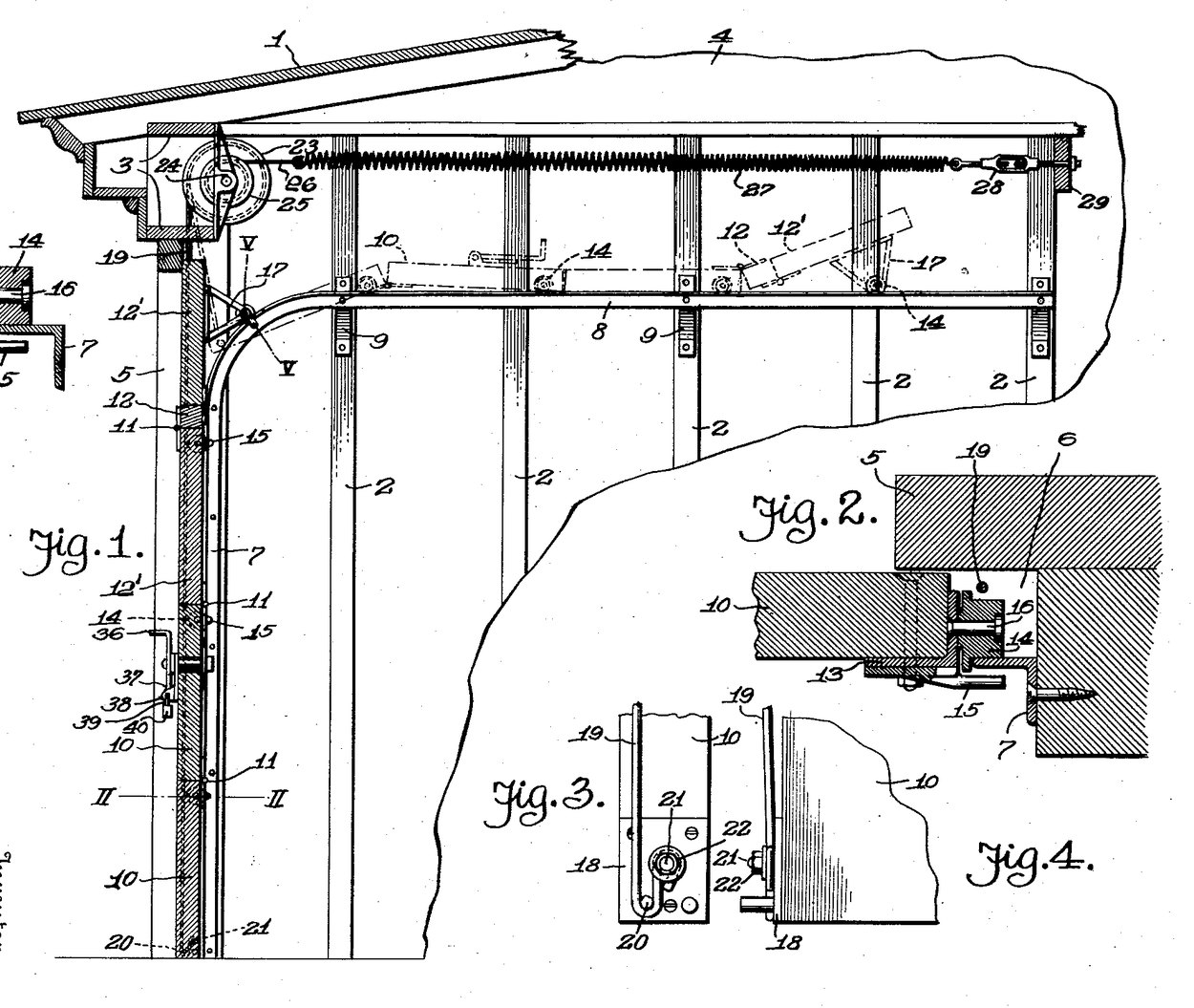
Dautrick's sectional garage door drawing, filed in 1921 and issued in 1925. Cropped and rotated from U.S. Patent 1,530,762.
Johnson also had to show buyers what the door did. He displayed it at the New York automobile show in 1923, according to the Door and Access Systems Manufacturers Association (DASMA). He and his wife, Flora, took the idea on the road with a working exhibit mounted on the back of a Model T Ford truck. A buyer could watch the door move up and out of the way before deciding to put one in a garage. DASMA centennial timeline.
How a sectional door fits above the car
The word sectional describes the horizontal panels that make up the door. When the door closes, the panels line up in a flat surface across the opening. As it opens, hinges let the panels change angle as the rollers travel around the bend in the tracks. The open door rests along the overhead part of the tracks. The patent drawing's main figure shows that change of direction at the upper corner.
Door travel and door weight are separate design problems. The track sets the path. A counterbalance offsets the weight so the door takes less effort to move. Dautrick ran springs above the open door. Johnson's own garage door patent, filed in 1923 and granted in 1927, housed compression springs at the sides of the doorway. The springs expanded as the door rose, helping lift it. Johnson's door mechanism patent.
On many residential overhead doors, springs do that work while the rollers guide the door. An electric opener moves the balanced door along its path. That is why the door, its garage door springs and the opener each have a job. Clopay's garage door components guide and CPSC garage door safety guide.
The swing clearance that a sectional door saves outside comes with a space requirement indoors. The tracks need room above the opening and space to extend into the garage. Installers call the clearance above the door headroom and the depth behind the opening backroom. In an older garage, a beam or pipe near the opening is worth pointing out when you have the space measured. Other types of garage doors move differently. A rolling steel door coils above the opening, an arrangement still used on commercial garage doors. Clopay's installation FAQ and commercial rolling door guide.
When did garages become part of the house?
By the end of the 1920s, builders included attached garages and garages below the main floor in stock plans for small homes. One early example is Radburn, New Jersey, where architect Frederick Ackerman designed houses with built-in garages in 1928–29. In 1940, the Federal Housing Administration introduced a design for a house that could expand, with a built-in garage already part of the plan. By the 1950s, designers were incorporating garages or carports into many homes. National Park Service, Historic Residential Suburbs, pp. 56–57.
You can see the difference on the site plan. A detached rear garage sits across the yard, reached by a driveway or alley. An attached garage can share a side wall with the house. A built-in garage can sit under living space in the same building. A carport gives the car a roof with open sides. Those layouts put shelter in different places on the lot and illustrate why garages have taken so many forms.
When was the electric garage door opener invented?
1926 is the milestone in Overhead Door's history. Herbert Cady Blodgett applied that year for his electric door control patent, which was granted in 1928. His design used a motor to open and close a door and switches to stop the motor at the ends of travel. Blodgett became president of the Door Control Company in Hartford City, Indiana, and Johnson became vice president. The patent names Blodgett as inventor. Blodgett's patent and DASMA's account of Blodgett.
There were earlier attempts to automate the door. DASMA found a 1923 ad for a product called the Boss Automatic Door Opener, offered as an option for the Dautrick-Johnson door. Blodgett's filing and the formation of Door Control Company give us a clearer record of how electric controls reached the market. DASMA's account of early openers.
Electric operation and radio control solved different problems. An electric motor moved the door when the user operated a switch. A radio transmitter let the driver send the command from the car. In 1954, Alliance Manufacturing began producing its Genie radio-controlled residential opener, a mass-market milestone the company documents in its manufacturer history. The types of garage door openers guide explains how the different drives move a door. Some current garage door openers add phone control and status alerts, including LiftMaster models with myQ.
When did garage door safety sensors arrive?
The key U.S. dates are January 1, 1991, and January 1, 1993. The first brought federal entrapment protection requirements, including automatic reversal, for automatic residential openers manufactured for sale in the U.S. The second brought additional entrapment protection requirements. A photoelectric sensor, also called a photo-eye, was one option under the 1993 rules. Other specified ways to comply included a sensing edge or a wall control that had to be held continuously to close the door. CPSC's first standard announcement and its 1993 rules announcement.
On an opener with photo-eyes, the sensors watch a beam across the opening near the floor. If a box breaks the beam as the door is closing, the opener reverses before the door hits the box. The opener's contact reversal is a separate check. It responds when a closing door encounters resistance. If you have an older opener, find its model label and follow the manufacturer's testing instructions. Our garage door sensor guide explains what the sensor lights mean. CPSC residential garage door safety guidance.
What carries over to the garage door you use?
The carriage-house look is still easy to find. A current door can have a center seam, small windows and decorative handles that suggest a pair of doors on hinges. Look from inside and you can see whether it swings on side hinges or has the horizontal joints and tracks of a sectional door. Manufacturers sell sectional carriage-house designs in wood and in materials such as insulated steel with a composite overlay. Steel, wood and aluminum with glass are also used in other designs. Clopay's carriage-house guide and materials guide.
If you're comparing an older door with a replacement, here's what you can check from the floor with the door closed. DASMA's occupant inspection guide.
- Look at the door from inside. Note whether you see side hinges or a series of horizontal sections. Take a photo of the opening and any low beams or pipes above it.
- Read the labels you can reach safely. Write down the door and opener model numbers if you can find them. Use the opener model to look up the correct manual and safety tests. The garage door maintenance checklist explains what to look for during a routine check.
- Leave loaded hardware to a technician. Springs, lift cables and bottom brackets are under tension. If the door looks crooked or you see a broken spring or frayed cable, stop using the door and have the hardware checked. DASMA garage door safety tips.
If you're keeping a carriage-house look or fitting a new door into an older opening in Metro Atlanta, see our garage door installation and replacement service. Call All Four Seasons at (678) 271-8918 or request an estimate.
Frequently asked questions
When were garages invented?
Garages for cars appeared in the U.S. in the early 1900s. Some owners adapted carriage houses or barns. Others built garages for automobiles, as the Edison family did at Glenmont in 1908–09. The records show a building type taking shape over several years. National Park Service garage history and Glenmont historic structures report.
Where did the word garage come from?
The French garage comes from garer, a verb used for putting something under shelter or parking a vehicle. In French, garage can describe a covered place for vehicles or a business that stores or repairs cars. Dictionnaire de l'Académie française.
When were overhead garage doors invented?
Owen L. Dautrick filed for a flexible upward-lifting door in 1919 and for a hinged-section design in 1921. Dautrick and C.G. Johnson began manufacturing and selling overhead doors in 1921. They later shared a patent for door improvements with Arthur Kraska. DASMA centennial timeline.
Did C.G. Johnson invent the electric garage door opener?
Johnson helped bring an electric opener to market with Herbert Cady Blodgett. Blodgett is the named inventor on the electric door control patent filed in 1926. He and Johnson led the company formed to manufacture electric door controls that year. U.S. Patent 1,677,129 and DASMA's history.
Are carriage-house garage doors still swing-out doors?
Some are side-hinged and swing out. Many carriage-house designs sold now use tracks and hinged sections to open overhead. Decorative straps and handles can give a sectional door the look of a pair of swing-out doors. Clopay's carriage-house garage door guide.
Does an overhead garage door need an electric opener?
An overhead door can work by hand when its hardware is in good condition and its springs balance the weight. If your door has an opener and the power goes out, follow the manual's instructions and our guide to opening a garage door manually. A damaged or unusually heavy door needs a technician. CPSC residential garage door safety guidance.
Top photo: Glenmont garage, 1909, National Park Service, Thomas Edison National Historical Park. Public domain, cropped.