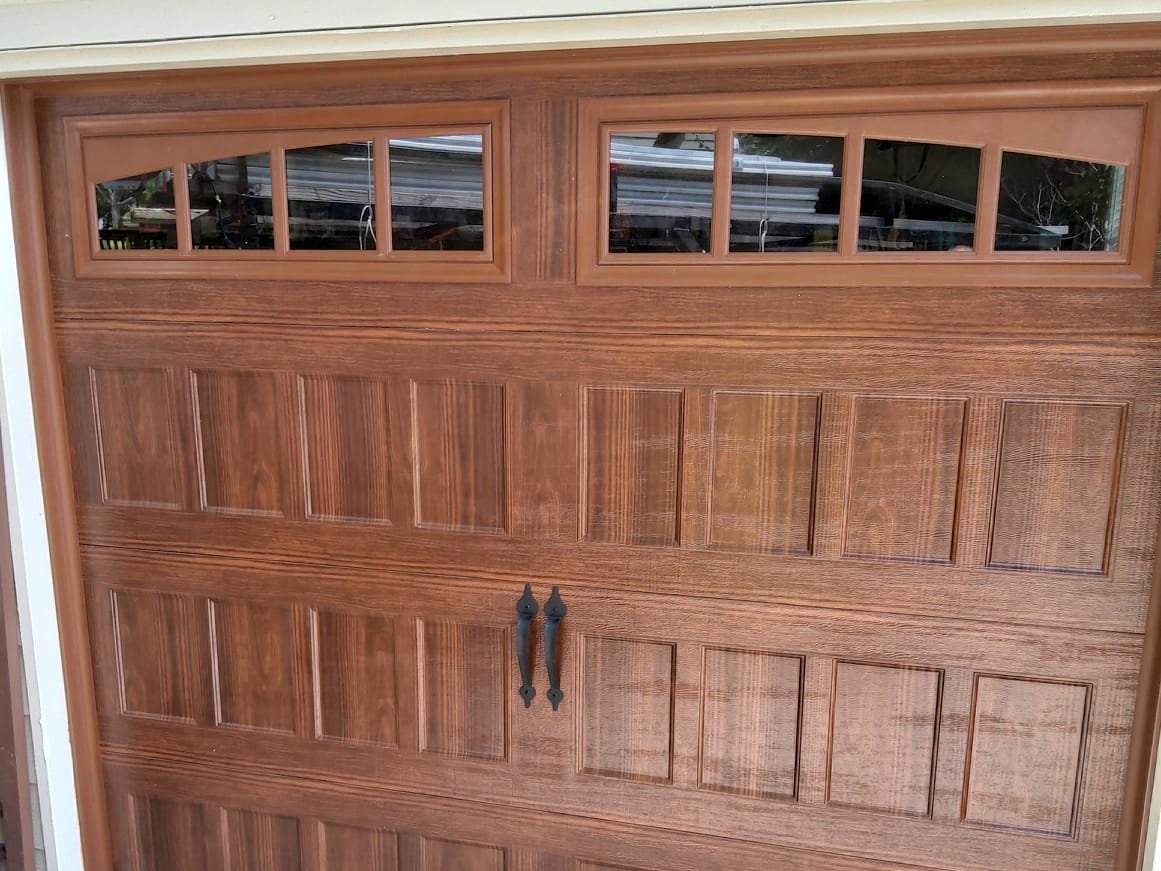
To make a steel garage door look like wood, clean it, prime any bare metal, roll on a light tan base coat, drag a darker brown glaze or gel stain through it with a graining tool, and seal it with an exterior clear coat. Check your door maker's painting rules first, because some coatings void the finish warranty.
This guide covers each step, the weather you need in Metro Atlanta, what Clopay, Amarr and C.H.I. say about painting their doors, how to paint a real wood door, and when a factory wood-look door makes more sense.
The job at a glance
| What to expect | |
|---|---|
| Skill level | Patient DIY. No door hardware comes off |
| Working days | Two to four, because each coat must dry before the next |
| Weather | Dry, mild days, out of direct sun, inside the range on every can |
| Base coat | 100% acrylic latex exterior paint in a light tan or golden color |
| Grain coat | A darker brown gel stain or glaze, or a second latex color brushed on dry |
| Top coat | An exterior clear finish approved by the grain coat's maker |
| Don't touch | Springs, cables, bottom brackets, rollers, the opener |
Before you buy paint: check what your door maker allows
A steel garage door leaves the factory with a baked-on paint system covered by the maker's paint warranty. Most steel doors can be repainted, but each maker sets its own rules:
| Door maker | What its documents say about painting |
|---|---|
| Clopay | Its painting instructions (effective May 11, 2020) allow "high quality 100% acrylic latex (flat, satin or semi-gloss) exterior grade paint" and strongly recommend a bonding primer. They add: "Do not use any type of oil-based paint or alkyd modified paint. These paints will void the warranty of your door." Not following the instructions also voids the warranty |
| Amarr | The residential steel door warranty (form 842, Nov. 2024): "Non-factory applied paint on an Amarr door voids the Paint Finish warranty." Non-factory paint on window frames or inserts voids the window warranty too |
| C.H.I. | Its steel door finishing instructions: wash with TSP, buff lightly with extra-fine steel wool, coat bare metal with a zinc-based primer, then use a quality oil-based or latex exterior paint, testing a small area first. Its warranty excludes "defects in paints or coatings used to finish door sections" |
What this means for a faux wood finish. Most gel stains are oil-based; the Old Masters gel stain data sheet lists an alkyd vehicle. That is fine on an older door whose paint warranty has run out, and C.H.I.'s instructions accept oil-based paint. On a Clopay door still under warranty, an oil-based gel stain clashes with the "no oil-based or alkyd" rule, and on an Amarr door any non-factory paint ends the paint finish cover. If your door is new, read your warranty or call the maker first, or use the latex-only method below.
Not sure who made your door? Look for a label on the inside, often on an end stile or the bottom section. Our garage door brands guide covers each maker's published warranty.
Two ways to make steel look like wood
| Method A: latex dry-brush grain | Method B: gel stain over a latex base | |
|---|---|---|
| Grain coat | A darker 100% acrylic latex, brushed on almost dry | Oil-based gel stain pulled through with a graining tool |
| Look | Brush-stroke grain, softer up close | Deeper color, more convincing grain |
| Clopay door under warranty | Fits the rules (all latex) | Doesn't fit (oil-based) |
| Amarr door under warranty | Ends the paint finish cover | Ends the paint finish cover |
| Clean-up | Soap and water | Mineral spirits; oily rags are a fire risk |
Both start the same way: clean, prime where needed, test, and lay down a light base coat.
Pick your colors, and keep dark doors in mind
Faux wood uses two colors: a light base that shows through as the pale part of the grain, and a darker grain coat. A tan or golden base under a medium or dark brown reads as oak, cherry or walnut from the street. Try your pair on a primed scrap first.
Dark finishes on insulated steel doors bring thermal bowing. DASMA, the door manufacturers' association, explains in Technical Data Sheet #185 that a dark insulated door facing the sun on a hot day bows outward more than the same door in white, and that a south-facing door is more likely to bow than a north-facing one. A bowed top section can rub the header. The makers limit dark colors for this reason:
- Clopay recommends solar reflective paint on all doors. On its Coachman carriage house doors it requires approved solar reflective paint for colors with a Light Reflectance Value (LRV) of 13 to 38 and doesn't permit 12 or below.
- Amarr allows its Classica doors to be painted with 100% acrylic exterior latex with an LRV of 8 or higher.
- C.H.I. says painting its overlay carriage house doors (5300, 5500, 5600 and 5800 series) a color under 50% LRV voids the warranty, except with Sherwin-Williams VinylSafe paint.
The LRV is usually on the paint chip or the paint maker's website. For choosing and matching colors, see our garage door paint color guide.
What you need
- Prep: TSP or a biodegradable cleaner, sponges, gray synthetic scuff pads (Clopay specifies gray, not green), a hose with a gentle spray, fine sandpaper for rust spots, a zinc-based or rust-inhibiting metal primer, a bonding primer, blue painter's tape, plastic sheeting and a drop cloth.
- Paint: 100% acrylic latex exterior paint for the base (and the grain for Method A); for Method B, an oil-based gel stain made for primed metal and exterior use, plus mineral spirits.
- Tools: a wood-graining rocker tool or graining comb, stiff brushes of several widths, a 4-inch brush, a small short-nap roller, a step ladder, gloves and eye protection.
- Finish: an exterior clear coat the grain coat's maker approves.
The Atlanta weather window
Paint needs a narrow band of temperature and humidity, and Atlanta's year swings well outside it. NOAA's 1991–2020 normals for Hartsfield-Jackson airport:
| Month | Normal high | Normal low | For painting |
|---|---|---|---|
| Dec–Feb | 54–58°F | 36–39°F | Too cold at night for most latex |
| Mar | 66°F | 45°F | Mild stretches only |
| Apr | 74°F | 53°F | Good |
| May | 81°F | 61°F | Good, in the morning shade |
| Jun–Aug | 87–90°F | 69–72°F | Hot and humid; early morning, out of the sun |
| Sep | 84°F | 66°F | Good late in the month |
| Oct | 74°F | 55°F | Good |
| Nov | 64°F | 44°F | Mild stretches only |
What the paint makers say:
- Read the can. Clopay says not to paint when the door's surface temperature is outside the paint maker's suggested range.
- The temperature matters for two days. Sherwin-Williams says conditions should ideally stay in the suggested range and above the dew point for at least 48 hours after painting. It calls 50°F the normal minimum for latex, and names some exterior lines that can go on and cure as low as 35°F.
- Watch for evening dew. Sherwin-Williams warns that a warm afternoon followed by a cool night puts dew on fresh paint, which can cause staining and adhesion problems. Finish early enough for each coat to set before sundown.
- Avoid direct sun. Hot sun dries paint too soon, Sherwin-Williams says, leaving brush marks, lap marks and poor adhesion. Paint a south- or west-facing door in the morning.
- Graining products like mild, dry air. Old Masters lists 70–75°F and 35–50% humidity as ideal for its gel stain. General Finishes recommends 70°F and 50% humidity, out of direct sun, for its glaze and its Exterior 450 clear coat.
In Metro Atlanta that points to April, May, late September and October, on days with no rain in the forecast.
Step 1: Clean the door properly
Paint sticks to clean steel and peels off dirty steel. Clopay's method:
- Mix 1/3 cup of TSP (or a biodegradable cleaner) into 1-1/2 to 2 gallons of water. Never mix cleaners or ammonia with bleach.
- Scrub with a gray pad soaked in the solution, with even pressure on every surface you'll paint. This cleans and lightly scuffs the factory finish.
- Rinse well, changing the water often, then give the door a final rinse.
- Remove any wax. Doors aren't waxed at the factory, but if someone waxed yours, wipe it with a rag soaked in xylene and don't let the solvent sit on the door.
- Let it dry completely.
Don't sand the whole door: Clopay notes that sanding can remove rust-inhibiting compounds, so sand only spots where bare metal shows. Don't use a pressure washer: Amarr's warranty excludes damage from one.
Step 2: Fix rust spots and prime
- Bare metal and rust: sand back to clean metal and coat with a metal primer. C.H.I. specifies a zinc-based primer.
- The whole door: Clopay strongly recommends a bonding primer as a first coat so the latex sticks. Follow the primer's label for drying time.
- Dents: paint won't hide a creased panel. A badly dented section is better replaced first; see garage door panel replacement.
Mask what you don't want painted: the weather seals, handles, lock, and window frames and inserts (on an Amarr door, non-factory paint on them voids their warranty).
Step 3: Test before you paint the whole door
Clopay requires a pre-test, and C.H.I. recommends one:
- Paint a small area following the can's directions.
- Let it dry, then look for blistering or peeling.
- Press masking tape over the spot and peel it back. The paint should stay on the door.
If it blisters, peels or lifts, Clopay says don't proceed: change the paint or the prep. For Method B, test the gel stain over a dried patch of base coat too, so you see the real color.
Step 4: Roll on the base coat
With the door down and the opener unplugged, apply the light base color in 100% acrylic latex exterior paint. Work from the top section down, brushing the recessed panel edges first and then rolling the flat areas. Keep coats thin so the recesses don't sag, plan on two coats, and wait the recoat time on the can. Let the base dry fully before graining; graining over soft paint drags it off.
Step 5: Grain the door
Real wood doors are built from horizontal rails and vertical stiles, with the grain running along each board. The factory finishes copy this: Amarr calls its woodgrain "dual directional for all panel designs," and Clopay's Ultra-Grain runs the oak grain horizontally on the rails and vertically on the stiles and panels. So grain in two passes:
- Tape off the vertical stiles and grain the horizontal rails, pulling each stroke the full width of the section.
- Let the rails dry, move the tape to cover them, and grain the stiles and panels vertically.
- Step back often and look from the end of the driveway. Fill thin spots and soften anything too regular.
Practice on a primed scrap or the inside face of the door first. Small stiff brushes make tight grain; wide soft ones make broad streaks.
Method A: latex dry-brush grain
Dip only the tips of a stiff brush in the darker latex and wipe most of it off. Drag it in long, light, slightly uneven strokes so the base shows between the bristle lines. Vary the pressure and let some strokes wander: even lines look painted, irregular ones look like grain. Add a second pass after the first dries for more depth.
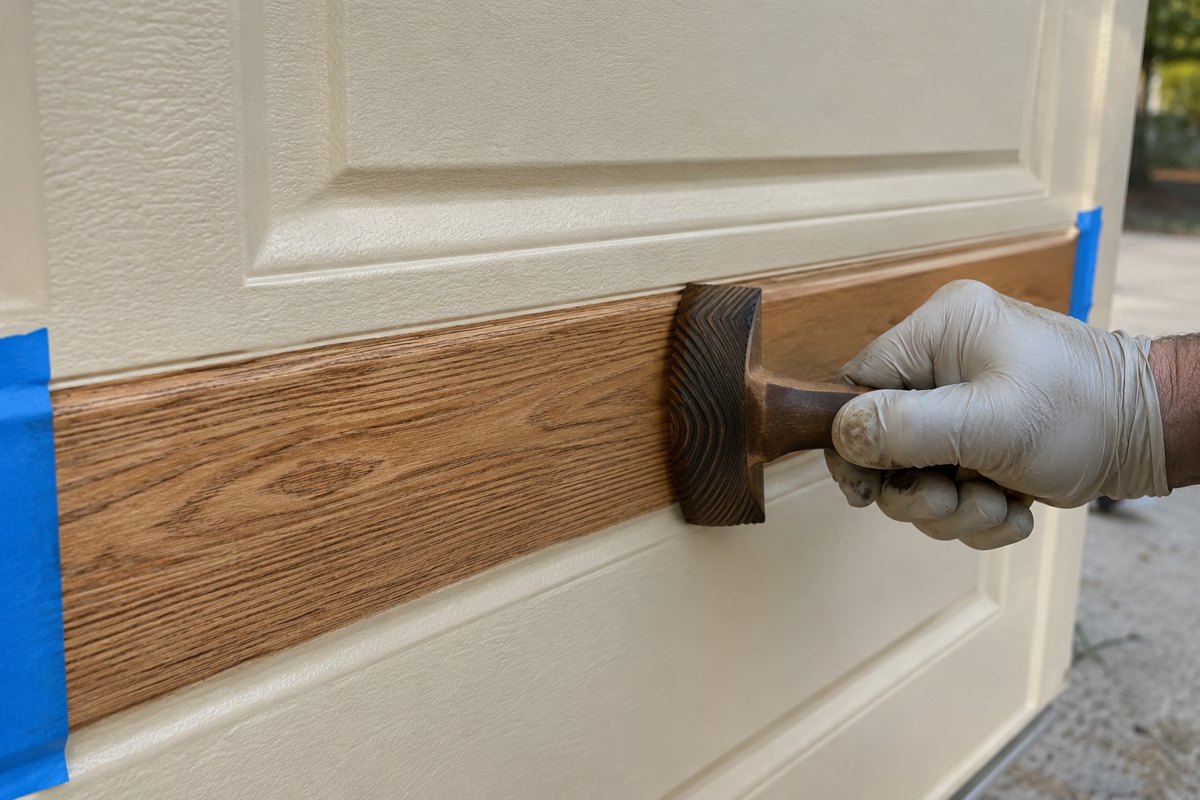
Method B: gel stain and a graining tool
The Old Masters gel stain data sheet (rev. 11/2020) describes this use: over a painted surface, "to create a simulated wood look," apply the stain with long, smooth strokes and form the grain with a wood-graining tool. It lists the stain for primed metal and exterior fiberglass.
- Work one rail or panel at a time so the stain stays wet.
- Brush on a thin, even coat.
- Pull the graining tool through it in one slow stroke, rocking it gently to form the oval heart-grain marks. Wipe the tool after each pass.
- Let it dry. Old Masters gives about 6 to 8 hours, depending on temperature, humidity and how much stain is on the surface, and says a second coat can go on after 8 hours.
Fire warning: Old Masters says rags, steel wool and other waste soaked with its oil-based stain can catch fire by themselves. Put them straight into a sealed, water-filled metal container and dispose of them by local fire rules.
Step 6: Seal it with an exterior clear coat
- Over gel stain: Old Masters says an exterior clear top coat is "strongly recommended" outdoors, and to let the stain dry completely, then wait another 24 hours before a water-based clear goes on.
- Over a glaze: General Finishes says to seal its Glaze Effects with 2 to 3 coats of top coat, but lists that glaze for interior use. On a garage door, choose a glaze its maker approves for exterior use, or use Method A.
- An example clear coat: General Finishes' Exterior 450 is a water-based acrylic/urethane clear for exterior doors, used over stain or non-white paint, with at least 3 coats, 2 hours between coats and a 21-day cure at 70°F and 50% humidity.
General Finishes advises testing first whenever one maker's product goes over another's. Use the products each maker names, and test a patch before you clear the whole door.
Step 7: Let it cure, then run the door
Pull the tape while the last coat is fresh enough to leave a clean line, and leave the door closed while it dries so wet paint at the section joints doesn't stick. Then plug the opener back in, run the door once, and watch the joints for sticking. "Dry" isn't "cured," so wash gently with mild soap for the first few weeks. After that, touch up chips in the base color before rust starts and recoat the clear when it turns dull or chalky. Our garage door maintenance checklist covers the rest of the door.
Throughout the job, leave the moving parts alone. Clopay warns that springs, bottom brackets, cables and related hardware are under high tension and can cause serious injury. Paint around them, not on them. If a spring or cable looks damaged, stop and see our garage door spring repair page.
Painting a real wood garage door
Wood takes paint and stain well but needs more prep and upkeep than steel. Clopay's wood door care manual sets out the method:
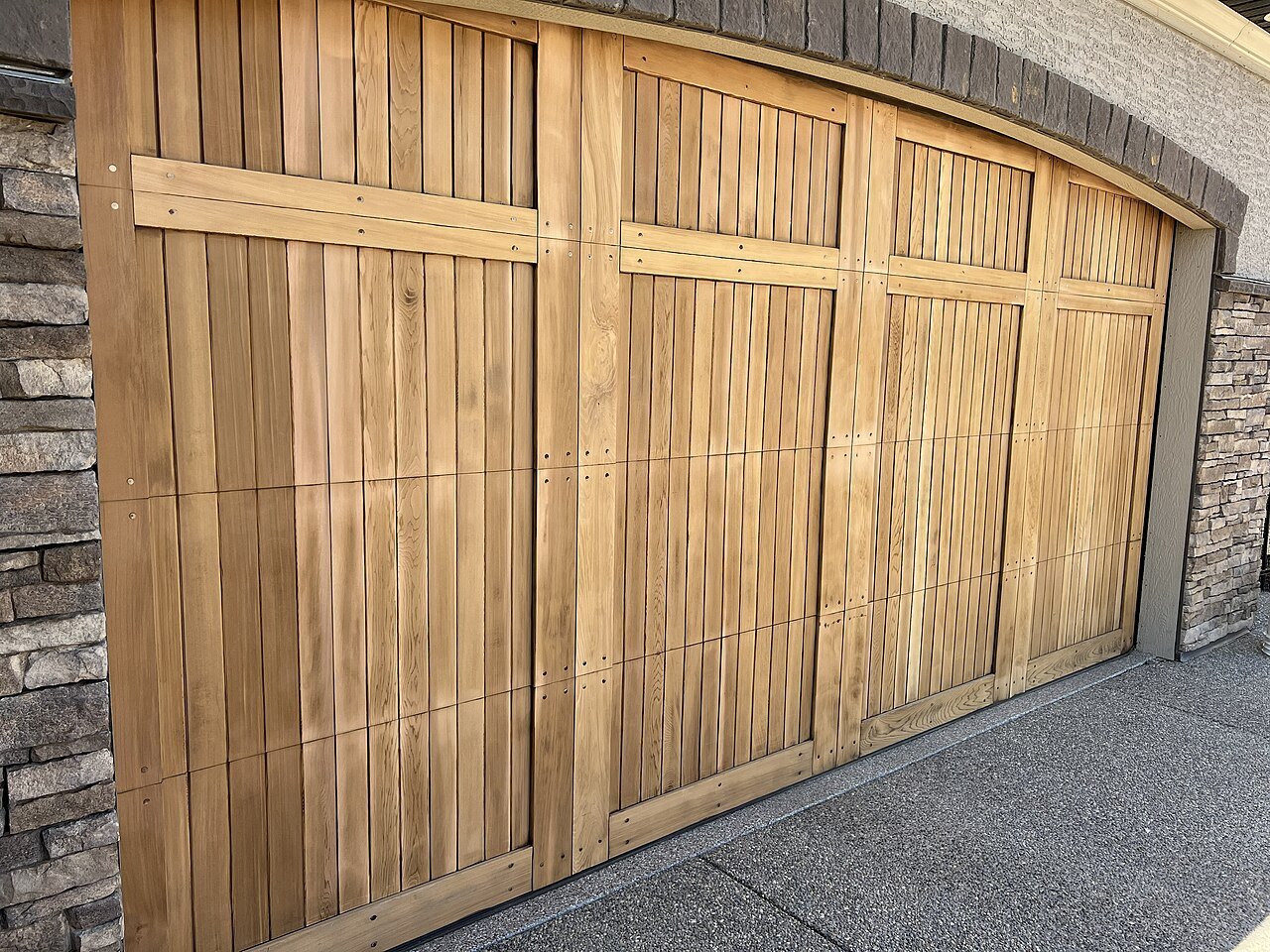
Photo: Dynamic Painting, CC BY 4.0, via Wikimedia Commons.
- Clean with a stiff bristle brush. Sand out scars or stains with 180-grit paper, with the grain only.
- Caulk the gaps between rails, stiles and panels with exterior paintable caulk (not silicone). Fill nail and screw holes with exterior wood filler.
- Prime all six sides of each section with a quality oil- or latex-based exterior primer suited to the wood. Redwood and cedar need a primer with a tannin blocker, or the wood can discolor the paint.
- Apply two finish coats of exterior paint compatible with the primer. Factory-primed doors take a latex finish.
- Avoid dark colors on sunny doors. Clopay says dark colors are not recommended, especially with direct southern exposure, because the heat can shrink, bow and crack the wood.
Staining instead. Clopay calls for a quality exterior oil-based penetrating stain that resists mildew, UV and water, and says not to use film-forming finishes such as varnish or urethane on its wood doors.
Upkeep. Clopay recommends repainting a painted wood door every 1 to 2 years and checking the finish every year; the bottom section takes the most water. See how to take care of wooden garage doors and our wood garage doors page.
Old paint and lead. The EPA says homes built before 1978 are more likely to have lead-based paint, and that its dust and chips are a common source of lead exposure. If you'll scrape or sand an old painted door, learn the EPA's lead-safe practices first.
The alternative: a factory wood-look steel door
If the door is dented, rusting or near the end of its life, or you'd rather not repaint every few years, the major makers sell steel doors with a factory wood-look finish:
- Clopay Ultra-Grain. Clopay describes it as a painted steel surface that looks like a stained door without the staining and upkeep of wood. On its Classic Steel line it comes in Medium, Cherry and Walnut over a stucco-textured steel face.
- Amarr woodgrain finishes. Golden Oak, Walnut and Mahogany on its steel doors, dual-directional on every panel design.
- C.H.I. Accents Woodtones. A wood-look finish on several C.H.I. steel lines, warranted for three years against color change beyond a set limit, with touch-up kits sold through dealers.
- Composite overlay carriage house doors. Clopay's Coachman and similar doors add a wood-look overlay to an insulated steel door, and take exterior latex paint within the dark-color limits above.
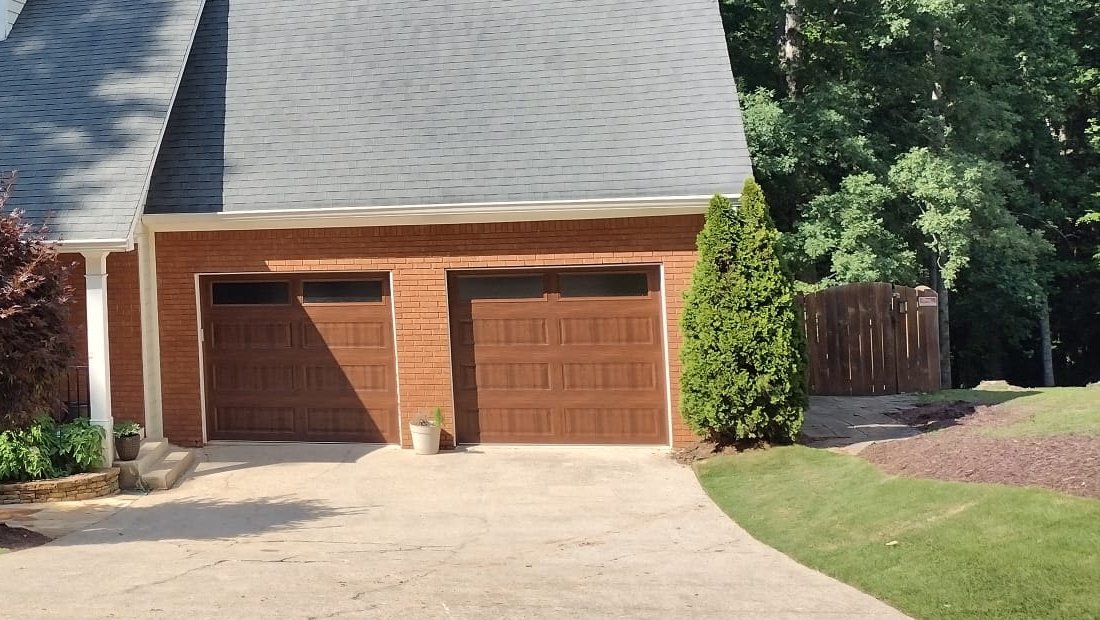
A factory finish carries the maker's paint warranty, which a home-applied faux finish doesn't, and a new door can add insulation and a new spring system in the same job. Compare options in our garage door types guide, see our steel and carriage house garage doors, or read about new garage door installation.
DIY or call us?
| Job | DIY? | Why |
|---|---|---|
| Cleaning, priming and faux wood painting | Yes | No hardware comes off; follow your maker's rules |
| Touching up chips and rust spots | Yes | Sand, prime, paint |
| A worn or paint-covered bottom seal | Usually | See weather seal replacement |
| A dented or creased section | No | Book a panel replacement |
| Springs, cables, brackets or rollers | No | They're under high spring tension |
| A door that bows, rubs or sticks after painting | No | It needs adjustment; book a garage door tune-up |
| A new door with a factory wood-look finish | No | Ask for a free consultation |
When to call us
Call us if your door is too dented or rusted to paint, if it rubs or bows after a dark paint job, or if you'd like to compare factory wood-look doors from Clopay, Amarr and C.H.I. All Four Seasons has installed and repaired garage doors across Metro Atlanta since 1999, we're rated 4.9 on Google with Over 4,000 Five-Star Reviews, and our office is open seven days a week, 7 AM to 8 PM. You'll get a written price before we start.
Call (678) 271-8918 or book a free consultation online.
Frequently asked questions
Does painting a garage door void the warranty?
It depends on the maker. Amarr's warranty says non-factory paint on an Amarr door voids the paint finish warranty. Clopay allows 100% acrylic latex exterior paint but says oil-based or alkyd-modified paint voids the warranty. C.H.I. allows oil or latex paint on its steel doors, and its warranty excludes defects in paints or coatings used to finish the sections. Read your own warranty first.
Can you use gel stain on a metal garage door?
Yes, with limits. The Old Masters data sheet lists its gel stain for primed metal and exterior use, with an exterior clear top coat strongly recommended. Most gel stains are oil-based, though, and Clopay rules out oil-based and alkyd coatings on its doors.
What kind of paint do you use on a steel garage door?
A high-quality 100% acrylic latex exterior paint over a bonding primer, as Clopay recommends. Prime bare metal with a metal primer; C.H.I. specifies a zinc-based primer. Test a small area for adhesion first.
What temperature do you need to paint a garage door?
Stay within the range on the can, measured at the door's surface. Sherwin-Williams calls 50°F the normal minimum for latex, notes some exterior lines rated to 35°F, and says conditions should stay in range and above the dew point for 48 hours. In Atlanta, April, May, late September and October suit painting.
How long does faux wood paint take to dry?
Old Masters gives its gel stain about 6 to 8 hours to dry, then another 24 hours before a water-based clear coat. General Finishes lists 2 hours between coats of its Exterior 450 clear and a 21-day cure. Plan the job over several days.
Is it better to paint my door or buy a wood-look door?
Paint suits a sound door you want to restyle. If the door is dented, rusting or uninsulated, or you don't want to repaint every few years, a factory wood-look steel door such as Clopay Ultra-Grain, an Amarr woodgrain finish or C.H.I. Accents Woodtones comes with the maker's paint warranty.