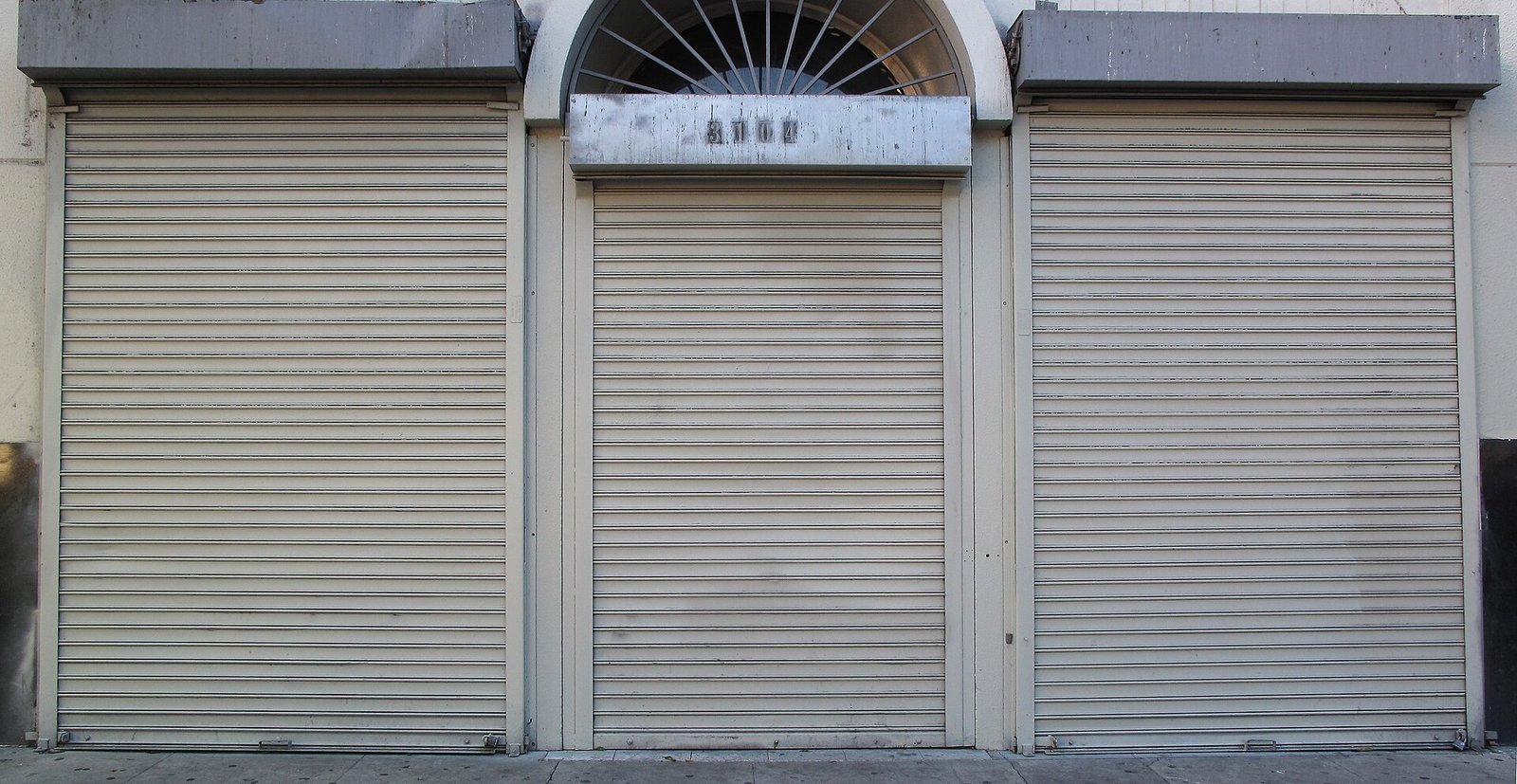
Choose a rolling steel door for a work bay, an insulated roll-up where temperature control matters, and a listed rolling fire door where the plans require one. For busy openings, match the spring and opener ratings to traffic.
A service bay in Marietta and a shipping door in Norcross can have the same opening size and need different doors. Picture the first bay staying open for the whole shift and the second closing after each truck. Start with what the opening does on a normal shift, then check what changes on the busiest one.
Commercial roll-up door types at a glance
A roll-up door coils above the opening. The moving face is called the curtain. On a rolling steel service door, interlocking slats form that curtain. The ends travel in vertical guides on either side. In the open position, the curtain wraps around a barrel, usually covered by a hood.
| If the opening serves this job | Start with this door | Verify before ordering |
|---|---|---|
| A warehouse bay, service shop or receiving area | Rolling steel service door | Clear opening, wall construction, wind pressure if exposed and expected use |
| An individual self-storage unit | Rolling sheet door | Opening size, mount, lock and the model's wind rating if required |
| A conditioned shop or dock | Insulated rolling steel service door | U-factor for the assembly, air leakage and the seals included in the quote |
| An opening that needs fire protection | Listed rolling fire door or fire shutter | Required rating, wall construction, release method and testing |
| A busy shipping bay or parking entrance | Service door with a high-cycle spring option or a high-performance rolling door | Peak hourly and daily traffic, spring or system rating and opener duty |
| A concession counter or a retail opening | Counter shutter or rolling security grille | Solid closure, visibility, ventilation and any required fire protection |
Several of these specifications can apply to the same opening. An insulated door can also have upgraded springs. A listed fire door can also be insulated. Write each requirement into the quote so you can compare the same configuration from one bid to the next.
Rolling steel service doors and rolling sheet doors
Rolling steel for work bays and loading areas
A rolling steel service door uses narrow slats that articulate as the curtain bends around the barrel. The guides, brackets and supporting wall carry loads from the assembly. On an exterior opening, the project team also has to account for wind forces that transfer into the jambs, the sides of the opening where the guides attach.
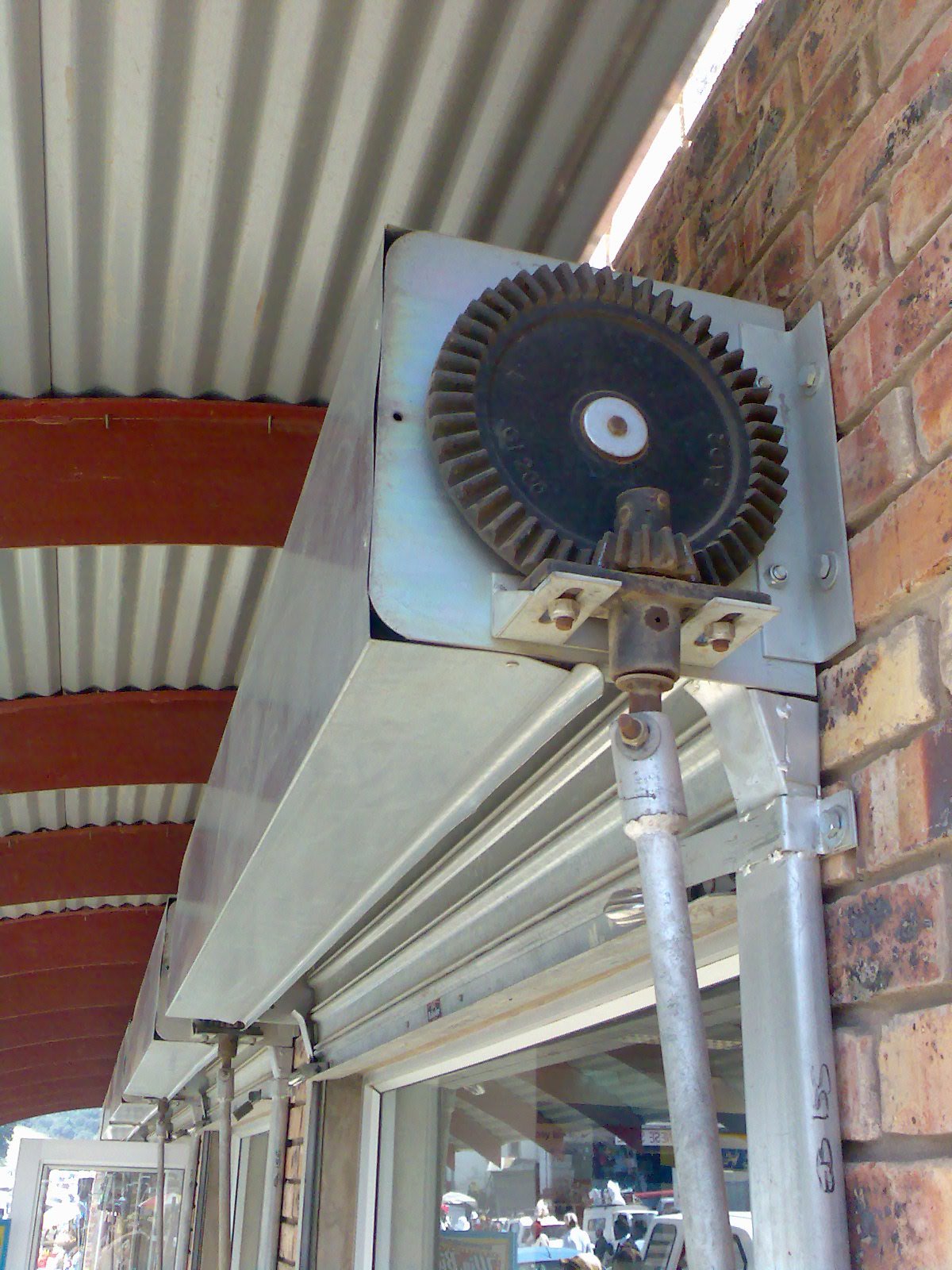
Photo by Gregory David Harington, Wikimedia Commons. CC BY-SA 2.5.

A Wayne Dalton Model 900 is one example of a rolling steel service door with manual push-up and chain-hoist configurations. Its Model 800 family also lists motorized operation and multiple guide and wind options. Use the drawing for the exact model and size to check the mounting space. Even doors from the same product family can have different clearances.
For an exposed loading bay, ask the building designer for the required positive and negative design pressures. Have the supplier show how the quoted door, guides and mounting meet those requirements. If the bay must operate in windy conditions, ask about that separately. Wind pressure that a closed door can withstand and wind conditions under which it can travel are separate specifications. See commercial rolling steel door installation in Atlanta for help applying those specifications to your site.
Rolling sheet doors for storage units
A rolling sheet door also coils, but corrugated steel sheets joined into a continuous curtain take the place of articulated slats. The Janus Model 650 is a self-storage example. Janus also makes commercial sheet doors, including the Series 2000, with an insulated option. Check wind data by model. The manufacturer's standard Model 2000 listing, for example, shows no wind-load rating.
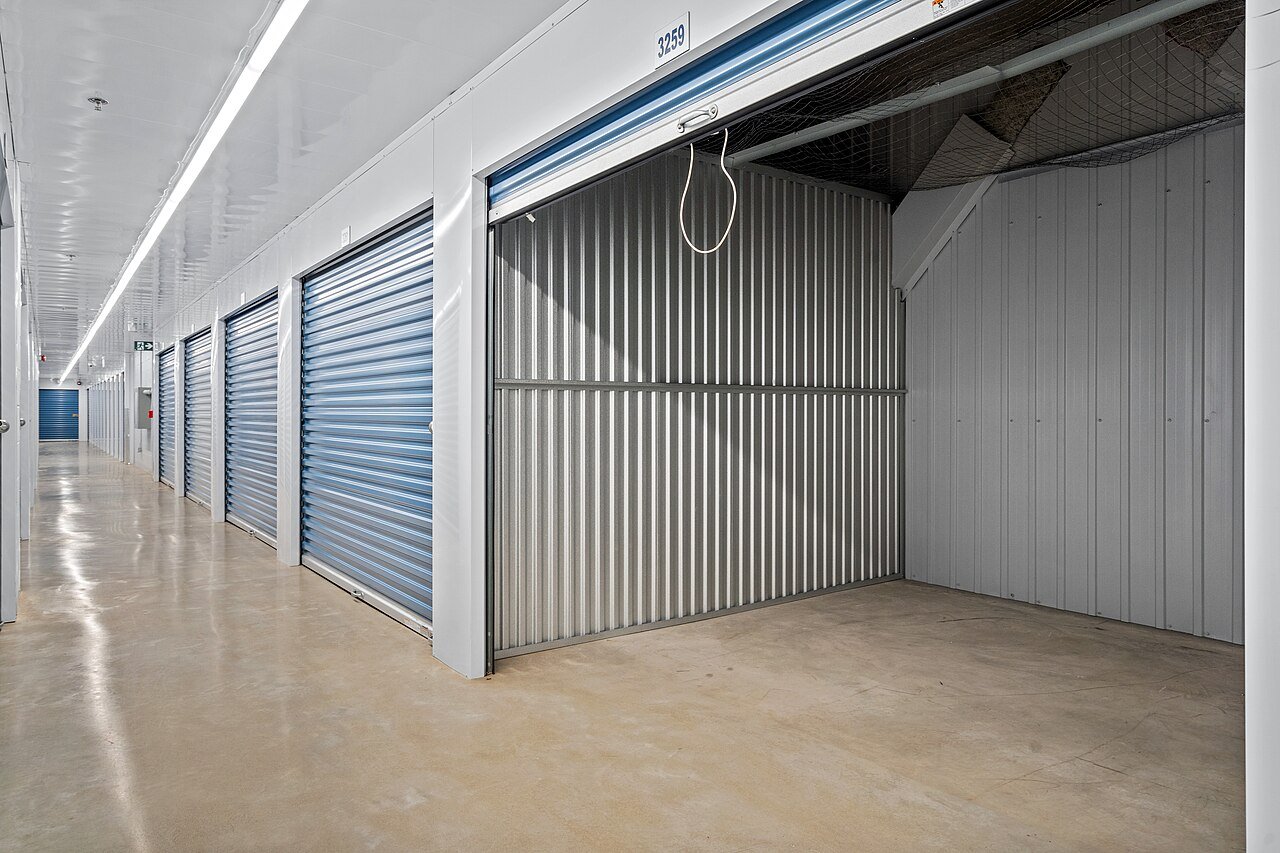
Photo by JMORGANSELFSTOR, Wikimedia Commons. CC BY-SA 4.0. Resized.

For a row of storage units, ask the supplier to identify any openings that need a different lock, mounting arrangement or wind rating. A storage unit inside a corridor and a drive-up unit facing the weather have different conditions even when they look alike on the floor plan.
Counter shutters and security grilles
A counter shutter fits an opening such as the service counter at a restaurant or a ticket window. A solid curtain closes off the opening after hours. A rolling grille lets air through and leaves a line of sight, useful at a retail storefront inside a shopping center. If the plans call for a fire shutter at a counter, have the design team specify the listed assembly and its rating before you choose finishes.
Insulated roll-up doors for conditioned spaces
Insulated rolling doors have insulating material in the curtain. The Wayne Dalton ThermoTite 800C and Cookson Thermiser are examples. When you compare bids for a conditioned bay, ask for the thermal figures and the seals on the quoted door. A model name alone leaves out details such as the guide seals and the seal at the header, the wall area just above the opening.
| Ask for | What it tells you | How to compare it |
|---|---|---|
| Section or slat R-value, if published | Resistance to heat flow through the stated part | Compare it with a value for the same kind of part |
| Installed assembly U-factor | Heat transfer through the tested or modeled assembly | A lower U-factor means less heat transfer under the stated conditions |
| Air leakage and its test conditions | Air passing through the closed assembly under a pressure difference | Compare at the same test pressure and check which seals were fitted |
| Perimeter seals included in the quote | How the door closes against the floor, guides and header | Check each edge against the drawing and test configuration |
Think through an actual shift. A conditioned assembly shop that opens its door for deliveries and closes it between them spends much of the day with the curtain down. At a dock where the door stays open through unloading, the closed-door ratings tell you about only part of that shift. Give your project team both the usual number of openings and how long the door stays open.
If insulation is the main goal and the overhead space is free, ask for an insulated sectional option alongside the rolling door quote. Our Wayne Dalton door guide covers the brand's door families.
When a sectional garage door makes sense
A sectional door travels on rollers and tracks. It has wide, hinged panels that follow the track, often back into the building or straight up the wall on a vertical-lift setup. A roll-up door keeps the open curtain in a coil at the opening. Put both track layouts on the drawing if beams, lights, pipes or a vehicle lift occupy the space above your bay. Our guide on how to choose a commercial garage door compares sectional, roll-up and high-speed doors.
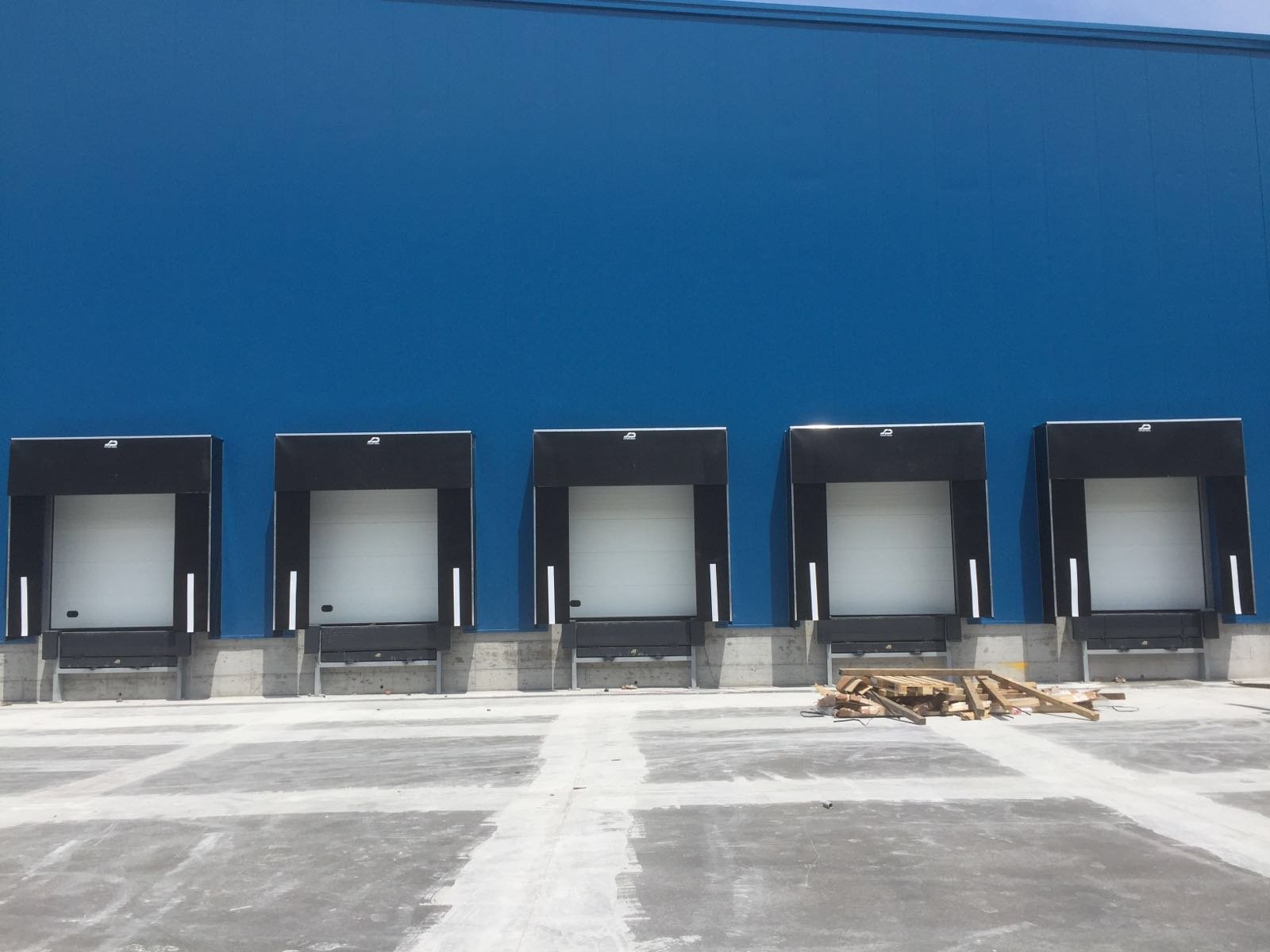
Photo by Davidbbcc, Wikimedia Commons. CC BY-SA 4.0.

For a customer-facing shop, daylight and visibility can matter as much as the way the door opens. Wayne Dalton's 451 and 452 full-view aluminum doors are examples of glazed sectional doors. Its Thermospan line is an example of insulated sectional steel. See our commercial garage door options if your project calls for both coiling and sectional doors.
Rolling fire doors and annual drop testing
A rolling fire door protects an opening where the building design calls for a fire-rated closure. During a fire, its release system lets the door close automatically. Start with the door schedule or the plans for the rated wall. Ask the architect or building and fire officials to confirm the required opening protection, rating, wall construction and release arrangement.
Georgia's Department of Community Affairs lists the state-adopted building and fire codes. For a Metro Atlanta project, take questions about a specific opening to the official who reviews that property. A restaurant's concession window and an opening in a warehouse fire separation call for separate decisions, even when both doors coil.
Wayne Dalton's FireStar 700 and insulated 700C are examples of rolling fire door assemblies. If you need both fire protection and thermal performance, have the supplier document both for the proposed configuration. On an existing opening, record the label information if you can read it safely from the floor and give the technician the last inspection record.
Have a trained rolling steel fire door systems technician handle the drop test when the door is installed. NFPA 80 calls for inspection and drop testing at least annually after that, including for doors that stay closed. The test verifies automatic closure. Keep the written results with your facility records and keep the closing path free of stock, carts and equipment. See our commercial garage door maintenance checklist for the facility team's role between visits.
High-cycle springs and opener duty
One cycle is a full opening and closing. On a spring-counterbalanced rolling door, the torsion spring is held under tension and offsets the weight of the curtain. A spring cycle rating is a design figure for that component. The opener has its own duty rating, and the door assembly has its own maintenance requirements.
Wayne Dalton lists 20,000 spring cycles for its Models 900 and 926. The same manufacturer lists spring upgrades of up to 200,000 cycles for its 800 and 800C family, depending on door size and weight. Those are examples for specific models. Ask what is available for the exact assembly quoted, especially if you need an insulated curtain or a larger opening.
For a simple comparison, a door that cycles 40 times per workday across 250 workdays logs 10,000 cycles a year. At that pace it reaches 20,000 cycles in about 2 years. That's a planning calculation. Inspection and maintenance still follow the manufacturer's instructions and the condition of the door.
Track the busiest hour as well as the daily total. If a service bay cycles 12 times in one hour and sits idle for the rest of the shift, the daily total alone hides that peak. LiftMaster lists separate hourly and daily duty limits for its MAXUM DC Hoist commercial opener, with different limits by configuration. Have the installer size the opener for the door's weight, dimensions and workload and specify the appropriate safety devices, such as photo-eyes or a sensing edge.
If traffic is heavy throughout multiple shifts, compare a complete high-performance rolling system alongside the spring upgrade. Cornell's Extreme 1024 series, for example, uses a springless design. Ask for the full system's duty rating, travel speed and service schedule. A spring upgrade and a faster door address different bottlenecks. Tell the installer whether your concern is repeat use, trucks waiting for clearance or both.
What to bring to a site measure
- Record the clear opening. Take the finished opening width and height from the floor where you can measure safely. Note the clearance your tallest loaded vehicle or equipment needs. Have the installer confirm the usable opening with the door fully raised.
- Photograph the space above and beside it. Headroom is the space above the opening for the coil, hood and brackets. Sideroom is the space at either side for the guides, drive and service access. Mark pipes, lights, sprinkler lines and other obstructions on your photos or drawings.
- Identify the wall and floor conditions. Tell the installer whether steel, concrete or masonry surrounds the opening and flag a sloped or uneven floor. Ask the project team to confirm the jambs, anchors and clearances against the manufacturer's drawing.
- Write down the work pattern. Give the number of shifts, peak hourly cycles, daily cycles and typical time open. Ask how staff will operate the door, where controls belong and what the approved procedure is if power is lost.
- Bring the project requirements. Share the rated-wall details, required wind pressures and thermal targets where they apply. Ask the supplier to identify the exact model, mounting, seals, opener and safety devices on the bid. At handover, ask for the manuals, approved drawings and service schedule.
If your notes are still rough, you can request a site consultation and use this list during the visit.
What your staff can check and when to call
| Facility staff can | A trained technician handles |
|---|---|
| Log cycles and note when the door began to bind, scrape or travel unevenly | Diagnose the curtain and guides, and inspect the barrel and counterbalance |
| Read a safely visible label and photograph the opening from the floor | Remove the hood, adjust spring tension or work on the opener and its controls |
| Keep stored goods and equipment clear of the path | Conduct the rolling fire door inspection, drop test and reset |
If the curtain hangs unevenly, binds or comes out of a guide, stop using the opening and keep people clear. Leave springs and their adjustments to a trained technician. For an existing door that needs attention, see commercial roll-up door repair and service. If the door is on a vehicle, use our box truck roll-up door guide.
Frequently asked questions
Is a roll-up door the same as a sectional garage door?
A roll-up curtain coils around a barrel above the opening. A sectional door lifts on tracks as its hinged panels follow the track path. Compare the available space at the header and jambs for a coiling door with the track space a sectional door will need.
What sizes do commercial roll-up doors come in?
Sizes vary with the model, curtain, mounting and wind requirements. A manufacturer's maximum width and maximum height can be independent limits. Give the supplier both dimensions for your opening and ask for a drawing that confirms the clear opening and the required space around it.
Is an insulated roll-up door worth it for a warehouse?
Consider insulation if the opening serves a heated or cooled space and is closed for much of the shift. Compare whole-door U-factor and air-leakage data, and check the seals in the actual quote. Where the bay stays open through loading, give the design team the time it spends open.
Do rolling fire doors need an annual drop test?
Yes. Have a trained rolling steel fire door systems technician inspect and drop-test the door at least annually under NFPA 80. Keep the inspection and test record. A door that stays closed still needs the test.
How long does a commercial roll-up door last?
Start with how often you use it and the ratings for the components in your door. A spring cycle rating gives you a basis for estimating how soon you will reach that count. Ask about the opener duty rating, the inspection schedule and signs of wear as part of the same discussion.
Can an existing rolling door take high-cycle springs?
Ask a trained technician to identify the model, opening size, curtain weight and existing barrel, then check the manufacturer's options. An upgrade depends on that assembly. If door traffic has changed, have the technician check the opener duty and the rest of the door at the same visit.
Which roll-up door fits a restaurant?
For an after-hours closure at a service counter, compare a solid counter shutter and a grille. Choose based on visibility, airflow and security needs. For a glazed opening to a patio, compare a full-view sectional door. If the plans require a fire shutter, begin with the specified listing.
Talk to a commercial door technician
All Four Seasons has been family-owned since 1999. Call (678) 271-8918 to talk through the opening, its daily use and the options for your Metro Atlanta facility. For a door that needs repair, visit our commercial garage door service page.
Top photo by Downtowngal, Wikimedia Commons. CC BY-SA 4.0. Cropped and resized.
