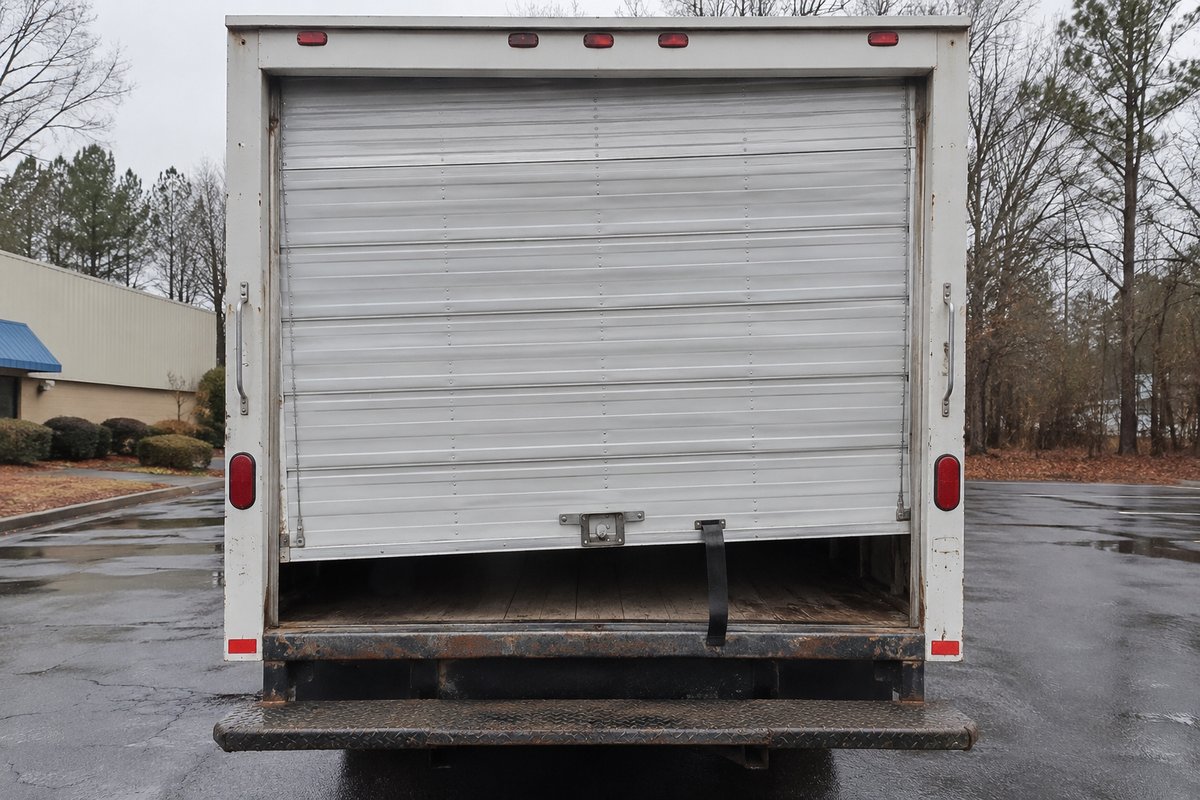
Most stuck box truck doors come down to four things: a latch under load, a dirty or bent track, a cable or spring out of balance, or ice at the sill. Check them in order; stop at the spring.
This guide is for drivers, owner-operators and fleet managers. It walks through each way a rear roll-up door gets stuck (shut, open, halfway, crooked, or too heavy to lift), what causes it on Whiting, Todco and similar truck doors, what you can safely check at the curb, and what to leave to a technician. If the door is already broken and you want it fixed, go straight to our box truck roll-up door repair page. For how the door works and what its parts are called, see our guide to box truck roll-up doors.
Stop first: when not to force the door
A truck door is a stack of steel or aluminum panels balanced by a torsion spring wound under high tension. Todco and Utilimaster both put the same warning on their doors and in their guides: the counterbalance spring can cause severe injury or death. So before you pull harder on the strap, look for these:
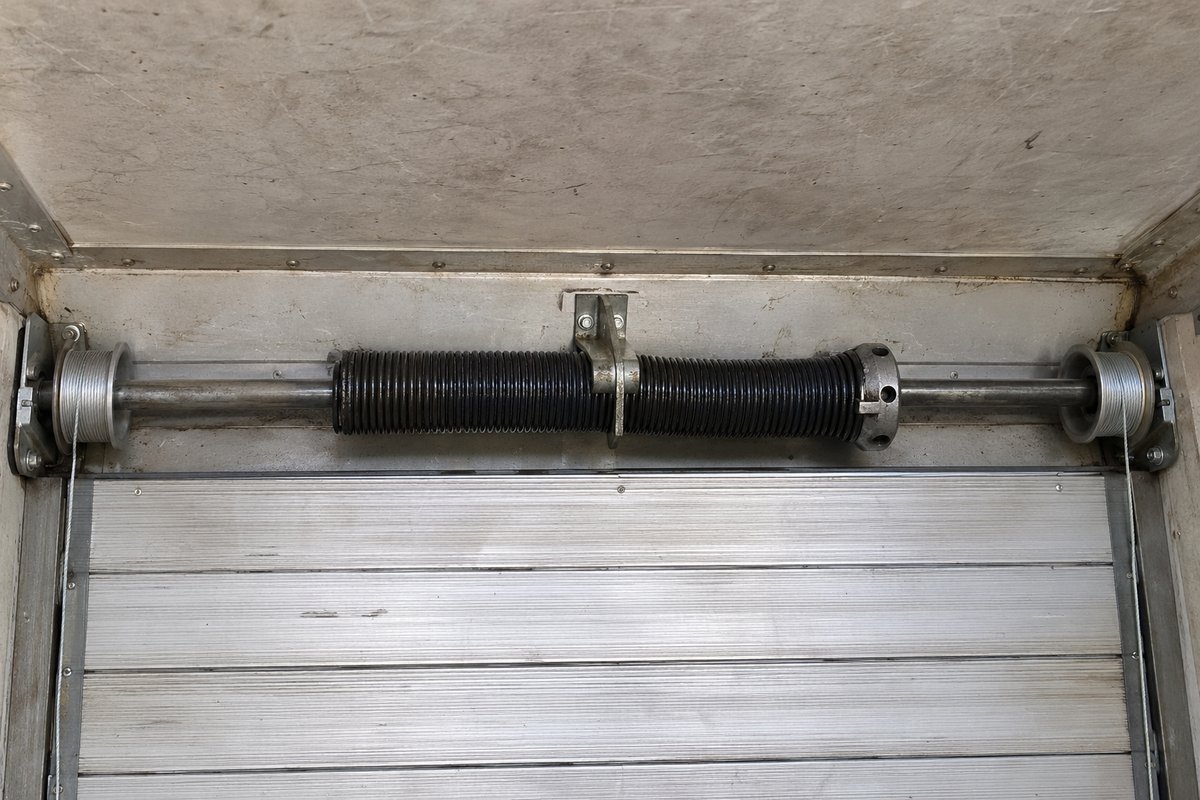
- A gap in the spring. With a light inside the box, look at the coiled spring on the shaft above the door. If there's a gap in the coils, the spring is broken. Todco's safety instructions say a door with a broken counterbalance spring isn't balanced and will fall if opened. Leave it closed and latched.
- A loose, frayed or missing cable. Each side of the door hangs on a steel cable that winds onto a drum at the top. Todco says not to operate the door with a broken spring or cable.
- A door that drops when you let go. That's a balance problem, not a jam. Lower it with the strap and don't run it again until it's checked.
- Cargo leaning on the door. If the load shifted in transit, the door can bind against it, and the load can come out with the door. Open the side door or look through a gap before you force anything.
If any of these apply, the fix is a technician's job. Our box truck door spring guide explains the spring signs in more detail.
Match the symptom to the likely cause
| What the door is doing | Most likely causes | First thing to check |
|---|---|---|
| Won't open, stuck closed | Latch under tension, stiff or frozen lock, bottom seal frozen to the sill, load leaning on the door | Push down on the door and work the latch (below) |
| Stuck halfway | Bent track or dented panel at that spot, a jammed roller, a cable off its drum | Look at the track and rollers where it stops |
| Hard to lift all the way | Dry rollers and hinges, dirt in the track, weak spring tension | Lubricate as the maker says, then test the balance |
| Hangs crooked, one side low | Cable off its drum, broken cable, loose drum, roller out of the track | Stop. Don't run the door |
| Won't come down, stuck open | Roller or panel caught in the horizontal track, track stop out of place, too much spring tension | Look for anything blocking the tracks overhead |
| Comes down but won't latch | Latch plate out of adjustment, debris in the catch at the sill, bent bottom panel | Clean the catch, close the door tight and try again |
| Slams down or won't stay up | Broken spring or cable, or low spring tension | Stop. See the spring guide |
The sections below take each one in turn.
Box truck door won't open: start with the latch
When a door won't budge from the outside, the latch is the usual suspect, and it's the one you can sort out yourself. On most truck doors the latch hooks into a catch at the sill, and the weight of the door and the seal pressing on it put tension on the latch.
Utilimaster's service guides describe the fix for their rear doors: to open from the outside, push down on the lower lift handle to relieve the tension on the latches, then turn the release handle until the latches let go. From inside the box it's the same idea: push down on the door, then move the release lever. That small push takes the load off the latch so it can turn.
Other things to try at the latch:
- The lock. On a keyed slam lock, make sure it's unlocked first. Utilimaster's guide has you turn the key until the thumb lock pops out, then turn the release handle.
- A banana lock. On a master security ("banana") lock, rotate the catch first, then swing the lock lever until it catches in the open position. If the truck has an interior release, the guide says to rotate the release knob and then the lever.
- A stiff lock. Todco's safety instructions say to check lock movement and, if it's stiff, lubricate it with a light oil such as Todco Lube, not grease. A worn or damaged lock should be replaced.
- Loose hardware. Todco also says to inspect and tighten loose fasteners on the lift handle, lock, pull strap and hinges before you operate the door.
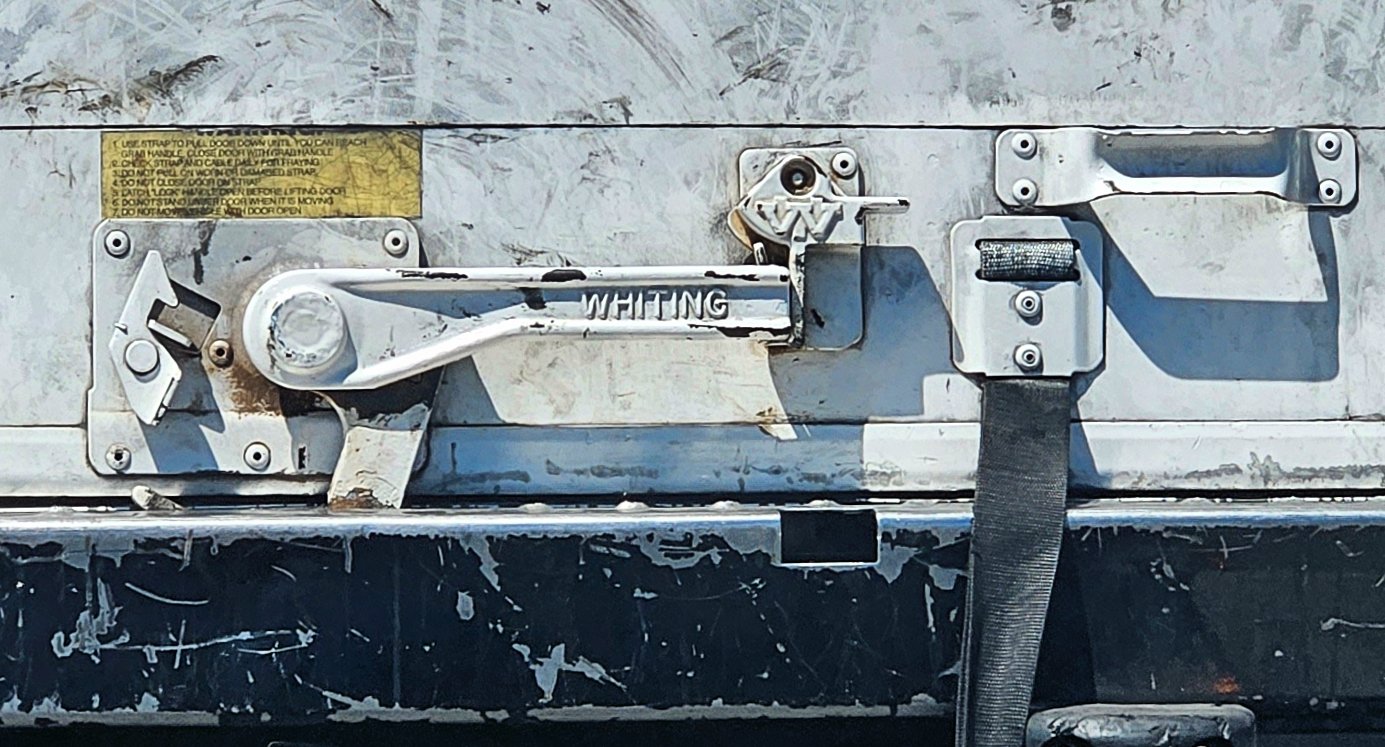
If the latch turns freely and the door still won't lift, the problem is lower down (a frozen seal) or higher up (the tracks, cables or spring). Don't pry under the bottom panel with a bar or a fork: that bends the bottom panel and tears the seal, and then the door won't latch or seal properly afterwards.
Door stuck halfway or hard to lift
A door that rolls up part of the way and stops, or that takes two hands and a grunt, is fighting either friction or balance. They feel the same from the strap, so separate them.
Friction first. Todco's instructions are clear on the order: if the door is hard to move, lubricate the rollers, the counterbalance spring and bearings, and the hinges with Todco Lube. Have damaged or worn rollers and hinges replaced. If the door is still hard to move, have a trained service person check it, and don't try to adjust or repair the spring yourself. Utilimaster's lubrication list is similar: the roller drums and shafts, the spring along its full length, the tracks (clean them first), the hinges, the rollers and the latches, with a light oil.
Two rules both makers agree on:
- No grease. Todco and Utilimaster both say not to use grease on their doors.
- Keep oil off the rubber seals. Utilimaster says to wipe up drips straight away.
Then balance. With the door unlatched, lift it by the strap to about waist height, standing to the side, and let go slowly. Whiting's installation audit form describes a properly adjusted door as one that neither rises nor falls without help. If it drops, the spring is weak or a part is broken. If it climbs, the tension is too high. Either way, the fix is at the spring, which is a technician's job. Our spring guide explains what the adjustment involves.
If it always stops at the same height, look at that spot. A door that binds in one place usually has something wrong in one place: a dent in the track, a dented panel edge rubbing the track, a roller that's cracked or jammed, or a hinge that's bent. Those are covered next.
Door off track or hanging crooked
A crooked door is the one to take most seriously. Each side of the door hangs on its own cable, and both cables wind onto drums on the same shaft. If one side sits lower, one cable has slipped off its drum, broken, or gone slack, and the door is now held unevenly by a loaded spring.
What the makers say about why it happens:
- Cables off the drum. Utilimaster warns that rotating the counterbalance too far can make the cables jump off the cable drums, and both Utilimaster and Todco say the drums must be tight against their bearings and the two cables must have equal tension.
- Track out of line. Whiting's installation audit checks that the track is the same width apart, within 1/8 inch, at the floor, the middle of the opening, the curve and along the horizontal track, and that the joint between the vertical and horizontal track lines up so the rollers pass smoothly. A bump from a dock, a forklift or a pallet jack knocks that out.
- Too tight in the track. Utilimaster's W-series guide notes that the door can jam if the roller brackets are adjusted too tightly. Whiting's audit form calls for about 1/4 to 3/8 inch of total side play between the track and the door.
- Spacer washers. Whiting and Todco both use spacer washers on the roller shafts at the top and bottom panel joints to keep the door square in the track and help the cables wind properly. Missing washers let the door wander sideways.
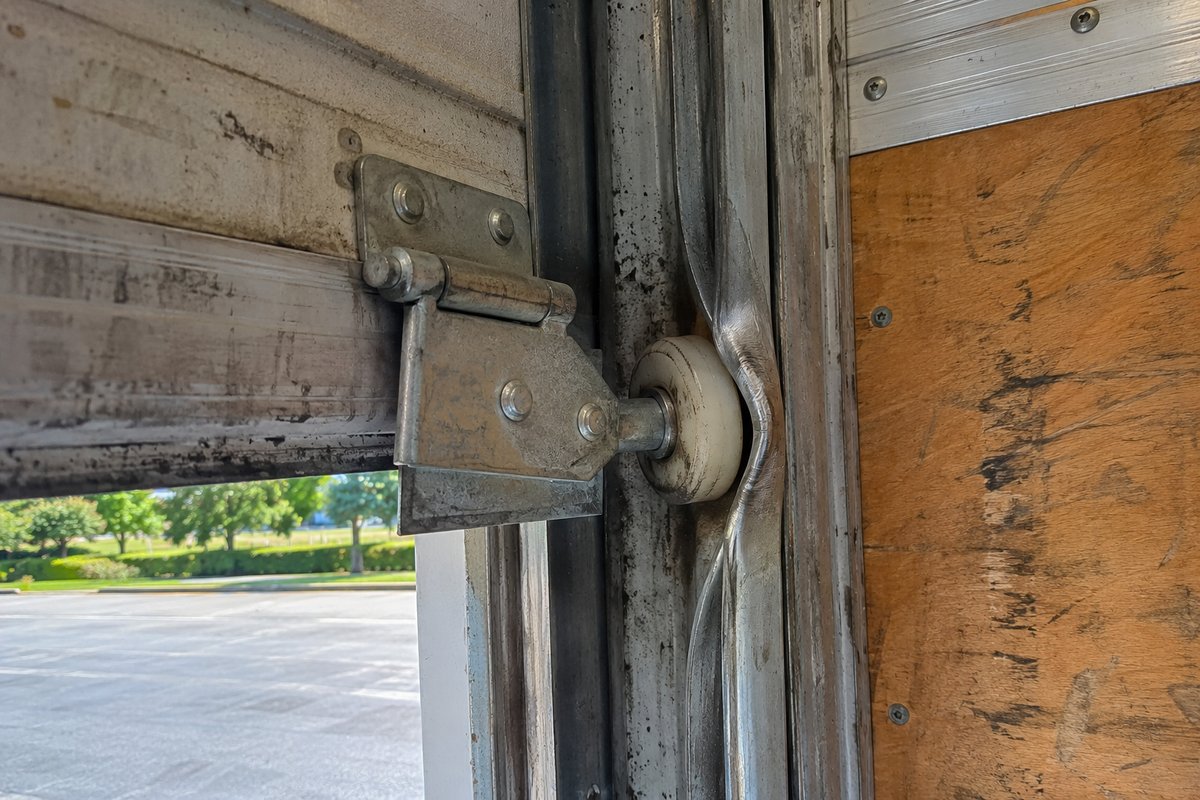
What to do: stop running the door. Don't try to push a roller back into the track or wind a cable back on its drum: the cable is holding spring tension, and putting it back means taking that tension off first. Close and latch the door if it will go down evenly with the strap; if it won't, keep people clear of it and call. On the house-door side, our pages on cable repair, drum replacement, bent tracks and broken rollers explain the same parts.
Dented panels and bent slats
Most rear truck doors are sectional: a few wide panels joined by hinges, not narrow slats. A dented panel matters when the dent reaches the edge, because the edge is where the hinges and rollers sit. A bent edge drags in the track, and a bent bottom panel won't sit flat on the sill, so the latch doesn't line up with its catch.
Replacing a panel isn't a curbside job. Utilimaster's guide has the door closed and the track clamped below the damaged panel so the door can't rise, the rivets in the hinges drilled out, and the rollers and brackets moved to the new panel, which is then drilled and riveted to match. Afterwards the door is checked for play in the track, for binding, and for being centered in the opening. The service page covers panel and seal repairs on truck doors.
Door won't close or won't latch
A door that won't come down from the open position is usually caught overhead. Look along both horizontal tracks under the roof for anything in the way: a strap, a load bar, a broken roller. Todco's safety instructions say to make sure the tracks and the door opening aren't blocked. Each horizontal track should also have a stop bolt with a rubber stop at the end (Whiting's audit lists it); if one is missing, the top panel can run past where it should.
A door that comes all the way down but won't latch is often a latch-plate problem. Utilimaster's guide says to adjust the latch if problems occur with latching or sealing. On a two-point fan-type latch, the latch should catch in its primary position every time; if it only catches in the secondary one, the latch plate needs adjusting so it sits snugly and square against the latch. Whiting's audit has the same idea: the lock cam should line up with the lock plate so the lock drops into the cutout easily when the door closes, and the lock handle should go into its keeper easily.
What you can do before you call:
- Clean the catch at the sill. Gravel, ice, packing straps and shrink-wrap end up in the catch box and stop the latch from seating.
- Close the door tight from inside so the bottom seal is pressed down, then try the latch. Utilimaster's adjustment starts the same way.
- Look at the bottom panel. If it's bent or sits unevenly on the sill, the latch won't meet the catch.
Don't drive with a door you can't latch. Todco and Utilimaster both say to close and latch (or lock) the rear door before you drive, to protect the cargo and the vehicle.
Frozen door: ice at the bottom seal
Atlanta averages about 36 nights a year at or below freezing (NOAA climate normals), and most of them come after a wet day. A truck parked outside overnight can have its rubber bottom seal frozen to the steel sill by morning, with frost in the latch catch as well. The door feels locked even after the latch is released.
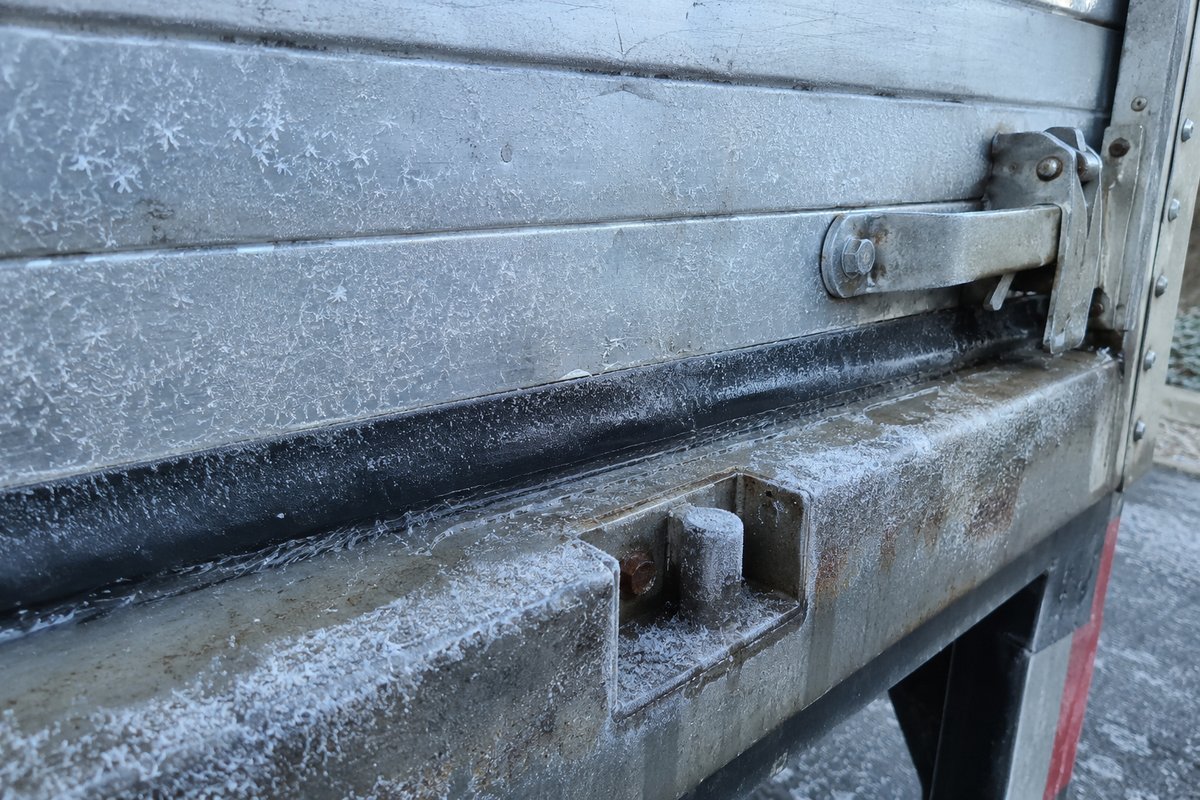
Garaga, a door maker, gives this advice for doors frozen to the threshold, and it carries over to a truck door:
- Don't force it. Lifting hard against a frozen seal tears the seal and strains the cables and spring.
- Warm the seal line. Use a hair dryer and keep it moving, rather than holding it in one spot. Slowly pouring warm water on the ice also works; dry the sill afterwards with a rag so it doesn't refreeze.
- Scrape the sill once the door is free, and clear ice out of the latch catch.
- Prevent it. Clear snow and ice from the sill after a storm, and open and close the door at least once a day in a cold spell.
Skip the pry bar and the ice chopper: that's how bottom seals get torn and bottom panels bent. Our winter garage door guide has more on what Atlanta's freeze–thaw nights do to doors and seals.
Dirt and debris in the tracks
Truck doors live in a dirty world. Road grit, salt, shrink-wrap, wood splinters from pallets and dried-on oil all collect in the tracks, and the rollers then have to climb over them. A door that's rough in one spot and smooth elsewhere often has something stuck in the track at that spot.
Both makers name the fix. Utilimaster says to clean and lubricate the track. Todco lists the tracks among the parts to lubricate with Todco Lube, says not to use grease, and notes that how often a door needs maintenance depends on how it's used, the climate and how it's cleaned. Todco also warns that high-pressure washing and harsh cleaners can damage the paint, so wipe the tracks rather than blasting them.
What a driver can safely check
Here's a short routine for a stuck door, in order. Stop at the first step that shows a broken part.
- Look before you pull. With a light inside the box, look at the spring for a gap, both cables for fraying or slack, and the tracks for dents.
- Relieve the latch. Push down on the door and then work the latch or release handle.
- Check the sill. Clear ice, gravel or debris from the seal line and the latch catch.
- Check the tracks. Look for anything caught in the vertical and horizontal tracks, and wipe out grit.
- Lubricate the rollers, hinges, lock and bearings with the maker's light oil, never grease, keeping it off the seals.
- Test the balance at waist height, standing to the side. A balanced door stays put.
- Inspect the pull strap. Todco says to replace a frayed or worn strap and not to tie anything to it. Utilimaster and Todco both say not to use the strap to climb in or out: it can break or pull the door down on you.
Utilimaster's inspection list for its rear doors is a good regular check too: the door opens easily and closes tightly, the latch works, nothing is loose, the strap isn't frayed, and the door is centered in the opening. For a whole fleet, our commercial door maintenance checklist covers the same kind of routine for building doors.
What to leave to a technician
| Safe for a driver | Leave to a trained technician |
|---|---|
| Push down to relieve the latch, work the lock | Adjusting the latch plate or lock catch |
| Clear ice and debris from the sill and catch | Any spring tension adjustment |
| Wipe out and lubricate tracks, rollers and hinges | Replacing a broken spring or the counterbalance |
| The balance test, with spring and cables intact | Putting a cable back on its drum or replacing cables |
| Replace a frayed pull strap | Straightening or replacing a bent track |
| Note the door maker and serial plate | Replacing rollers, hinges or a dented panel |
The line is the spring. Utilimaster says only qualified technicians should adjust it, Todco says not to try adjusting or repairing the spring or counterbalance assembly, and Whiting's maintenance guides open by telling anyone not trained in roll-up truck door repair to leave the work to people who are. Any job that means loosening a set screw on the shaft, a drum or the winding plug falls on the technician's side.
Rental trucks and trailers
Rented truck? If the door on a rental truck jams, call the rental company first, using the roadside number on your rental paperwork. It's their door to repair, and a third-party repair can complicate the return.
Trailer doors work the same way. Whiting and Todco build rear roll-up doors for truck bodies and trailers, and Whiting's installation audit form has a line for the trailer or unit number. The checks above apply to a trailer door as much as a box truck door.
When to call us
Call if the door is crooked, a cable is slack or off its drum, the spring has a gap, the door slams or won't stay up, a track is bent, or the door won't latch and you need to move the truck. We repair the rear roll-up doors on Whiting, Todco and other box truck bodies: box truck roll-up door repair in Atlanta covers springs, cables, tracks, rollers, latches and panels, for one truck or a whole fleet. We serve the same work out of Marietta, Kennesaw and other cities around Atlanta, and we handle commercial door service at depots and warehouses too.
A door that won't close or latch on a loaded truck can't wait for office hours. We offer 24/7 emergency service, and same-day repair when the schedule allows.
When you call, have the door brand and serial plate, what the door is doing, and where the truck is parked. Todco puts its serial plate inside the door; Utilimaster puts its door tag in the inside upper corner on the driver's side. All Four Seasons is family-owned and has worked on garage, overhead and roll-up doors around Atlanta since 1999, with 250+ years of combined experience on the crew. We're rated 4.9 on Google with Over 4,000 Five-Star Reviews, and the office is open Mon–Sun, 7 AM to 8 PM.
Call (678) 271-8918 or book online. The technician looks at the door first and writes down the price before any work starts.
Frequently asked questions
How do you fix a sticking or jammed box truck roll-up door?
Work from the bottom up. Push down on the door to take the load off the latch, then release it. Clear ice or debris from the sill, wipe and lubricate the tracks, rollers and hinges with light oil (not grease), and test the balance. If the spring, cables or tracks are damaged, call a technician.
Why won't my box truck roll-up door open?
Usually the latch is under tension from the door's weight. Push down on the lower lift handle, then turn the release handle, as Utilimaster's guide describes. Other causes: a stiff or locked lock, a bottom seal frozen to the sill, cargo leaning on the door, or a broken spring.
Why is my box truck door stuck halfway?
Something at that height is catching: a dent in the track, a dented panel edge, a jammed roller or a bent hinge. A cable off its drum stops the door too, and usually leaves it crooked. Don't force it past the spot; look at the track and rollers where it stops.
Why is my box truck door so hard to lift?
Friction or balance. Todco says to lubricate the rollers, spring, bearings and hinges first. If it's still hard, the spring tension is low or a part is broken, and a trained technician should check it. A door that drops when you let go is a spring or cable problem.
How do I open a box truck door that's frozen shut?
Release the latch, then warm the seal line along the sill with a hair dryer, moving it as you go, or pour warm water on the ice slowly. Don't pry under the door. Once it's open, scrape and dry the sill and clear the latch catch so it doesn't refreeze.
Can I put a box truck door back on its track myself?
No. A door off its track is usually held unevenly by a loaded spring through its cables. Putting the rollers back, rehanging a cable or straightening the track means releasing spring tension first, and the door makers say spring work is for trained technicians.
What should I do if a rental truck's roll-up door is stuck?
Try the latch first: push down on the door, then release the handle. If it still won't move, call the rental company's roadside number on your paperwork rather than having it repaired yourself.